Skulls of the Pyramid
Book: Weird Computer Games
Author: Usborne Publishing
Translator: Marcus Medina
Story
Deep within the desert lies the Pyramid of Akh-Met, where six golden skulls are hidden behind cursed doors. Treasure hunters whisper that only those who can outwit the spirits of the pyramid and keep their courage will escape alive. You must enter each chamber, choose a door, and hope for treasure—not traps. Collect enough skulls before your strength fails, or be sealed inside forever.
Pseudocode
health = 100skulls = 0FOR chamber FROM 1 TO 6 SHOW chamber, health, skulls ASK player to pick door 1-3 VALIDATE choice treasure_door = random door 1-3 IF choice == treasure_door THEN skulls += 1 SHOW success message ELSE damage = random between 10 and 30 health -= damage SHOW trap message IF health <= 0 THEN EXIT LOOPEND FORIF health > 0 AND skulls >= 3 THEN Player escapes with treasureELSE Pyramid curse claims the adventurerFlowchart
flowchart TD
    A[Start] --> B[health = 100, skulls = 0]
    B --> C{Chamber <= 6?}
    C -->|No| G[Evaluate outcome]
    C -->|Yes| D[Display stats]
    D --> E[Player chooses door 1-3]
    E --> F{Choice valid?}
    F -->|No| D
    F -->|Yes| H[random treasure door]
    H --> I{Choice == treasure?}
    I -->|Yes| J[skulls++]
    I -->|No| K[health -= damage]
    K --> L{health <= 0?}
    L -->|Yes| G
    L -->|No| C
    J --> C
    G --> M{health > 0 AND skulls >= 3?}
    M -->|Yes| N[Escape with treasure]
    M -->|No| O[Cursed ending]
    N --> P[End]
    O --> P
Code
Pages
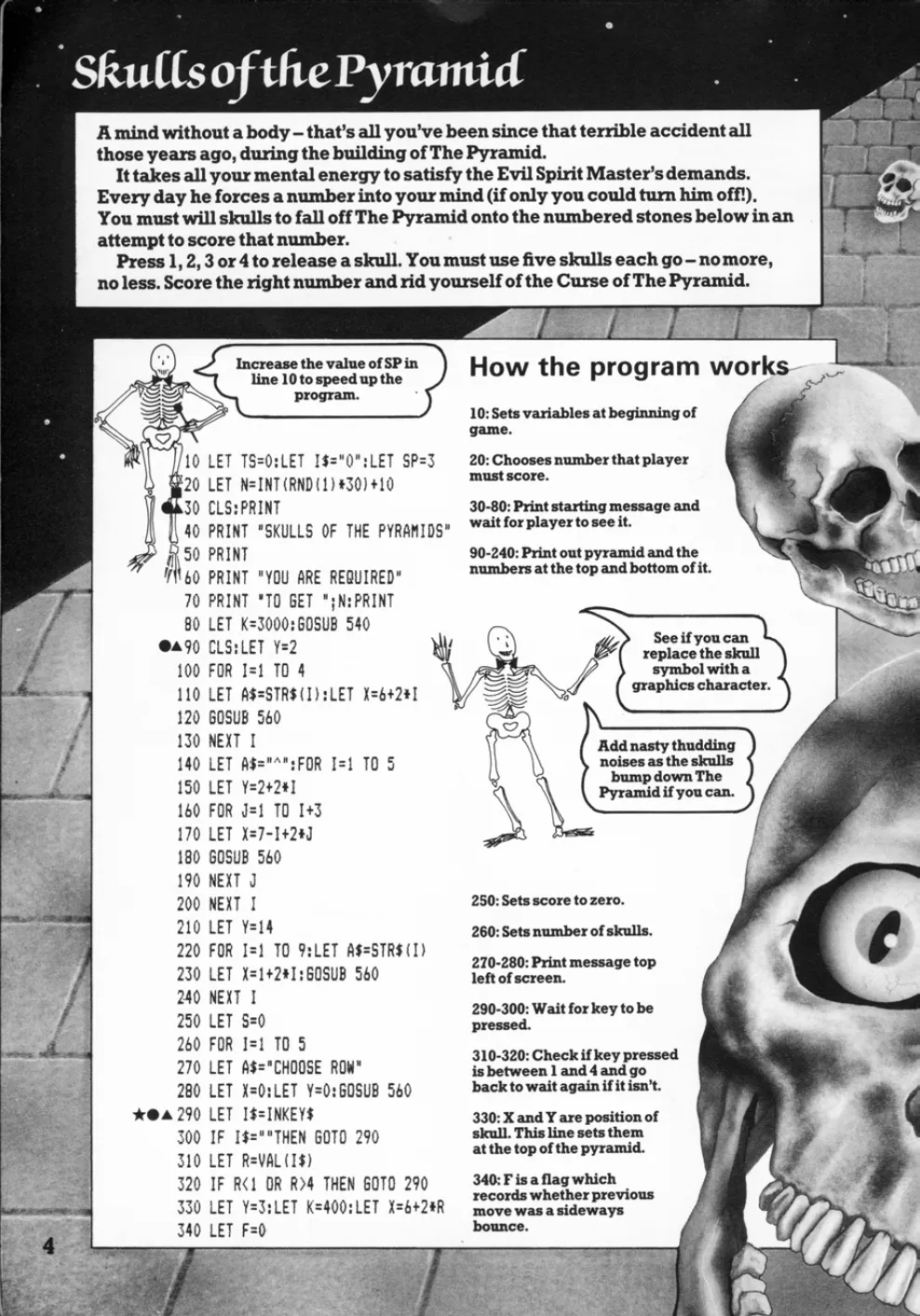
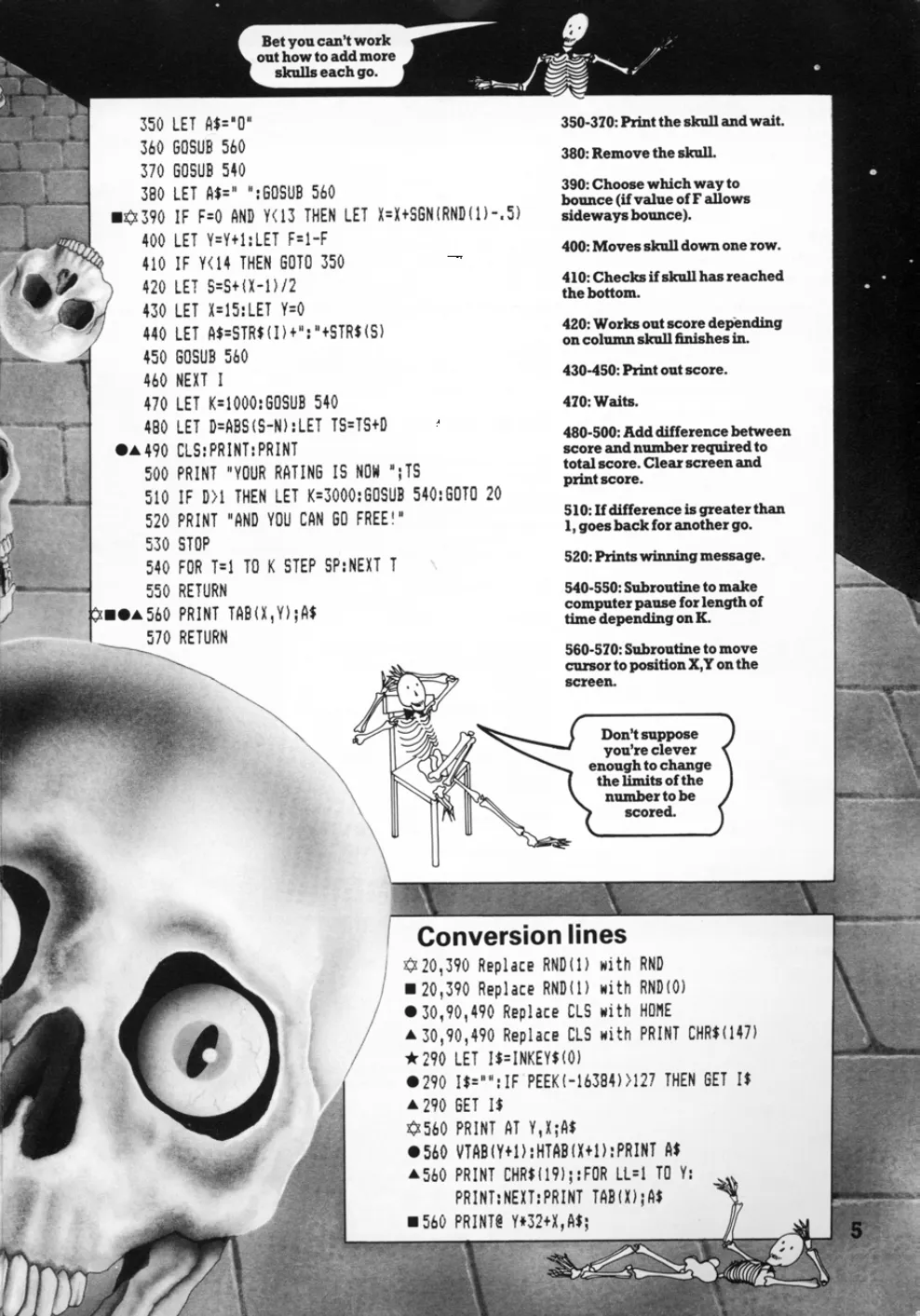
ZX-81 BASIC
10 LET TS=0:LET I$="0":LET SP=320 LET N=INT(RND(1)*30)+1030 CLS:PRINT40 PRINT "SKULLS OF THE PYRAMIDS"50 PRINT60 PRINT "YOU ARE REQUIRED"70 PRINT "TO GET ";N:PRINT80 LET K=3000:GOSUB 54090 CLS:LET Y=2100 FOR I=1 TO 4110 LET A$=STR$(I):LET X=6+2*I120 GOSUB 560130 NEXT I140 LET A$="^^":FOR I=1 TO 5150 LET Y=2+2*I160 FOR J=1 TO I+3170 LET X=7-I+2*J180 GOSUB 560190 NEXT J200 NEXT I210 LET Y=14220 FOR I=1 TO 9:LET A$=STR$(I)230 LET X=1+2*I:GOSUB 560240 NEXT I250 PRINT260 PRINT "YOU MUST USE 5"270 PRINT "SKULLS TO SCORE"280 PRINT "THE NUMBER"290 LET S=0:GOSUB 430300 PRINT "TOTAL SO FAR ";TS310 PRINT320 LET L=TS:LET I$=" ":LET SP=SP-1330 IF SP=0 THEN GOTO 370340 PRINT "SPARES LEFT ";SP350 PRINT360 GOTO 410370 PRINT "NO SPARES LEFT"380 PRINT:PRINT "YOUR FINAL SCORE IS ";TS390 STOP410 PRINT "LEVER? ";420 INPUT A$430 LET I=VAL (A$)440 IF I<1 OR I>4 THEN PRINT "YOU ARE DESTROYED":STOP450 LET Z=Z+(5-I)460 IF Z>5 THEN PRINT "TOO MANY SKULLS":STOP470 LET X=6+2*I:LET Y=3:LET A$=" ":GOSUB 560480 LET Y=5:LET A$="<>":GOSUB 560490 LET M=I500 LET F=F+1510 IF F<5 THEN RETURN520 LET Z=0:LET F=0530 LET Q=INT(RND(1)*4)+1540 DIM T(4):DIM O(4)550 FOR I=1 TO 4560 LET T(I)=INT(RND(1)*9)+1570 LET O(I)=T(I)580 NEXT I:RETURN590 LET TS=TS+Q600 LET X=1+2*Q:LET A$="**"610 LET Y=17:GOSUB 560620 RETURNModern Implementations
C#
using System;
namespace WeirdComputerGames;
public static class SkullsOfThePyramid{    private const int Chambers = 6;    private const int MinimumSkulls = 3;
    public static void Main()    {        var random = new Random();        int health = 100;        int skulls = 0;
        for (int chamber = 1; chamber <= Chambers && health > 0; chamber++)        {            Console.WriteLine($"\nChamber {chamber}");            Console.WriteLine($"Health: {health} | Skulls: {skulls}");            Console.Write("Choose a door (1-3): ");
            if (!int.TryParse(Console.ReadLine(), out int choice) || choice < 1 || choice > 3)            {                Console.WriteLine("Only three doors stand here.");                chamber--;                continue;            }
            int treasureDoor = random.Next(1, 4);            if (choice == treasureDoor)            {                skulls++;                Console.WriteLine("A golden skull gleams in the torchlight!");            }            else            {                int damage = random.Next(10, 31);                health -= damage;                Console.WriteLine($"A trap snaps! You lose {damage} health.");            }        }
        if (health > 0 && skulls >= MinimumSkulls)            Console.WriteLine($"You stagger into the moonlight clutching {skulls} skulls!");        else if (health > 0)            Console.WriteLine("The pyramid seals shut—you needed more skulls.");        else            Console.WriteLine("The curse overwhelms you. The tomb keeps its secrets.");    }}
Python
import random
CHAMBERS = 6MINIMUM_SKULLS = 3

def play() -> None:    health = 100    skulls = 0
    for chamber in range(1, CHAMBERS + 1):        if health <= 0:            break
        print(f"\nChamber {chamber}")        print(f"Health: {health} | Skulls: {skulls}")
        try:            choice = int(input("Choose a door (1-3): "))        except ValueError:            print("You must enter a number between 1 and 3.")            continue
        if choice not in (1, 2, 3):            print("There are only three doors.")            continue
        treasure_door = random.randint(1, 3)        if choice == treasure_door:            skulls += 1            print("You claim a glittering skull!")        else:            damage = random.randint(10, 30)            health -= damage            print(f"Blades flash! You lose {damage} health.")
    if health > 0 and skulls >= MINIMUM_SKULLS:        print(f"You escape with {skulls} skulls and your life!")    elif health > 0:        print("The door slams shut—you failed to gather enough skulls.")    else:        print("Your spirit joins the guardians of the pyramid.")

if __name__ == "__main__":    play()
Java
import java.util.Random;import java.util.Scanner;
public class SkullsOfThePyramid {    private static final int CHAMBERS = 6;    private static final int MINIMUM_SKULLS = 3;
    public static void main(String[] args) {        Scanner scanner = new Scanner(System.in);        Random random = new Random();
        int health = 100;        int skulls = 0;
        for (int chamber = 1; chamber <= CHAMBERS && health > 0; chamber++) {            System.out.printf("%nChamber %d%n", chamber);            System.out.printf("Health: %d | Skulls: %d%n", health, skulls);            System.out.print("Choose a door (1-3): ");
            String input = scanner.nextLine();            int choice;            try {                choice = Integer.parseInt(input);            } catch (NumberFormatException ex) {                System.out.println("You must enter a number between 1 and 3.");                chamber--;                continue;            }
            if (choice < 1 || choice > 3) {                System.out.println("Only three doors here.");                chamber--;                continue;            }
            int treasureDoor = random.nextInt(3) + 1;            if (choice == treasureDoor) {                skulls++;                System.out.println("You lift a golden skull from its niche!");            } else {                int damage = random.nextInt(21) + 10;                health -= damage;                System.out.printf("Spears thrust from the walls! You lose %d health.%n", damage);            }        }
        if (health > 0 && skulls >= MINIMUM_SKULLS) {            System.out.printf("You escape with %d skulls!%n", skulls);        } else if (health > 0) {            System.out.println("You limp out empty-handed as the pyramid seals behind you.");        } else {            System.out.println("Your adventure ends in the dark halls of the pyramid.");        }    }}
Go
package main
import (    "bufio"    "fmt"    "math/rand"    "os"    "strconv"    "strings"    "time")
const (    chambers      = 6    minimumSkulls = 3)
func main() {    rand.Seed(time.Now().UnixNano())    reader := bufio.NewReader(os.Stdin)
    health := 100    skulls := 0
    for chamber := 1; chamber <= chambers && health > 0; chamber++ {        fmt.Printf("\nChamber %d\n", chamber)        fmt.Printf("Health: %d | Skulls: %d\n", health, skulls)        fmt.Print("Choose a door (1-3): ")
        line, _ := reader.ReadString('\n')        choice, err := strconv.Atoi(strings.TrimSpace(line))        if err != nil || choice < 1 || choice > 3 {            fmt.Println("Only doors 1, 2, or 3 exist.")            chamber--            continue        }
        treasureDoor := rand.Intn(3) + 1        if choice == treasureDoor {            skulls++            fmt.Println("A golden skull drops into your hands!")        } else {            damage := rand.Intn(21) + 10            health -= damage            fmt.Printf("A trap springs! You lose %d health.\n", damage)        }    }
    if health > 0 && skulls >= minimumSkulls {        fmt.Printf("You escape carrying %d skulls!\n", skulls)    } else if health > 0 {        fmt.Println("The pyramid seals behind you—you needed more skulls.")    } else {        fmt.Println("You collapse among the dunes—the curse claims another victim.")    }}
C++
#include <iostream>#include <random>#include <string>
int main() {    std::mt19937 rng(std::random_device{}());    std::uniform_int_distribution<int> doorDist(1, 3);    std::uniform_int_distribution<int> damageDist(10, 30);
    int health = 100;    int skulls = 0;
    for (int chamber = 1; chamber <= 6 && health > 0; ++chamber) {        std::cout << "\nChamber " << chamber << '\n'                  << "Health: " << health << " | Skulls: " << skulls << '\n'                  << "Choose a door (1-3): ";
        std::string line;        std::getline(std::cin, line);        int choice = std::stoi(line);        if (choice < 1 || choice > 3) {            std::cout << "Only doors 1, 2, or 3 exist.\n";            --chamber;            continue;        }
        int treasureDoor = doorDist(rng);        if (choice == treasureDoor) {            ++skulls;            std::cout << "A priceless skull drops into your arms!\n";        } else {            int damage = damageDist(rng);            health -= damage;            std::cout << "Hidden darts strike! You lose " << damage << " health.\n";        }    }
    if (health > 0 && skulls >= 3) {        std::cout << "You escape with " << skulls << " skulls!\n";    } else if (health > 0) {        std::cout << "You limp away empty-handed as the pyramid seals shut.\n";    } else {        std::cout << "Your adventure ends beneath the drifting sands.\n";    }
return 0;}Each chamber presents a simple gamble: three doors, one treasure, two traps. Success is about risk management — you must gather at least three skulls while your health ticks down from missteps. The modern versions faithfully recreate that loop, keeping health, skulls, and chambers in sync with the original.
Challenges
- Map of Clues – Add cryptic hints that suggest which door is safest based on previous rounds.
- Limited Bandages – Let the adventurer carry a few restoratives that can be used between rooms.
- Two Adventurers – Allow two players to take turns exploring and compare scores at the end.
Copyright
These programs are adaptations of the original Usborne Computer Guides published in the 1980s. The books are free to download for personal or educational use from Usborne’s Computer and Coding Books. Programs and adaptations may not be used for commercial purposes.
Return to Weird Computer Games.