The Number Wizard
Book: Creepy Computer Games
Author: Brendon Kavanagh, Colin Reynolds, Val Robinson, Alan Ramsey, Keith Campbell, Chris Oxlade
Translator: Marcus Medina
Story
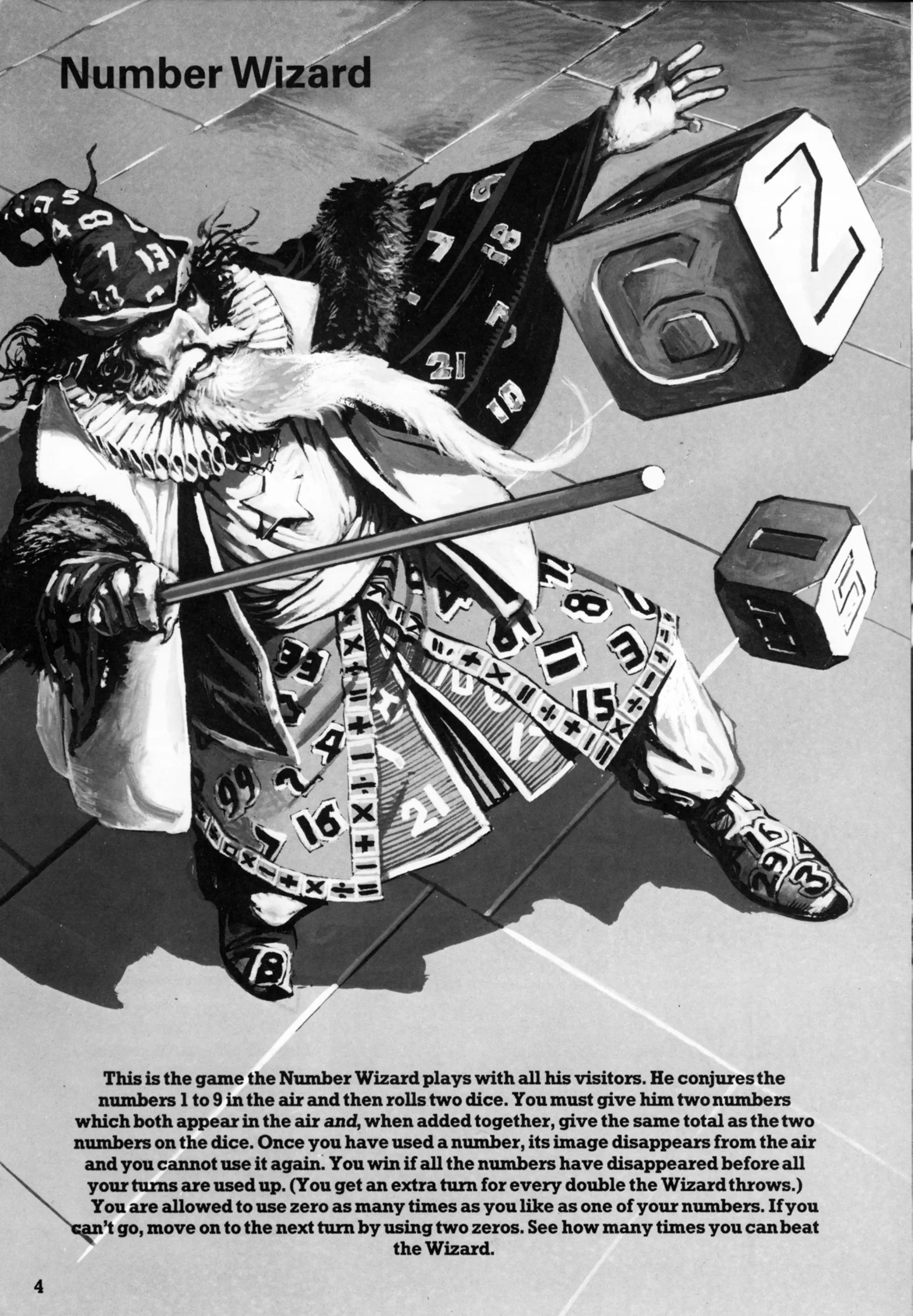
The mysterious Number Wizard challenges you to a magical duel of numbers! He conjures the digits 1 to 9 into the air, then rolls two enchanted dice. Your task: pick two numbers that add up to the total of the dice throw.
Once a number is used, it vanishes — gone for the rest of the game. Use all numbers before your turns run out, and you’ll defeat the Wizard. Fail, and your mind will be trapped forever in his realm of arithmetic.
Remember:
- Doubles give you extra turns.
- You can use zero as many times as you like.
- The Wizard never forgives a mistake…
Pseudocode
PRINT "THE NUMBER WIZARD"SET turns = 8CREATE array A(1..10) and fill with 1ENSURE A(1) = 1 (allows zero use)
REPEAT UNTIL all numbers used OR turns = 0    DISPLAY remaining numbers    PRINT number of turns left    ROLL two dice (C and B) between 1 and 6    IF dice are equal THEN add 2 extra turns    ASK player for two numbers M and N    IF M+N != (C+B) OR either number already used THEN        PRINT "TRY AGAIN"        CONTINUE loop    ELSE        SET A(M+1)=0 and A(N+1)=0 (mark as used)        SUBTRACT 1 turn    END IFEND LOOP
IF all numbers used THEN PRINT "THE WIZARD WON"ELSE PRINT "YOU WON"
Flowchart
flowchart TD
    A[Start Game] --> B[Initialize numbers 1-9]
    B --> C[Set turns = 8]
    C --> D[Display remaining numbers]
    D --> E[Roll two dice]
    E --> F[If double, add 2 turns]
    F --> G[Ask player for two numbers M and N]
    G --> H[Valid? Sum == dice total and unused]
    H -->|No| I[Show TRY AGAIN and repeat]
    H -->|Yes| J[Mark M and N as used]
    J --> K[Subtract 1 turn]
    K --> L[Check win/lose conditions]
    L -->|All numbers used| M[Show THE WIZARD WON]
    L -->|No turns left| N[Show YOU WON]
    M --> O[End]
    N --> O[End]
Code
Pages
ZX-81 BASIC
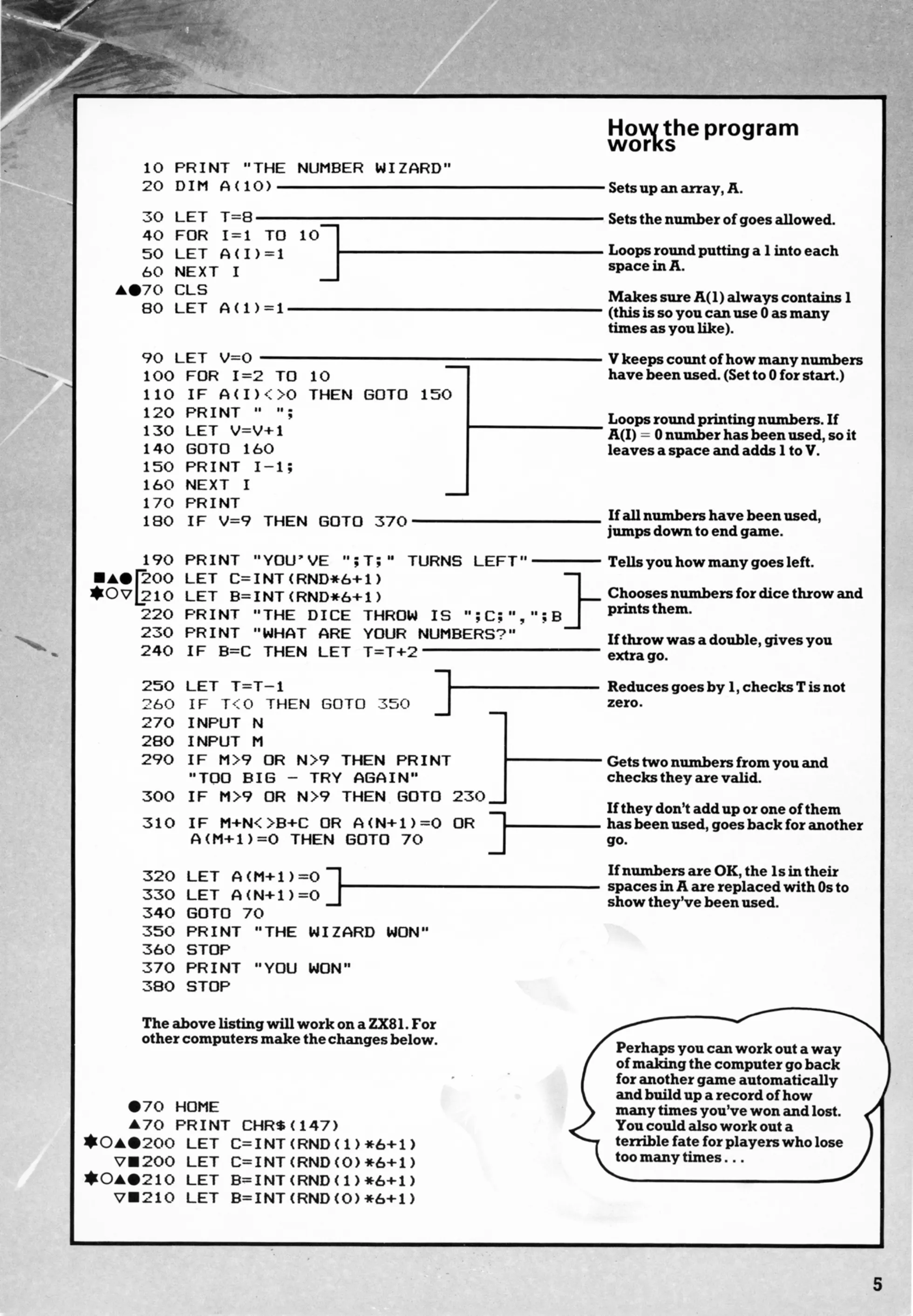
10 PRINT "THE NUMBER WIZARD"20 DIM A(10)30 LET T=840 FOR I=1 TO 1050 LET A(I)=160 NEXT I70 CLS80 LET A(1)=190 LET V=0100 FOR I=2 TO 10110 IF A(I)<0 THEN GOTO 150120 PRINT " ";130 LET V=V+1140 GOTO 160150 PRINT I-1160 NEXT I170 PRINT180 IF V=9 THEN GOTO 370190 PRINT "YOU'VE ";T;" TURNS LEFT"200 LET C=INT(RND*6)+1210 LET B=INT(RND*6)+1220 PRINT "THE DICE THROW IS ";C;" + ";B230 PRINT "WHAT ARE YOUR NUMBERS?"250 LET T=T-1260 IF T<0 THEN GOTO 350270 INPUT M280 INPUT N290 IF M>9 OR N>9 THEN PRINT "TOO BIG - TRY AGAIN"300 IF M>9 OR N>9 THEN GOTO 230310 IF M+N<>B+C OR A(M+1)=0 OR A(N+1)=0 THEN GOTO 70320 LET A(M+1)=0330 LET A(N+1)=0340 GOTO 70350 PRINT "THE WIZARD WON"360 STOP370 PRINT "YOU WON"380 STOPC#
using System;
class NumberWizard{    static void Main()    {        int[] numbers = new int[10];        for (int i = 0; i < numbers.Length; i++) numbers[i] = 1;
        int turns = 8;        Random rnd = new Random();
        while (turns > 0 && !AllUsed(numbers))        {            Console.Clear();            Console.WriteLine("Numbers left:");            for (int i = 1; i <= 9; i++)                if (numbers[i] > 0) Console.Write($"{i} ");            Console.WriteLine($"\nTurns left: {turns}");
            int dice1 = rnd.Next(1, 7);            int dice2 = rnd.Next(1, 7);            Console.WriteLine($"Dice throw: {dice1} + {dice2} = {dice1 + dice2}");
            if (dice1 == dice2)            {                turns += 2;                Console.WriteLine("Double! You gain 2 extra turns!");            }
            Console.Write("Enter two numbers separated by space: ");            string[] input = Console.ReadLine()?.Split(' ');            if (input == null || input.Length < 2) continue;
            if (!int.TryParse(input[0], out int m) || !int.TryParse(input[1], out int n))                continue;
            if (m < 0 || n < 0 || m > 9 || n > 9)            {                Console.WriteLine("Invalid numbers! Try again.");                continue;            }
            if (numbers[m] == 0 || numbers[n] == 0)            {                Console.WriteLine("One of those numbers is already used!");                continue;            }
            if (m + n != dice1 + dice2)            {                Console.WriteLine("They don't add up! Try again.");                continue;            }
            numbers[m] = numbers[n] = 0;            turns--;        }
        Console.WriteLine(AllUsed(numbers)            ? "🎩 The Wizard Won!"            : "✨ You Won!");    }
    static bool AllUsed(int[] arr)    {        for (int i = 1; i <= 9; i++)            if (arr[i] != 0) return false;        return true;    }}
Python
import random
def number_wizard():    numbers = [1] * 10    turns = 8
    while turns > 0 and sum(numbers[1:]) > 0:        print("\nNumbers left:", [i for i in range(1, 10) if numbers[i] > 0])        print(f"Turns left: {turns}")
        dice1 = random.randint(1, 6)        dice2 = random.randint(1, 6)        print(f"The dice throw is {dice1} + {dice2} = {dice1 + dice2}")
        if dice1 == dice2:            turns += 2            print("Double! You get 2 extra turns!")
        try:            m, n = map(int, input("Enter two numbers: ").split())        except ValueError:            print("Invalid input.")            continue
        if not (0 <= m <= 9 and 0 <= n <= 9):            print("Numbers must be between 0 and 9.")            continue        if numbers[m] == 0 or numbers[n] == 0:            print("One of those has already been used!")            continue        if m + n != dice1 + dice2:            print("They don't add up! Try again.")            continue
        numbers[m] = numbers[n] = 0        turns -= 1
    if sum(numbers[1:]) == 0:        print("\nTHE WIZARD WON!")    else:        print("\nYOU WON!")
if __name__ == "__main__":    number_wizard()
Java
import java.util.Random;import java.util.Scanner;
public class NumberWizard {    public static void main(String[] args) {        int[] numbers = new int[10];        for (int i = 0; i < numbers.length; i++) numbers[i] = 1;
        int turns = 8;        Random rnd = new Random();        Scanner scanner = new Scanner(System.in);
        while (turns > 0 && !allUsed(numbers)) {            System.out.print("\nNumbers left:");            for (int i = 1; i <= 9; i++)                if (numbers[i] > 0) System.out.print(" " + i);            System.out.println();            System.out.println("Turns left: " + turns);
            int dice1 = rnd.nextInt(6) + 1;            int dice2 = rnd.nextInt(6) + 1;            System.out.println("The dice throw is " + dice1 + " + " + dice2 + " = " + (dice1 + dice2));
            if (dice1 == dice2) {                turns += 2;                System.out.println("Double! You get 2 extra turns!");            }
            System.out.print("Enter two numbers separated by space: ");            if (!scanner.hasNextLine()) break;            String line = scanner.nextLine();            String[] parts = line.trim().split("\\s+");            if (parts.length < 2) {                System.out.println("Invalid input.");                continue;            }
            int m, n;            try {                m = Integer.parseInt(parts[0]);                n = Integer.parseInt(parts[1]);            } catch (NumberFormatException e) {                System.out.println("Invalid input.");                continue;            }
            if (m < 0 || n < 0 || m > 9 || n > 9) {                System.out.println("Numbers must be between 0 and 9.");                continue;            }            if (numbers[m] == 0 || numbers[n] == 0) {                System.out.println("One of those has already been used!");                continue;            }            if (m + n != dice1 + dice2) {                System.out.println("They don't add up! Try again.");                continue;            }
            numbers[m] = 0;            numbers[n] = 0;            turns--;        }
        if (allUsed(numbers)) {            System.out.println("\nTHE WIZARD WON!");        } else {            System.out.println("\nYOU WON!");        }    }
    static boolean allUsed(int[] arr) {        for (int i = 1; i <= 9; i++)            if (arr[i] != 0) return false;        return true;    }}
Go
package main
import (  "bufio"  "fmt"  "math/rand"  "os"  "strconv"  "strings"  "time")
func allUsed(numbers [10]int) bool {  for i := 1; i <= 9; i++ {    if numbers[i] != 0 {      return false    }  }  return true}
func main() {  var numbers [10]int  for i := range numbers {    numbers[i] = 1  }
  turns := 8  rand.Seed(time.Now().UnixNano())  reader := bufio.NewReader(os.Stdin)
  for turns > 0 && !allUsed(numbers) {    fmt.Print("\nNumbers left:")    for i := 1; i <= 9; i++ {      if numbers[i] > 0 {        fmt.Printf(" %d", i)      }    }    fmt.Println()    fmt.Printf("Turns left: %d\n", turns)
    dice1 := rand.Intn(6) + 1    dice2 := rand.Intn(6) + 1    fmt.Printf("The dice throw is %d + %d = %d\n", dice1, dice2, dice1+dice2)
    if dice1 == dice2 {      turns += 2      fmt.Println("Double! You get 2 extra turns!")    }
    fmt.Print("Enter two numbers separated by space: ")    line, err := reader.ReadString('\n')    parts := strings.Fields(line)    if len(parts) < 2 {      if err != nil {        break      }      fmt.Println("Invalid input.")      continue    }
    m, err1 := strconv.Atoi(parts[0])    n, err2 := strconv.Atoi(parts[1])    if err1 != nil || err2 != nil {      fmt.Println("Invalid input.")      continue    }
    if m < 0 || n < 0 || m > 9 || n > 9 {      fmt.Println("Numbers must be between 0 and 9.")      continue    }    if numbers[m] == 0 || numbers[n] == 0 {      fmt.Println("One of those has already been used!")      continue    }    if m+n != dice1+dice2 {      fmt.Println("They don't add up! Try again.")      continue    }
    numbers[m] = 0    numbers[n] = 0    turns--  }
  if allUsed(numbers) {    fmt.Println("\nTHE WIZARD WON!")  } else {    fmt.Println("\nYOU WON!")  }}
C++
#include <iostream>#include <cstdlib>#include <ctime>
bool allUsed(int numbers[10]) {    for (int i = 1; i <= 9; i++)        if (numbers[i] != 0) return false;    return true;}
int main() {    int numbers[10];    for (int i = 0; i < 10; i++) numbers[i] = 1;
    int turns = 8;    srand(time(0));
    while (turns > 0 && !allUsed(numbers)) {        std::cout << "\nNumbers left:";        for (int i = 1; i <= 9; i++)            if (numbers[i] > 0) std::cout << " " << i;        std::cout << std::endl;        std::cout << "Turns left: " << turns << std::endl;
        int dice1 = rand() % 6 + 1;        int dice2 = rand() % 6 + 1;        std::cout << "The dice throw is " << dice1 << " + " << dice2 << " = " << (dice1 + dice2) << std::endl;
        if (dice1 == dice2) {            turns += 2;            std::cout << "Double! You get 2 extra turns!" << std::endl;        }
        std::cout << "Enter two numbers separated by space: ";        int m, n;        if (!(std::cin >> m >> n)) {            if (std::cin.eof()) break;            std::cin.clear();            std::cin.ignore(10000, '\n');            std::cout << "Invalid input." << std::endl;            continue;        }
        if (m < 0 || n < 0 || m > 9 || n > 9) {            std::cout << "Numbers must be between 0 and 9." << std::endl;            continue;        }        if (numbers[m] == 0 || numbers[n] == 0) {            std::cout << "One of those has already been used!" << std::endl;            continue;        }        if (m + n != dice1 + dice2) {            std::cout << "They don't add up! Try again." << std::endl;            continue;        }
        numbers[m] = 0;        numbers[n] = 0;        turns--;    }
    if (allUsed(numbers)) {        std::cout << "\nTHE WIZARD WON!" << std::endl;    } else {        std::cout << "\nYOU WON!" << std::endl;    }
    return 0;}
Explanation
The wizard rolls two dice and challenges you to match their sum using two of the remaining numbers (1-9). When you use numbers, they disappear. Doubles grant bonus turns. You must clear all numbers before your turns run out.
Challenges
- Fate Counter – Keep a record of how many times you’ve lost or won.
- Evil Mode – Make the wizard “curse” you by taking away a number when you guess wrong.
- Automatic Replay – Add a loop that restarts the game automatically after finishing.
- Sound & Graphics – Use color or sound feedback for dice rolls and wins.
- Zero Strategy – Add the option to use zero as one of the numbers strategically.
Copyright
These programs are adaptations of the original Usborne Computer Guides published in the 1980s. The books are free to download for personal or educational use from Usborne’s Computer and Coding Books. Programs and adaptations may not be used for commercial purposes.
Return to Creepy Computer Games.