Supersonic Bomber
Book: Computer Battlegames
Author: Usborne Publishing
Translator: Marcus Medina
Story
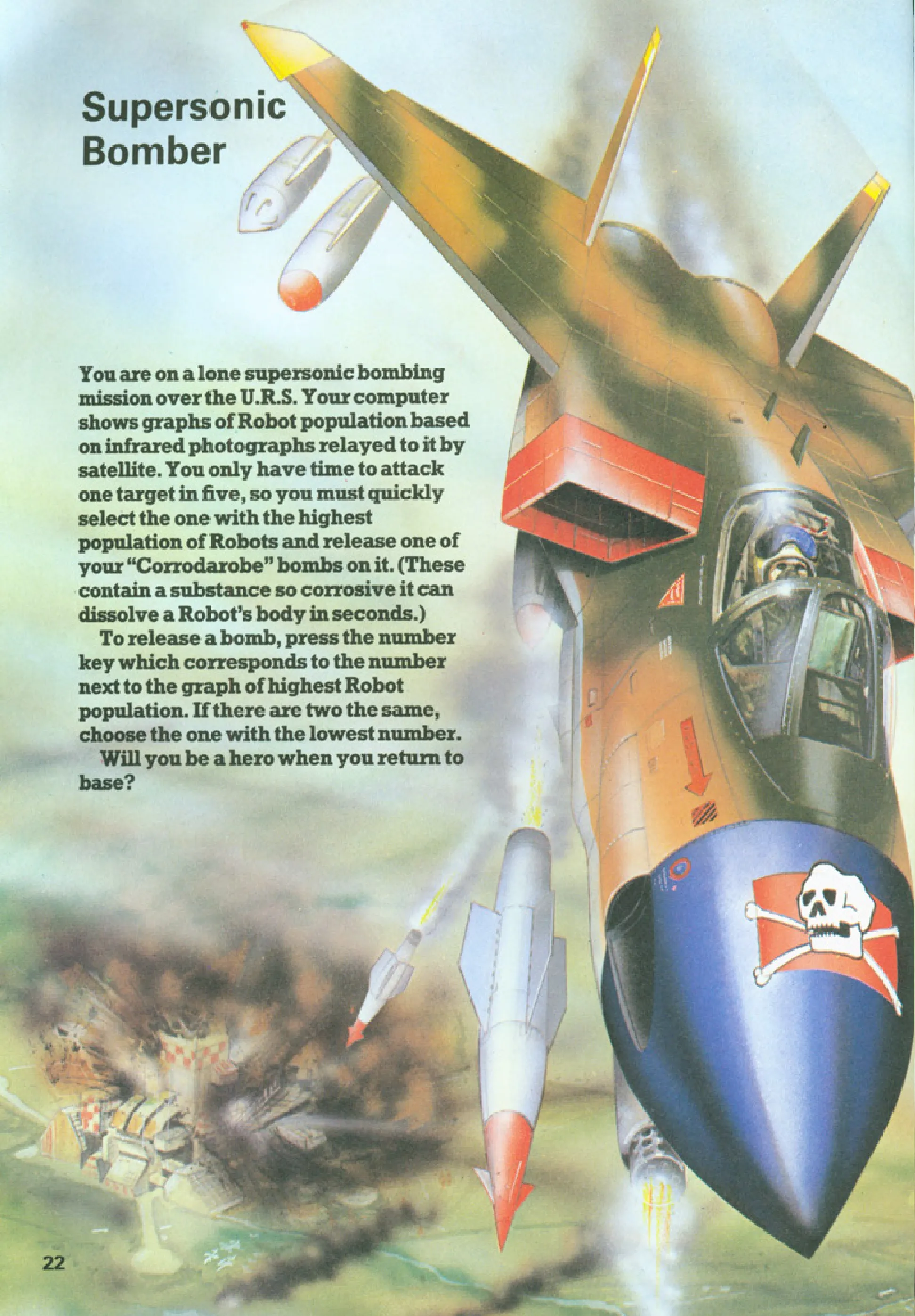
You are on a lone supersonic bombing mission over the U.R.S. Your computer shows graphs of Robot population based on infrared photographs relayed to it by satellite. You only have time to attack one target in five, so you must quickly select the one with the highest population of Robots and release one of your “Corrodarobe” bombs on it. (These contain a substance so corrosive it can dissolve a Robot’s body in seconds.)
To release a bomb, press the number key which corresponds to the number next to the graph of the highest Robot population. If there are two the same, choose the one with the lowest number.
Will you be a hero when you return to base?
Marcus Note
Even though I do enjoy the idea of small simple games, I think it would be better to change the name of the bomb to something less destructive. There’s a lot of wars in the world already, so I don’t want to promote that in any way.
Maybe the game could be about delivering food to the village with the highest population density. or a game about delivering medicine to the village with the highest population density. or a game about fighting a forest fire in the section of the forest with the highest amount of fires.
Pseudocode
STARTInitialize score and array B to store 5 random valuesFOR each of the 10 rounds: Display the graphs with corresponding population sizes Player chooses a target Check if the chosen target matches the highest population graph If correct: Increment score Else: Print "Too Late" or "Incorrect"END FORDisplay the final score and print success/failure message based on performanceENDFlowchart
flowchart TD
    Start --> Initialize['Initialize score and targets array']
    Initialize --> RoundLoop['FOR each of 10 rounds']
    RoundLoop --> GenerateRandom['Generate random population values']
    GenerateRandom --> DisplayGraphs['Display graphs and populations']
    DisplayGraphs --> PlayerInput['Player selects a target']
    PlayerInput --> ValidateSelection['Check if selected target is correct']
    ValidateSelection -->|Correct| IncrementScore['Increment score']
    ValidateSelection -->|Incorrect| PrintIncorrect['Print 'Incorrect']
    IncrementScore --> NextRound['Proceed to next round']
    PrintIncorrect --> NextRound
    NextRound -->|End of 10 rounds| FinalScore['Display final score']
    FinalScore --> End['END']
Code
Pages
ZX-81 BASIC
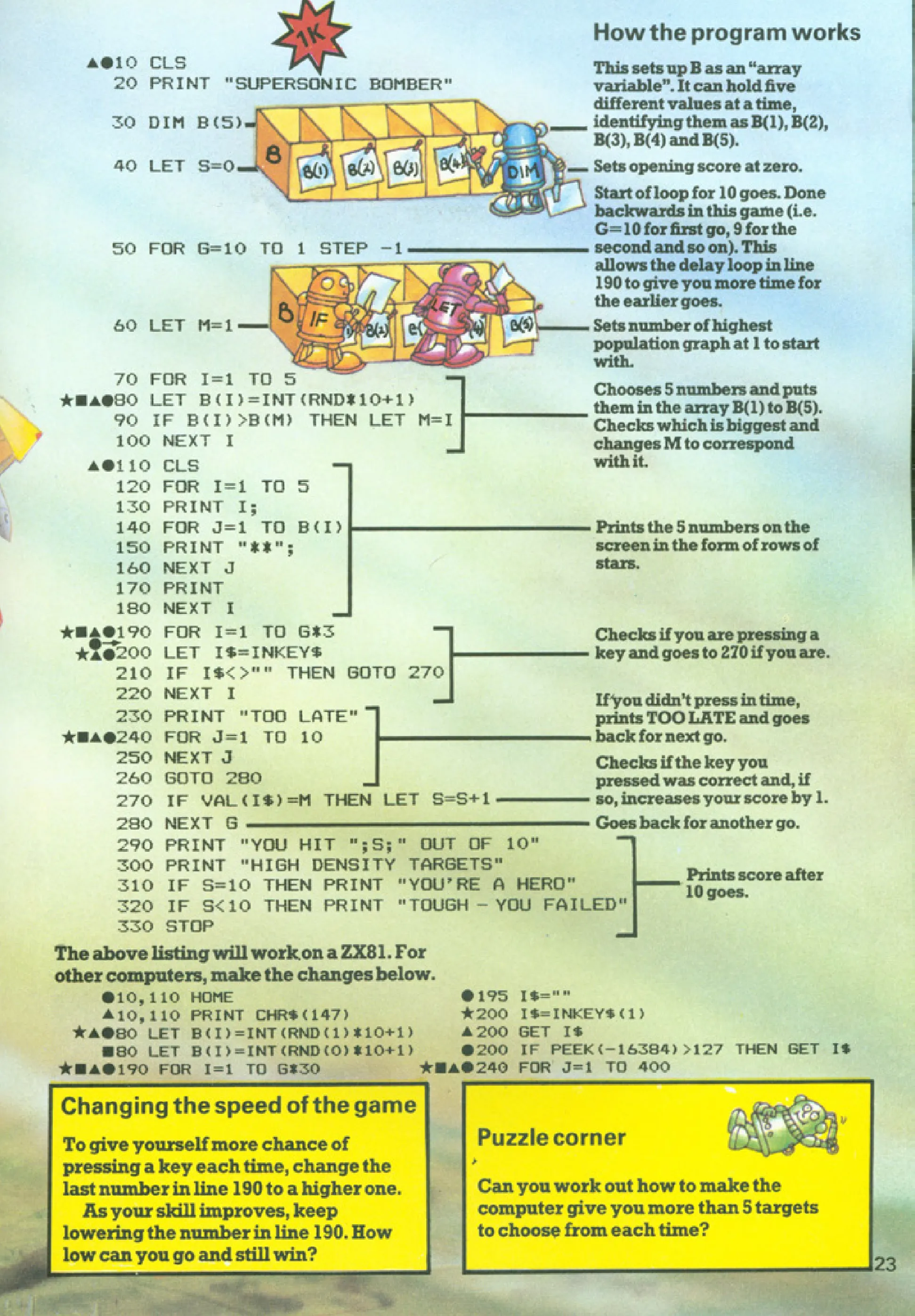
10 CLS20 PRINT "SUPERSONIC BOMBER"30 DIM B(5)40 LET S=050 FOR G=10 TO 1 STEP -160 LET M=170 FOR I=1 TO 580 LET B(I)=INT(RND*10+1)90 IF B(I)>B(M) THEN LET M=I100 NEXT I110 CLS120 FOR I=1 TO 5130 PRINT I;140 FOR J=1 TO B(I)150 PRINT "*";160 NEXT J170 PRINT180 NEXT I190 FOR I=1 TO G*3200 LET I$=INKEY$210 IF I$<>"" THEN GOTO 270220 NEXT I230 PRINT "TOO LATE"240 FOR J=1 TO 10250 NEXT J260 GOTO 280270 IF VAL(I$)=M THEN LET S=S+1280 NEXT G290 PRINT "YOU HIT ";S;" OUT OF 10"300 PRINT "HIGH DENSITY TARGETS"310 IF S=10 THEN PRINT "YOU'RE A HERO"320 IF S<10 THEN PRINT "TOUGH - YOU FAILED"330 STOPC#
using System;
class SupersonicBomber{    static void Main()    {        Console.WriteLine("Supersonic Bomber");        Random random = new Random();        int score = 0;
        for (int round = 1; round <= 10; round++)        {            int[] populations = new int[5];            for (int i = 0; i < 5; i++)                populations[i] = random.Next(1, 11);
            int maxIndex = 0;            for (int i = 1; i < populations.Length; i++)                if (populations[i] > populations[maxIndex])                    maxIndex = i;
            Console.WriteLine("Targets:");            for (int i = 0; i < 5; i++)                Console.WriteLine($"Target {i + 1}: {populations[i]}");
            int choice;            do            {                Console.Write("Select a target (1-5): ");            } while (!int.TryParse(Console.ReadLine(), out choice) || choice < 1 || choice > 5);            choice--; // Convert to 0-based index
            if (choice == maxIndex)            {                Console.WriteLine("Correct! Highest population hit.");                score++;            }            else            {                Console.WriteLine("Incorrect. You missed the highest population.");            }        }
        Console.WriteLine($"Final Score: {score} out of 10");    }}
Python
import random
print("Supersonic Bomber")score = 0
for round in range(10):    populations = [random.randint(1, 10) for _ in range(5)]    max_index = populations.index(max(populations))
    print("Targets:")    for i, pop in enumerate(populations, start=1):        print(f"Target {i}: {pop}")
    choice = int(input("Select a target (1-5): ")) - 1
    if choice == max_index:        print("Correct! Highest population hit.")        score += 1    else:        print("Incorrect. You missed the highest population.")
print(f"Final Score: {score} out of 10")
Java
import java.util.Random;import java.util.Scanner;
public class SupersonicBomber {    public static void main(String[] args) {        Scanner scanner = new Scanner(System.in);        Random random = new Random();        int score = 0;
        System.out.println("Supersonic Bomber");
        for (int round = 1; round <= 10; round++) {            int[] populations = new int[5];            for (int i = 0; i < 5; i++) {                populations[i] = random.nextInt(10) + 1;            }
            int maxIndex = 0;            for (int i = 1; i < populations.length; i++) {                if (populations[i] > populations[maxIndex]) {                    maxIndex = i;                }            }
            System.out.println("Targets:");            for (int i = 0; i < populations.length; i++) {                System.out.println("Target " + (i + 1) + ": " + populations[i]);            }
            System.out.print("Select a target (1-5): ");            int choice = scanner.nextInt() - 1;
            if (choice == maxIndex) {                System.out.println("Correct! Highest population hit.");                score++;            } else {                System.out.println("Incorrect. You missed the highest population.");            }        }
        System.out.println("Final Score: " + score + " out of 10");        scanner.close();    }}
Go
package main
import (  "fmt"  "math/rand"  "time")
func main() {  rand.Seed(time.Now().UnixNano())  fmt.Println("Supersonic Bomber")  score := 0
  for round := 1; round <= 10; round++ {    targets := make([]int, 5)    for i := range targets {      targets[i] = rand.Intn(10) + 1    }
    maxIndex := 0    for i, v := range targets {      if v > targets[maxIndex] {        maxIndex = i      }    }
    fmt.Println("Targets:")    for i, v := range targets {      fmt.Printf("Target %d: %d\n", i+1, v)    }
    fmt.Print("Select a target (1-5): ")    var choice int    fmt.Scan(&choice)    choice--
    if choice == maxIndex {      fmt.Println("Correct! Highest population hit.")      score++    } else {      fmt.Println("Incorrect. You missed the highest population.")    }  }
  fmt.Printf("Final Score: %d out of 10\n", score)}
C++
#include <iostream>#include <cstdlib>#include <ctime>
int main() {    std::cout << "Supersonic Bomber" << std::endl;    int score = 0;
    srand(time(0));
    for (int round = 1; round <= 10; round++) {        int populations[5];        for (int i = 0; i < 5; i++) {            populations[i] = rand() % 10 + 1;        }
        int maxIndex = 0;        for (int i = 1; i < 5; i++) {            if (populations[i] > populations[maxIndex]) {                maxIndex = i;            }        }
        std::cout << "Targets:" << std::endl;        for (int i = 0; i < 5; i++) {            std::cout << "Target " << (i + 1) << ": " << populations[i] << std::endl;        }
        int choice;        std::cout << "Select a target (1-5): ";        std::cin >> choice;        choice--;
        if (choice == maxIndex) {            std::cout << "Correct! Highest population hit." << std::endl;            score++;        } else {            std::cout << "Incorrect. You missed the highest population." << std::endl;        }    }
    std::cout << "Final Score: " << score << " out of 10" << std::endl;    return 0;}
Challenges
-
Increase Difficulty:
- Decrease the time available for selecting a target.
- Add decoy information to mislead the player.
-
Add Features:
- Introduce multiple levels with increasing difficulty.
- Add a timer for each round.
-
Customize:
- Replace bombing with humanitarian missions, such as delivering supplies or medicine.
- Incorporate environmental themes like fighting forest fires.
-
Educational Purpose:
- Introduce geography or population density questions for bonus points.
- Adapt the game for classroom use with embedded quizzes.
Book Information
- Title: Computer Battlegames
- Publisher: Usborne Publishing
Copyright
These programs are adaptations of the original Usborne Computer Guides published in the 1980s. The books are free to download for personal or educational use from Usborne’s Computer and Coding Books. Programs and adaptations may not be used for commercial purposes.
Return to Computer Battlegames.