Ghost Guzzler
Book: Creepy Computer Games
Author: Brendon Kavanagh, Colin Reynolds, Val Robinson, Alan Ramsey, Keith Campbell, Chris Oxlade
Translator: Marcus Medina
Story
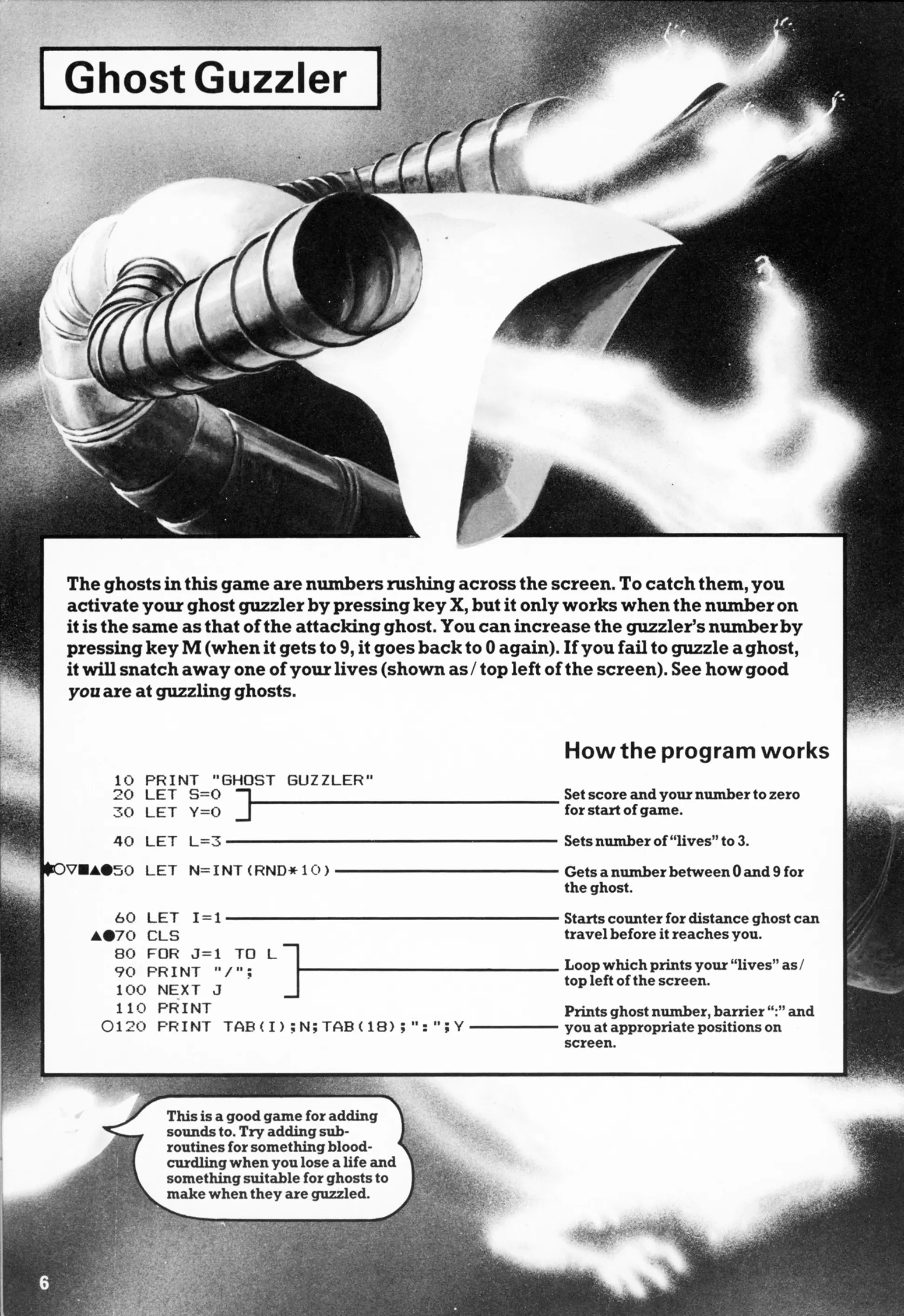
The ghosts are loose! 👻 Numbers rush across your screen — each one a ghostly apparition trying to invade your computer. Your only defense is the Ghost Guzzler, a strange contraption that devours numbers — but only when you match the right one!
Press X to activate your guzzler when the number matches the attacking ghost. Press M to increase your guzzler’s setting (0-9, looping back to 0). If you fail to catch the ghost, it steals one of your lives. Lose them all and the ghosts will haunt your machine forever…
Pseudocode
PRINT "GHOST GUZZLER"SET score = 0SET player_number = 0SET lives = 3
LOOP while lives > 0    CHOOSE random ghost_number between 0 and 9    DISPLAY number of lives, ghost_number, and your_number    WAIT a short time    CHECK if a key is pressed:        - X: try to catch ghost        - M: increase your number by 1    IF your_number == ghost_number THEN        PRINT "GOT IT!"        INCREASE score    ELSE IF ghost reaches end THEN        DECREASE lives    END IFEND LOOP
PRINT final scoreASK "ANOTHER GO?"
Flowchart
flowchart TD
    A[Start Game] --> B[Set Score=0, Y=0, Lives=3]
    B --> C[Generate Ghost Number 0-9]
    C --> D[Display Ghost Number and Player Number]
    D --> E[Check for Key Input]
    E -->|M Pressed| F["Increase player number (0-9)"]
    E -->|X Pressed| G[Compare Numbers]
    G -->|Match| H[Increase Score]
    G -->|No Match| I[Decrease Lives]
    H --> J[Next Ghost]
    I --> J
    J -->|Lives > 0| C
    J -->|Lives = 0| K[Game Over]
    K --> L[Display Score and Replay Option]
    L --> M[End]
Code
Pages
ZX-81 BASIC
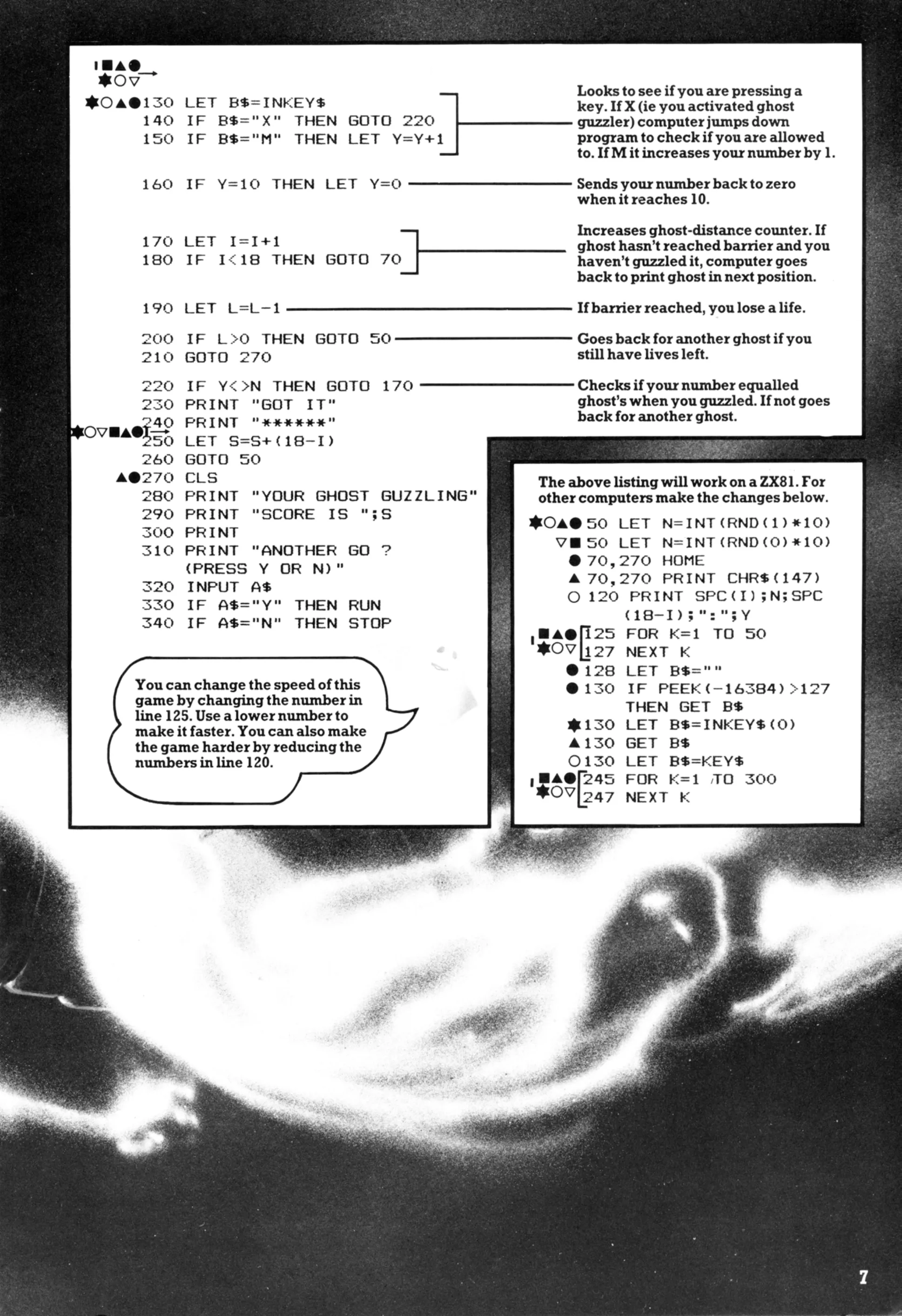
10 PRINT "GHOST GUZZLER"20 LET S=030 LET Y=040 LET L=350 LET N=INT(RND*10)60 LET I=170 CLS80 FOR J=1 TO L90 PRINT "/";100 NEXT J110 PRINT120 PRINT TAB(I);N;TAB(18);":";Y130 LET B$=INKEY$140 IF B$="X" THEN GOTO 220150 IF B$="M" THEN LET Y=Y+1160 IF Y=10 THEN LET Y=0170 LET I=I+1180 IF I<18 THEN GOTO 70190 LET L=L-1200 IF L>0 THEN GOTO 50210 GOTO 270220 IF Y<>N THEN GOTO 170230 PRINT "GOT IT"240 PRINT "*******"250 LET S=S+(18-I)260 GOTO 50270 CLS280 PRINT "YOUR GHOST GUZZLING"290 PRINT "SCORE IS ";S300 PRINT310 PRINT "ANOTHER GO? (PRESS Y OR N)"320 INPUT A$330 IF A$="Y" THEN RUN340 IF A$="N" THEN STOPC#
using System;using System.Threading;
class GhostGuzzler{    static void Main()    {        int score = 0;        int player = 0;        int lives = 3;        Random rnd = new Random();
        while (lives > 0)        {            int ghost = rnd.Next(0, 10);            for (int pos = 1; pos < 18; pos++)            {                Console.Clear();                Console.WriteLine(new string('/', lives));                Console.WriteLine($"\nGhost: {ghost}   You: {player}");                Thread.Sleep(100);
                if (Console.KeyAvailable)                {                    var key = Console.ReadKey(true).Key;                    if (key == ConsoleKey.M)                    {                        player = (player + 1) % 10;                    }                    else if (key == ConsoleKey.X)                    {                        if (player == ghost)                        {                            Console.WriteLine("GOT IT!");                            score += 18 - pos;                            Thread.Sleep(500);                            break;                        }                    }                }
                if (pos == 17)                {                    lives--;                    Console.WriteLine("A ghost got you!");                    Thread.Sleep(800);                }            }        }
        Console.Clear();        Console.WriteLine($"Your Ghost Guzzling Score: {score}");        Console.Write("Another go? (Y/N): ");        if (Console.ReadKey(true).Key == ConsoleKey.Y)            Main();    }}
Python
import randomimport timeimport msvcrt
def ghost_guzzler():    score = 0    player = 0    lives = 3
    while lives > 0:        ghost = random.randint(0, 9)        for i in range(1, 18):            print("\033c", end="")  # clear screen            print("/" * lives)            print(f"\nGhost: {ghost}   You: {player}")            time.sleep(0.1)
            if msvcrt.kbhit():                key = msvcrt.getwch().upper()                if key == "M":                    player = (player + 1) % 10                elif key == "X":                    if player == ghost:                        print("GOT IT!")                        score += (18 - i)                        time.sleep(0.5)                        break            if i == 17:                lives -= 1                print("A ghost got you!")                time.sleep(0.8)
    print(f"\nYour Ghost Guzzling Score: {score}")    again = input("Another go? (Y/N): ").upper()    if again == "Y":        ghost_guzzler()
if __name__ == "__main__":    ghost_guzzler()
Java
import java.util.Random;import java.util.Scanner;
public class GhostGuzzler {    public static void main(String[] args) {        Scanner scanner = new Scanner(System.in);        play(scanner);    }
    static void play(Scanner scanner) {        Random rnd = new Random();        int score = 0;        int player = 0;        int lives = 3;
        while (lives > 0) {            int ghost = rnd.nextInt(10);            boolean caught = false;
            for (int pos = 1; pos < 18 && !caught; pos++) {                System.out.println("/".repeat(lives));                System.out.println("\nGhost: " + ghost + "   You: " + player);                System.out.print("Press M to change your number, X to guzzle, or Enter to wait: ");
                if (!scanner.hasNextLine()) {                    System.out.println("\nYour Ghost Guzzling Score: " + score);                    return;                }                String key = scanner.nextLine().trim().toUpperCase();
                if (key.equals("M")) {                    player = (player + 1) % 10;                } else if (key.equals("X") && player == ghost) {                    System.out.println("GOT IT!");                    score += 18 - pos;                    caught = true;                }
                if (!caught && pos == 17) {                    lives--;                    System.out.println("A ghost got you!");                }            }        }
        System.out.println("\nYour Ghost Guzzling Score: " + score);        System.out.print("Another go? (Y/N): ");        if (scanner.hasNextLine()) {            String again = scanner.nextLine().trim().toUpperCase();            if (again.equals("Y")) {                play(scanner);            }        }    }}
Go
package main
import (  "bufio"  "fmt"  "math/rand"  "os"  "strings"  "time")
func play(reader *bufio.Reader) {  score := 0  player := 0  lives := 3
  for lives > 0 {    ghost := rand.Intn(10)    caught := false
    for pos := 1; pos < 18 && !caught; pos++ {      fmt.Println(strings.Repeat("/", lives))      fmt.Printf("\nGhost: %d   You: %d\n", ghost, player)      fmt.Print("Press M to change your number, X to guzzle, or Enter to wait: ")
      line, err := reader.ReadString('\n')      if err != nil {        fmt.Printf("\nYour Ghost Guzzling Score: %d\n", score)        return      }      key := strings.ToUpper(strings.TrimSpace(line))
      if key == "M" {        player = (player + 1) % 10      } else if key == "X" && player == ghost {        fmt.Println("GOT IT!")        score += 18 - pos        caught = true      }
      if !caught && pos == 17 {        lives--        fmt.Println("A ghost got you!")      }    }  }
  fmt.Printf("\nYour Ghost Guzzling Score: %d\n", score)  fmt.Print("Another go? (Y/N): ")  line, err := reader.ReadString('\n')  if err == nil && strings.ToUpper(strings.TrimSpace(line)) == "Y" {    play(reader)  }}
func main() {  rand.Seed(time.Now().UnixNano())  reader := bufio.NewReader(os.Stdin)  play(reader)}
C++
#include <iostream>#include <string>#include <cstdlib>#include <ctime>#include <algorithm>
void play() {    int score = 0;    int player = 0;    int lives = 3;
    while (lives > 0) {        int ghost = rand() % 10;        bool caught = false;
        for (int pos = 1; pos < 18 && !caught; pos++) {            std::cout << std::string(lives, '/') << std::endl;            std::cout << "\nGhost: " << ghost << "   You: " << player << std::endl;            std::cout << "Press M to change your number, X to guzzle, or Enter to wait: ";
            std::string key;            if (!std::getline(std::cin, key)) {                std::cout << "\nYour Ghost Guzzling Score: " << score << std::endl;                return;            }            std::transform(key.begin(), key.end(), key.begin(), ::toupper);
            if (key == "M") {                player = (player + 1) % 10;            } else if (key == "X" && player == ghost) {                std::cout << "GOT IT!" << std::endl;                score += 18 - pos;                caught = true;            }
            if (!caught && pos == 17) {                lives--;                std::cout << "A ghost got you!" << std::endl;            }        }    }
    std::cout << "\nYour Ghost Guzzling Score: " << score << std::endl;    std::cout << "Another go? (Y/N): ";    std::string again;    if (std::getline(std::cin, again)) {        std::transform(again.begin(), again.end(), again.begin(), ::toupper);        if (again == "Y") {            play();        }    }}
int main() {    srand(time(0));    play();    return 0;}
Explanation
Each ghost is represented by a number (0-9) moving across the screen. You must press X when your number matches the ghost’s. Press M to change your guzzler’s number. If you miss, you lose a life. Your score increases the sooner you catch the ghost.
Challenges
- Sound Effects – Add spooky sound when you lose a life or catch a ghost.
- Speed Control – Adjust line 125 (or the sleep delay) to make ghosts faster.
- Difficulty Curve – Reduce starting lives or increase ghost speed over time.
- Ghost Count – Track how many ghosts you’ve caught.
- Two-Player Mode – Add alternating turns for two ghost hunters.
Copyright
These programs are adaptations of the original Usborne Computer Guides published in the 1980s. The books are free to download for personal or educational use from Usborne’s Computer and Coding Books. Programs and adaptations may not be used for commercial purposes.
Return to Creepy Computer Games.