Micropuzzle
Book: Weird Computer Games
Author: Usborne Publishing
Translator: Marcus Medina
Story
What’s happened? Where are you? Everything seems fairly normal — except you feel a bit sick. Better look around and figure out what’s going on. (Hint: talk to your computer in two-word sentences.)
This miniature adventure challenges you to experiment with short commands, solve small riddles, and escape before the micropuzzle resets.
Pseudocode
Load vocabulary (verbs and nouns) and map dataSet starting room and game flagsLOOP Display room description and visible objects Prompt for two-word command Parse verb and noun IF verb or noun unknown THEN show error and continue Handle verbs: GO <direction> -> move between rooms if exit exists TAKE <object> -> add to inventory if object present DROP <object> -> remove from inventory and place in room USE <object> -> perform scripted actions (unlock door, disarm cat, etc.) LOOK -> repeat description Update flags (cat tamed, door unlocked, countdown) Check win/lose conditionsEND LOOP when escape achieved or timer expiresFlowchart
flowchart TD
    A[Start] --> B[Load rooms, objects, verbs]
    B --> C[Set current room, inventory]
    C --> D[Describe room]
    D --> E[Get two-word command]
    E --> F{Command valid?}
    F -->|No| D
    F -->|Yes| G[Execute action]
    G --> H{Victory?}
    H -->|Yes| I[Print success, end]
    H -->|No| J{Failure?}
    J -->|Yes| K[Print failure, end]
    J -->|No| D
Code
Pages
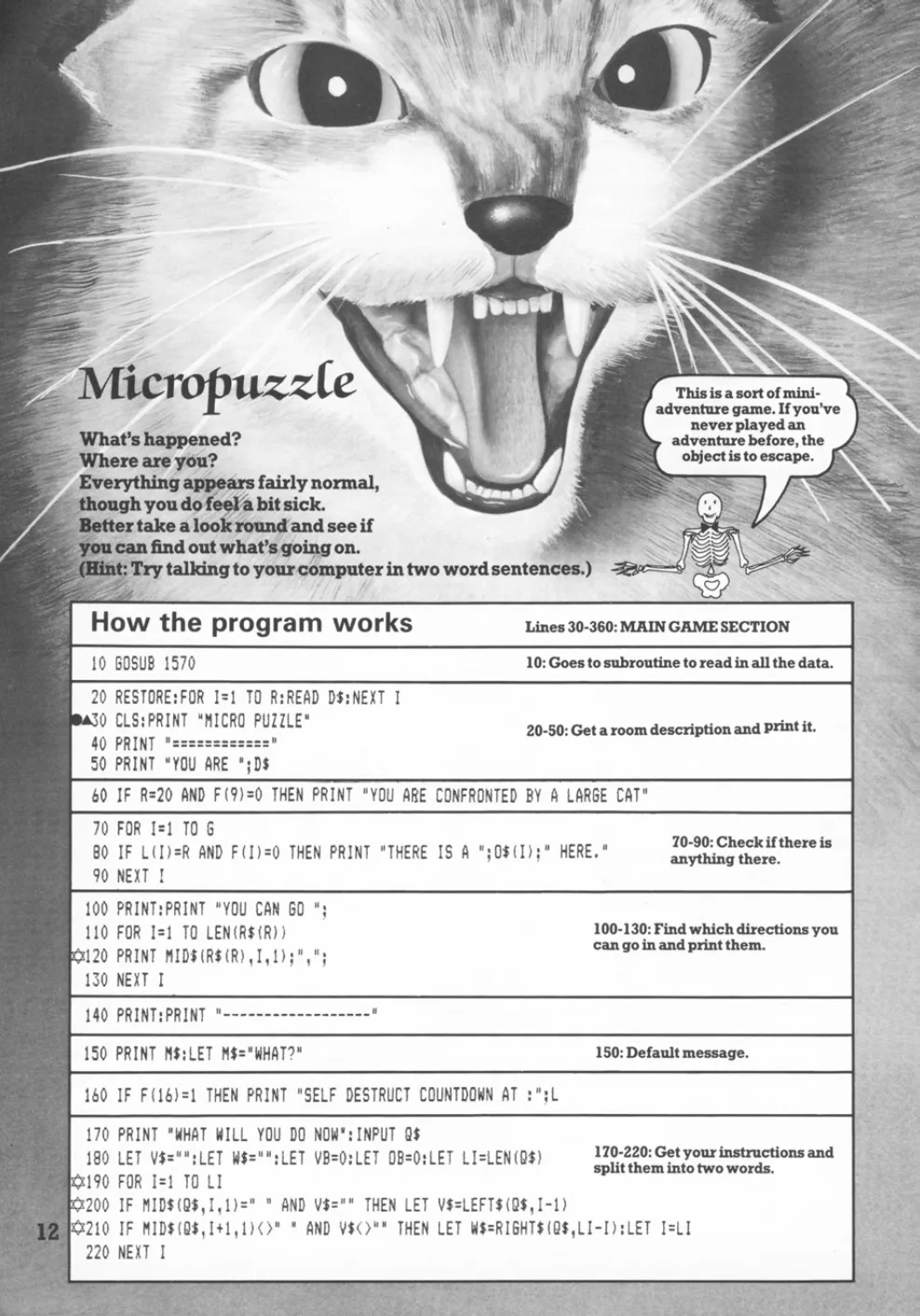
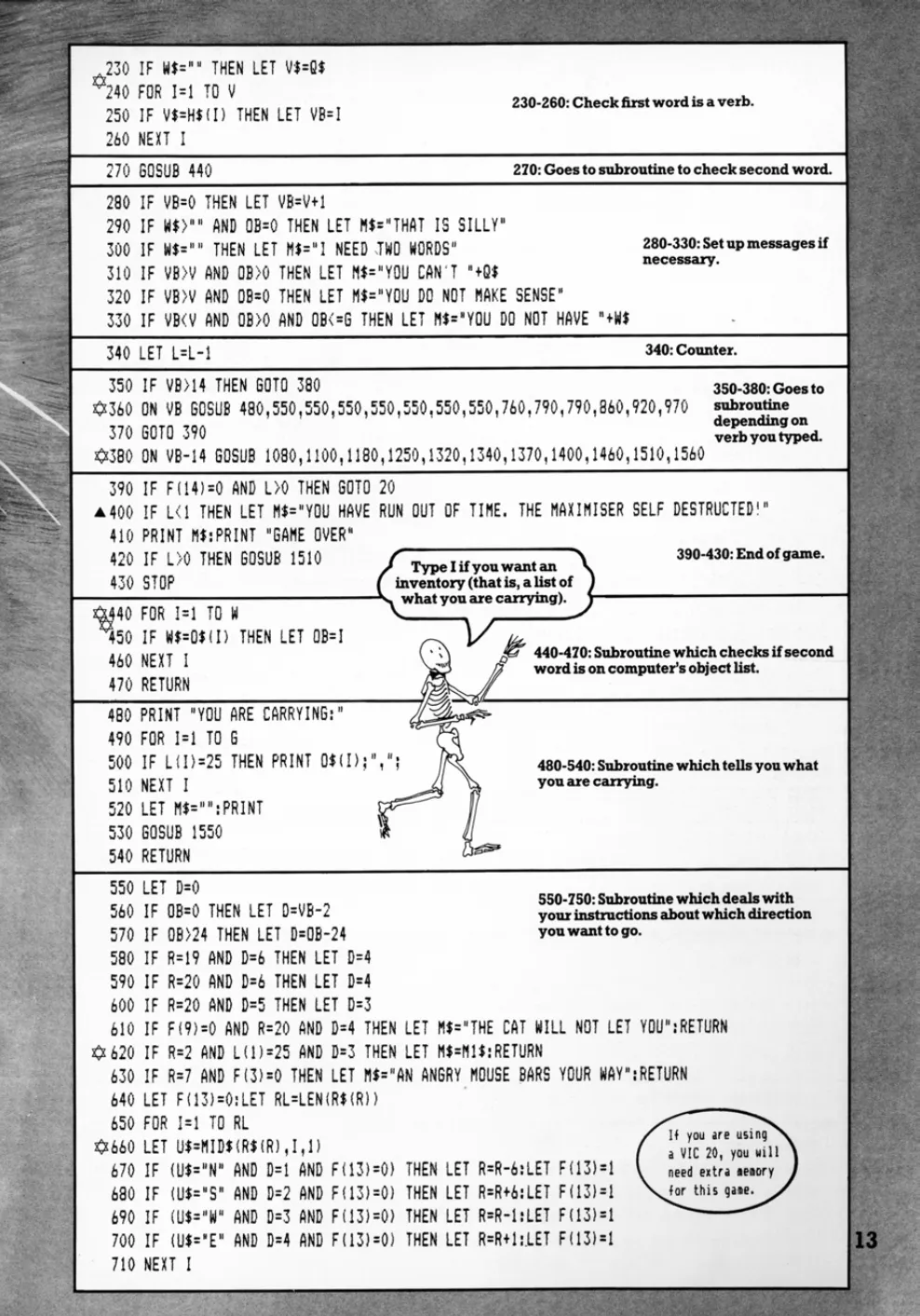
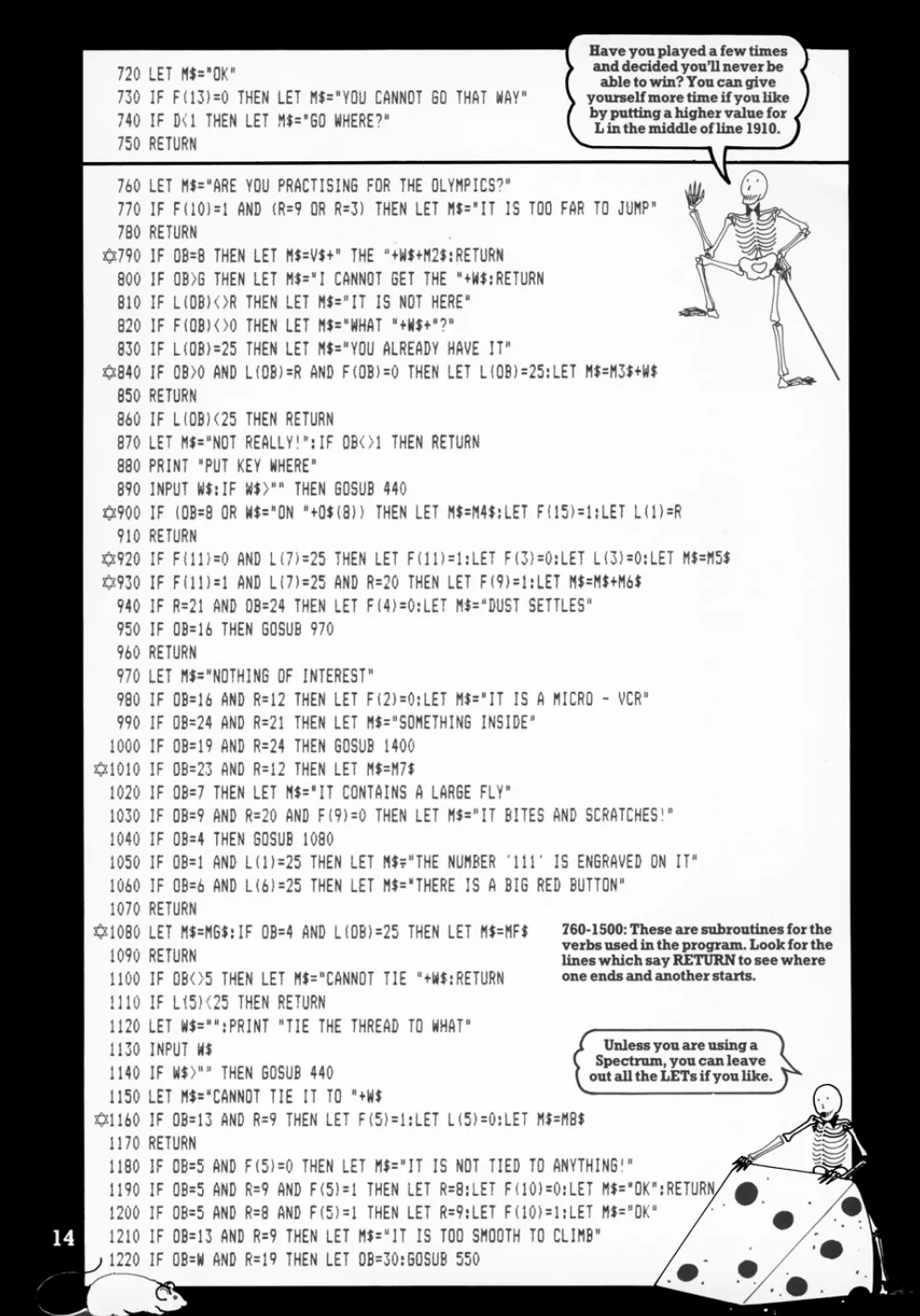
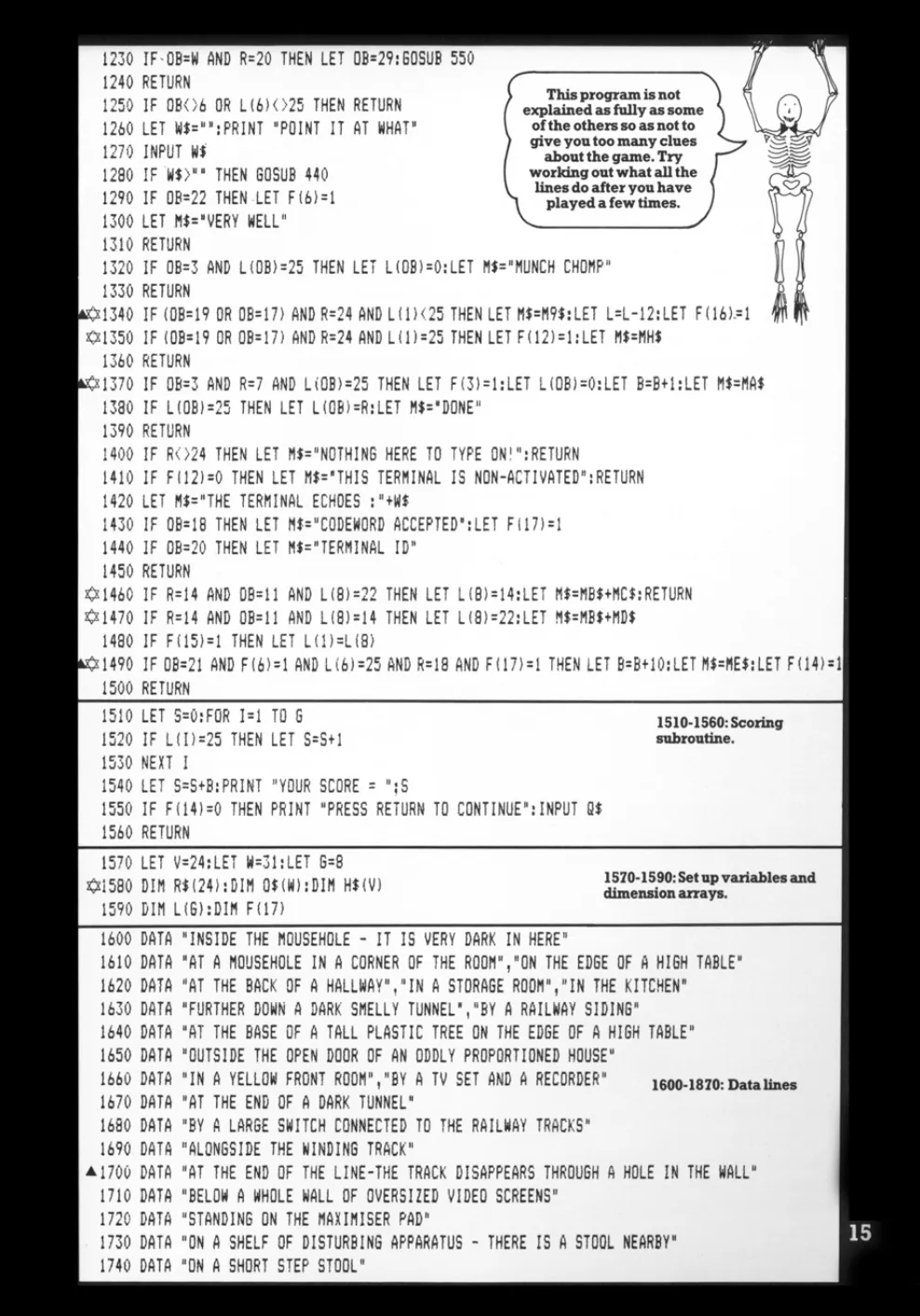
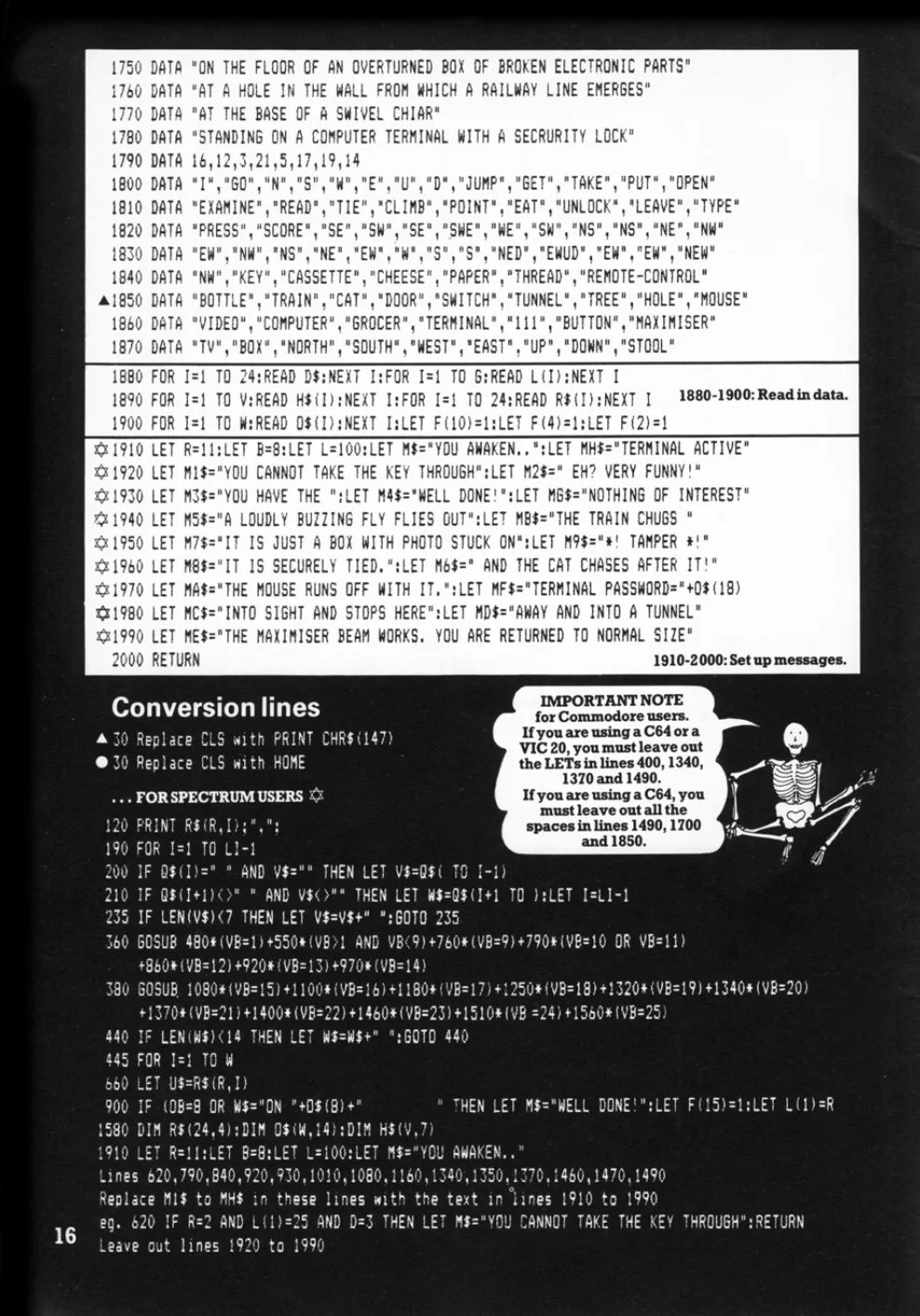
ZX-81 BASIC
10 GOSUB 157020 RESTORE:FOR I=1 TO R:READ D$(I):NEXT I30 CLS:PRINT "MICRO PUZZLE"40 PRINT "==============="50 PRINT "YOU ARE ";D$(R)60 IF R=20 AND F(9)=0 THEN PRINT "YOU ARE CONFRONTED BY A LARGE CAT"70 FOR I=1 TO 680 IF L(I)=R AND F(I)=0 THEN PRINT "THERE IS A ";O$(I);" HERE."90 NEXT I100 PRINT:PRINT "YOU CAN GO ";110 FOR I=1 TO LEN(R$(R))120 PRINT MID$(R$(R),I,1);130 NEXT I140 PRINT:PRINT "-------------------"150 PRINT M$:LET M$="WHAT?"160 IF F(16)=1 THEN PRINT "SELF DESTRUCT COUNTDOWN AT ";L170 PRINT "WHAT WILL YOU DO NOW";:INPUT Q$180 LET V$="":LET W$="":LET D8=0:LET L1=LEN(Q$)190 FOR I=1 TO L1200 IF MID$(Q$,I,1)=" " AND V$="" THEN LET V$=LEFT$(Q$,I-1)210 IF MID$(Q$,I+1,1)<>" " AND V$<>"" THEN LET W$=RIGHT$(Q$,L1-I):LET I=L1220 NEXT I230 IF W$="" THEN LET W$=Q$240 FOR I=1 TO V250 IF V$=H$(I) THEN LET VB=I260 NEXT I270 GOSUB 440280 IF VB=0 THEN LET VB=VB+1290 IF V$="" AND OB=0 THEN LET M$="THAT IS SILLY"300 IF W$="" THEN LET M$="I NEED TWO WORDS"310 IF VB<>0 AND OB<>0 THEN LET M$="YOU CAN'T "+Q$320 IF VB<>0 AND OB=0 THEN LET M$="YOU DO NOT MAKE SENSE"330 IF VB<>0 AND OB<>0 AND OB>G THEN LET M$="YOU DO NOT HAVE "+W$340 LET L=L-1350 IF L=0 THEN GOTO 600360 ON VB GOTO 370,410,470,520,550,580370 GOSUB 650:RETURN410 GOSUB 710:RETURN470 GOSUB 870:RETURN520 GOSUB 1030:RETURN550 GOSUB 1140:RETURN580 GOSUB 1280:RETURN600 PRINT:PRINT "THE PUZZLE RESETS";:STOP650 IF OB<>0 THEN LET M$="YOU ARE ALREADY CARRYING IT":RETURN660 IF F(OB)<>0 THEN LET M$="YOU CAN'T TAKE IT":RETURN670 FOR I=1 TO 6680 IF L(I)=R AND I=OB THEN LET F(I)=1:LET M$="TAKEN":RETURN690 NEXT I700 LET M$="IT ISN'T HERE":RETURN710 IF F(OB)=0 THEN LET M$="YOU AREN'T CARRYING IT":RETURN720 FOR I=1 TO 6730 IF I=OB THEN LET F(I)=0:LET L(I)=R:LET M$="DROPPED":RETURN740 NEXT I750 LET M$="YOU CAN'T DROP THAT":RETURN870 IF OB<>0 THEN LET M$="YOU CAN'T":RETURN880 LET A=ASC(W$)890 FOR I=1 TO LEN(R$(R))900 IF ASC(MID$(R$(R),I,1))=A THEN LET R=V(I):LET M$="OK":RETURN910 NEXT I920 LET M$="YOU CAN'T GO THAT WAY":RETURN1030 IF OB<>4 THEN LET M$="YOU CAN'T":RETURN1040 IF R<>7 THEN LET M$="NOTHING HAPPENS":RETURN1050 IF F(9)=1 THEN LET M$="THE CAT PURRS":RETURN1060 LET M$="THE CAT IS NOW FRIENDLY":LET F(9)=1:RETURN1140 IF OB<>5 THEN LET M$="YOU CAN'T":RETURN1150 IF R<>8 THEN LET M$="NOTHING HAPPENS":RETURN1160 LET M$="THE DOOR UNLOCKS":LET F(10)=1:RETURN1280 IF OB<>6 THEN LET M$="YOU CAN'T":RETURN1290 IF F(10)=0 THEN LET M$="THE DOOR IS LOCKED":RETURN1300 LET M$="THE DOOR OPENS. YOU ESCAPE!":STOP1570 LET R=20:LET L=2001580 DIM D$(20):DIM R$(20):DIM L(6):DIM O$(6)1590 DIM F(20):DIM H$(6)1600 FOR I=1 TO 6:READ O$(I):NEXT I1610 DATA "KEY","CATNIP","LASER","MILK","CARD","DOOR"1620 FOR I=1 TO 6:READ L(I):NEXT I1630 DATA 17,15,5,17,18,81640 FOR I=1 TO 6:READ H$(I):NEXT I1650 DATA "TAKE","DROP","GO","GIVE","INSERT","OPEN"1660 FOR I=1 TO 20:READ R$(I):NEXT I1670 DATA "N","E","S","W","NS","NS","W","E","NS","NS"1680 DATA "E","W","N","S","N","S","E","W","N",""1690 FOR I=1 TO 20:READ D$(I):NEXT I1700 DATA "CELL","CORRIDOR","LAB","SLEEPING QUARTERS","CAT PEN"1710 DATA "STORES","GUARD ROOM","AIRLOCK","CONTROL ROOM","SHUTTLE"1720 DATA "OBSERVATORY","DOCK","CRYO CHAMBER","CANTEEN","GALLEY"1730 DATA "HYDROPONICS","ENGINE ROOM","ARMOURY","CAPTAIN'S CABIN"1740 DATA "AIR VENT"1750 RETURNModern Implementations
The rewrites below keep the spirit of the original two-word parser while trimming the content to a handful of rooms and scripted interactions. Commands such as GO NORTH, TAKE KEY, USE CARD, and LOOK will lead you through a tiny escape scenario.
C#
using System;using System.Collections.Generic;
namespace WeirdComputerGames;
public static class Micropuzzle{    private record Room(string Name, string Description,        Dictionary<string, string> Exits,        List<string> Items);
    public static void Main()    {        var rooms = new Dictionary<string, Room>        {            ["cell"] = new Room(                "Holding Cell",                "Bare walls, flickering light, a locked door to the north.",                new() { ["N"] = "corridor" },                new List<string>()),            ["corridor"] = new Room(                "Guarded Corridor",                "A nervous robot guard snores beside a locker.",                new() { ["S"] = "cell", ["E"] = "lab" },                new List<string> { "card" }),            ["lab"] = new Room(                "Research Lab",                "Smashed glass covers the benches. A door to the east flashes red.",                new() { ["W"] = "corridor", ["E"] = "airlock" },                new List<string> { "key" }),            ["airlock"] = new Room(                "Airlock",                "A heavy outer door stands shut. A reader waits for an access card.",                new() { ["W"] = "lab", ["E"] = "docks" },                new List<string>()),            ["docks"] = new Room(                "Docks",                "Starlight shines on escape pods. Freedom is a step away.",                new() { },                new List<string>())        };
        var inventory = new HashSet<string>();        string current = "cell";        bool airlockUnlocked = false;
        while (true)        {            var room = rooms[current];            Console.WriteLine($"\n{room.Name}\n{room.Description}");            if (room.Items.Count > 0)            {                Console.WriteLine("You see: " + string.Join(", ", room.Items));            }            Console.WriteLine("Exits: " + string.Join(", ", room.Exits.Keys));            Console.Write("Command (two words): ");            string[] parts = (Console.ReadLine() ?? string.Empty)                .Trim()                .ToUpperInvariant()                .Split(' ', StringSplitOptions.RemoveEmptyEntries);            if (parts.Length == 0)                continue;
            string verb = parts[0];            string noun = parts.Length > 1 ? parts[1] : "";
            switch (verb)            {                case "LOOK":                    continue;                case "GO":                    if (room.Exits.TryGetValue(noun, out string next))                    {                        if (next == "docks" && !airlockUnlocked)                        {                            Console.WriteLine("The door stays locked.");                        }                        else                        {                            current = next;                        }                    }                    else                    {                        Console.WriteLine("You can't go that way.");                    }                    break;                case "TAKE":                    if (room.Items.Remove(noun.ToLower()))                    {                        inventory.Add(noun.ToLower());                        Console.WriteLine("Taken.");                    }                    else                    {                        Console.WriteLine("There isn't one here.");                    }                    break;                case "DROP":                    if (inventory.Remove(noun.ToLower()))                    {                        room.Items.Add(noun.ToLower());                        Console.WriteLine("Dropped.");                    }                    else                    {                        Console.WriteLine("You're not carrying that.");                    }                    break;                case "USE":                    HandleUse(noun.ToLower(), room, inventory, ref airlockUnlocked);                    if (airlockUnlocked && current == "docks")                    {                        Console.WriteLine("You launch an escape pod. FREEDOM!\n");                        return;                    }                    break;                case "INVENTORY":                    Console.WriteLine("Carrying: " + (inventory.Count == 0 ? "nothing" : string.Join(", ", inventory)));                    break;                default:                    Console.WriteLine("That doesn't work.");                    break;            }        }    }
    private static void HandleUse(string noun, Room room,        HashSet<string> inventory, ref bool airlockUnlocked)    {        if (noun == "key" && room.Name == "Guarded Corridor" && inventory.Contains("key"))        {            Console.WriteLine("You rattle the locker open. A deck card slides out.");            room.Items.Add("card");        }        else if (noun == "card" && room.Name == "Airlock" && inventory.Contains("card"))        {            airlockUnlocked = true;            Console.WriteLine("The reader beeps and the airlock door unlocks.");        }        else if (noun == "card" && room.Name == "Docks" && airlockUnlocked)        {            Console.WriteLine("The pod accepts the card and powers up.");        }        else        {            Console.WriteLine("Nothing happens.");        }    }}
Python
from dataclasses import dataclass, fieldfrom typing import Dict, List, Set
@dataclassclass Room:    name: str    description: str    exits: Dict[str, str]    items: List[str] = field(default_factory=list)
rooms = {    "cell": Room(        "Holding Cell",        "Bare walls, flickering light, a locked door to the north.",        {"N": "corridor"}    ),    "corridor": Room(        "Guarded Corridor",        "A nervous robot snores beside a steel locker.",        {"S": "cell", "E": "lab"},        ["card"]    ),    "lab": Room(        "Research Lab",        "Smashed glass and broken jars. A warning light flashes east.",        {"W": "corridor", "E": "airlock"},        ["key"]    ),    "airlock": Room(        "Airlock",        "A heavy door blocks the escape pods. A reader awaits a card.",        {"W": "lab", "E": "docks"}    ),    "docks": Room(        "Docks",        "Beyond the transparent hull lies space and freedom.",        {}    ),}
inventory: Set[str] = set()current = "cell"airlock_unlocked = False
while True:    room = rooms[current]    print(f"\n{room.name}\n{room.description}")    if room.items:        print("You see:", ", ".join(room.items))    if room.exits:        print("Exits:", ", ".join(room.exits.keys()))
    command = input("Command (two words): ").strip().upper().split()    if not command:        continue    verb = command[0]    noun = command[1] if len(command) > 1 else ""
    if verb == "LOOK":        continue    elif verb == "GO":        if noun in room.exits:            target = room.exits[noun]            if target == "docks" and not airlock_unlocked:                print("The door refuses to budge.")            else:                current = target        else:            print("You can't go that way.")    elif verb == "TAKE":        noun = noun.lower()        if noun in room.items:            room.items.remove(noun)            inventory.add(noun)            print("Taken.")        else:            print("There isn't one here.")    elif verb == "DROP":        noun = noun.lower()        if noun in inventory:            inventory.remove(noun)            room.items.append(noun)            print("Dropped.")        else:            print("You're not carrying that.")    elif verb == "USE":        noun = noun.lower()        if noun == "key" and current == "corridor" and "key" in inventory:            print("You pop open the locker and a deck card falls out.")            room.items.append("card")        elif noun == "card" and current == "airlock" and "card" in inventory:            airlock_unlocked = True            print("The reader beeps. The airlock unlocks!")        elif noun == "card" and current == "docks" and airlock_unlocked:            print("The pod accepts the card and slides open.")            print("You escape into space. FREEDOM!")            break        else:            print("Nothing happens.")    elif verb == "INVENTORY":        print("Carrying:", ", ".join(sorted(inventory)) or "nothing")    else:        print("That doesn't work.")
Java
import java.util.*;
public class Micropuzzle {    private record Room(String name, String description,                        Map<String, String> exits,                        List<String> items) {}
    public static void main(String[] args) {        Map<String, Room> rooms = buildWorld();        Set<String> inventory = new HashSet<>();        String current = "cell";        boolean airlockUnlocked = false;        Scanner scanner = new Scanner(System.in);
        while (true) {            Room room = rooms.get(current);            System.out.printf("%n%s%n%s%n", room.name(), room.description());            if (!room.items().isEmpty()) {                System.out.println("You see: " + String.join(", ", room.items()));            }            if (!room.exits().isEmpty()) {                System.out.println("Exits: " + String.join(", ", room.exits().keySet()));            }
            System.out.print("Command (two words): ");            String[] parts = scanner.nextLine().trim().toUpperCase().split("\\s+");            if (parts.length == 0 || parts[0].isEmpty()) {                continue;            }            String verb = parts[0];            String noun = parts.length > 1 ? parts[1] : "";
            switch (verb) {                case "LOOK" -> {}                case "GO" -> {                    String exit = room.exits().get(noun);                    if (exit == null) {                        System.out.println("You can't go that way.");                    } else if (exit.equals("docks") && !airlockUnlocked) {                        System.out.println("The door stays locked.");                    } else {                        current = exit;                    }                }                case "TAKE" -> {                    noun = noun.toLowerCase();                    if (room.items().remove(noun)) {                        inventory.add(noun);                        System.out.println("Taken.");                    } else {                        System.out.println("There isn't one here.");                    }                }                case "DROP" -> {                    noun = noun.toLowerCase();                    if (inventory.remove(noun)) {                        room.items().add(noun);                        System.out.println("Dropped.");                    } else {                        System.out.println("You're not carrying that.");                    }                }                case "USE" -> {                    noun = noun.toLowerCase();                    if (noun.equals("key") && current.equals("corridor") && inventory.contains("key")) {                        System.out.println("You unlock the locker and find a deck card.");                        room.items().add("card");                    } else if (noun.equals("card") && current.equals("airlock") && inventory.contains("card")) {                        airlockUnlocked = true;                        System.out.println("The reader beeps. The airlock opens.");                    } else if (noun.equals("card") && current.equals("docks") && airlockUnlocked) {                        System.out.println("The pod accepts the card. You escape!\nFREEDOM!");                        return;                    } else {                        System.out.println("Nothing happens.");                    }                }                case "INVENTORY" -> {                    if (inventory.isEmpty()) {                        System.out.println("Carrying nothing.");                    } else {                        System.out.println("Carrying: " + String.join(", ", inventory));                    }                }                default -> System.out.println("That doesn't work.");            }        }    }
    private static Map<String, Room> buildWorld() {        Map<String, Room> rooms = new HashMap<>();        rooms.put("cell", new Room(            "Holding Cell",            "Bare walls, flickering light, a locked door to the north.",            Map.of("N", "corridor"),            new ArrayList<>()));        rooms.put("corridor", new Room(            "Guarded Corridor",            "A nervous robot snores beside a steel locker.",            new HashMap<>(Map.of("S", "cell", "E", "lab")),            new ArrayList<>(List.of("card"))));        rooms.put("lab", new Room(            "Research Lab",            "Smashed glass and broken jars. A warning light flashes east.",            new HashMap<>(Map.of("W", "corridor", "E", "airlock")),            new ArrayList<>(List.of("key"))));        rooms.put("airlock", new Room(            "Airlock",            "A heavy door blocks the escape pods. A reader awaits a card.",            new HashMap<>(Map.of("W", "lab", "E", "docks")),            new ArrayList<>()));        rooms.put("docks", new Room(            "Docks",            "Beyond the transparent hull lies space and freedom.",            new HashMap<>(),            new ArrayList<>()));        return rooms;    }}
Go
package main
import (    "bufio"    "fmt"    "os"    "strings")
type room struct {    name        string    description string    exits       map[string]string    items       []string}
type gameState struct {    rooms           map[string]*room    inventory       map[string]bool    current         string    airlockUnlocked bool}
func main() {    state := newGame()    reader := bufio.NewReader(os.Stdin)
    for {        r := state.rooms[state.current]        fmt.Printf("\n%s\n%s\n", r.name, r.description)        if len(r.items) > 0 {            fmt.Printf("You see: %s\n", strings.Join(r.items, ", "))        }        if len(r.exits) > 0 {            exits := make([]string, 0, len(r.exits))            for dir := range r.exits {                exits = append(exits, dir)            }            fmt.Printf("Exits: %s\n", strings.Join(exits, ", "))        }
        fmt.Print("Command (two words): ")        line, _ := reader.ReadString('\n')        parts := strings.Fields(strings.ToUpper(line))        if len(parts) == 0 {            continue        }        verb := parts[0]        noun := ""        if len(parts) > 1 {            noun = strings.ToLower(parts[1])        }
        switch verb {        case "LOOK":            continue        case "GO":            target, ok := r.exits[noun]            if !ok {                fmt.Println("You can't go that way.")            } else if target == "docks" && !state.airlockUnlocked {                fmt.Println("The door stays locked.")            } else {                state.current = target            }        case "TAKE":            idx := indexOf(r.items, noun)            if idx == -1 {                fmt.Println("There isn't one here.")            } else {                r.items = append(r.items[:idx], r.items[idx+1:]...)                state.inventory[noun] = true                fmt.Println("Taken.")            }        case "DROP":            if !state.inventory[noun] {                fmt.Println("You're not carrying that.")            } else {                r.items = append(r.items, noun)                delete(state.inventory, noun)                fmt.Println("Dropped.")            }        case "USE":            handleUse(&state, noun)            if state.current == "docks" && state.airlockUnlocked && noun == "card" {                fmt.Println("You power up a pod and blast free. FREEDOM!")                return            }        case "INVENTORY":            if len(state.inventory) == 0 {                fmt.Println("Carrying nothing.")            } else {                items := make([]string, 0, len(state.inventory))                for item := range state.inventory {                    items = append(items, item)                }                fmt.Printf("Carrying: %s\n", strings.Join(items, ", "))            }        default:            fmt.Println("That doesn't work.")        }    }}
func newGame() gameState {    return gameState{        rooms: map[string]*room{            "cell": {                name:        "Holding Cell",                description: "Bare walls, flickering light, a locked door to the north.",                exits:       map[string]string{"N": "corridor"},            },            "corridor": {                name:        "Guarded Corridor",                description: "A nervous robot snores beside a steel locker.",                exits:       map[string]string{"S": "cell", "E": "lab"},                items:       []string{"card"},            },            "lab": {                name:        "Research Lab",                description: "Smashed glass and broken jars. A warning light flashes east.",                exits:       map[string]string{"W": "corridor", "E": "airlock"},                items:       []string{"key"},            },            "airlock": {                name:        "Airlock",                description: "A heavy door blocks the escape pods. A reader awaits a card.",                exits:       map[string]string{"W": "lab", "E": "docks"},            },            "docks": {                name:        "Docks",                description: "Beyond the transparent hull lies space and freedom.",                exits:       map[string]string{},            },        },        inventory: make(map[string]bool),        current:   "cell",    }}
func handleUse(state *gameState, noun string) {    room := state.rooms[state.current]    switch noun {    case "key":        if state.current == "corridor" && state.inventory["key"] {            fmt.Println("You unlock the locker and a deck card slides out.")            room.items = append(room.items, "card")        } else {            fmt.Println("Nothing happens.")        }    case "card":        if state.current == "airlock" && state.inventory["card"] {            state.airlockUnlocked = true            fmt.Println("The reader beeps. The airlock unlocks.")        } else if state.current == "docks" && state.airlockUnlocked {            fmt.Println("The pod powers up.")        } else {            fmt.Println("Nothing happens.")        }    default:        fmt.Println("Nothing happens.")    }}
func indexOf(slice []string, target string) int {    for i, v := range slice {        if v == target {            return i        }    }    return -1}
C++
#include <algorithm>#include <iostream>#include <map>#include <set>#include <string>#include <vector>
struct Room {    std::string name;    std::string description;    std::map<std::string, std::string> exits;    std::vector<std::string> items;};
int main() {    std::map<std::string, Room> rooms {        {"cell", {            "Holding Cell",            "Bare walls, flickering light, a locked door to the north.",            {{"N", "corridor"}},            {}        }},        {"corridor", {            "Guarded Corridor",            "A nervous robot snores beside a steel locker.",            {{"S", "cell"}, {"E", "lab"}},            {"card"}        }},        {"lab", {            "Research Lab",            "Smashed glass and broken jars. A warning light flashes east.",            {{"W", "corridor"}, {"E", "airlock"}},            {"key"}        }},        {"airlock", {            "Airlock",            "A heavy door blocks the escape pods. A reader awaits a card.",            {{"W", "lab"}, {"E", "docks"}},            {}        }},        {"docks", {            "Docks",            "Beyond the transparent hull lies space and freedom.",            {},            {}        }}    };
    std::set<std::string> inventory;    std::string current = "cell";    bool airlockUnlocked = false;
    while (true) {        Room& room = rooms[current];        std::cout << "\n" << room.name << "\n" << room.description << "\n";        if (!room.items.empty()) {            std::cout << "You see: ";            for (size_t i = 0; i < room.items.size(); ++i) {                std::cout << room.items[i] << (i + 1 == room.items.size() ? '\n' : ',');            }        }        if (!room.exits.empty()) {            std::cout << "Exits: ";            for (auto it = room.exits.begin(); it != room.exits.end(); ++it) {                std::cout << it->first;                if (std::next(it) != room.exits.end()) std::cout << ',';            }            std::cout << '\n';        }
        std::cout << "Command (two words): ";        std::string verb, noun;        std::cin >> verb;        std::getline(std::cin, noun);        if (!noun.empty() && noun[0] == ' ') noun.erase(noun.begin());        std::transform(verb.begin(), verb.end(), verb.begin(), ::toupper);        std::transform(noun.begin(), noun.end(), noun.begin(), ::toupper);
        if (verb == "LOOK") continue;        else if (verb == "GO") {            auto exit = room.exits.find(noun);            if (exit == room.exits.end()) {                std::cout << "You can't go that way.\n";            } else if (exit->second == "docks" && !airlockUnlocked) {                std::cout << "The door stays locked.\n";            } else {                current = exit->second;            }        }        else if (verb == "TAKE") {            std::string item = noun;            std::transform(item.begin(), item.end(), item.begin(), ::tolower);            auto it = std::find(room.items.begin(), room.items.end(), item);            if (it == room.items.end()) {                std::cout << "There isn't one here.\n";            } else {                inventory.insert(item);                room.items.erase(it);                std::cout << "Taken.\n";            }        }        else if (verb == "DROP") {            std::string item = noun;            std::transform(item.begin(), item.end(), item.begin(), ::tolower);            if (!inventory.erase(item)) {                std::cout << "You're not carrying that.\n";            } else {                room.items.push_back(item);                std::cout << "Dropped.\n";            }        }        else if (verb == "USE") {            std::string item = noun;            std::transform(item.begin(), item.end(), item.begin(), ::tolower);            if (item == "key" && current == "corridor" && inventory.contains("key")) {                std::cout << "You unlock the locker and discover a deck card.\n";                room.items.push_back("card");            } else if (item == "card" && current == "airlock" && inventory.contains("card")) {                airlockUnlocked = true;                std::cout << "The reader beeps. The airlock opens.\n";            } else if (item == "card" && current == "docks" && airlockUnlocked) {                std::cout << "The pod accepts the card. You blast away. FREEDOM!\n";                break;            } else {                std::cout << "Nothing happens.\n";            }        }        else if (verb == "INVENTORY") {            if (inventory.empty()) std::cout << "Carrying nothing.\n";            else {                std::cout << "Carrying: ";                for (auto it = inventory.begin(); it != inventory.end(); ++it) {                    std::cout << *it;                    if (std::next(it) != inventory.end()) std::cout << ',';                }                std::cout << '\n';            }        }        else {            std::cout << "That doesn't work.\n";        }    }
return 0;}The ZX-81 original stores vocabulary, room descriptions, and puzzle logic in arrays, making a surprisingly flexible two-word parser for the era. The modern ports mirror that structure with maps and lists plus a small scripted escape sequence. The verbs GO, TAKE, DROP, USE, and LOOK remain, but the content is trimmed for clarity.
Challenges
- Expanded Map – Add more rooms and new verbs such as
TALKorEXAMINEto deepen the puzzle. - Countdown Pressure – Introduce a timer that shortens each loop iteration to recreate the original’s urgency.
- Synonym Support – Accept synonyms (
NORTH,UP,CARD,PASS) and show how parser tables can scale.
Copyright
These programs are adaptations of the original Usborne Computer Guides published in the 1980s. The books are free to download for personal or educational use from Usborne’s Computer and Coding Books. Programs and adaptations may not be used for commercial purposes.
Return to Weird Computer Games.