Escape!
Book: Computer Battlegames
Author: Usborne Publishing
Translator: Marcus Medina
Story
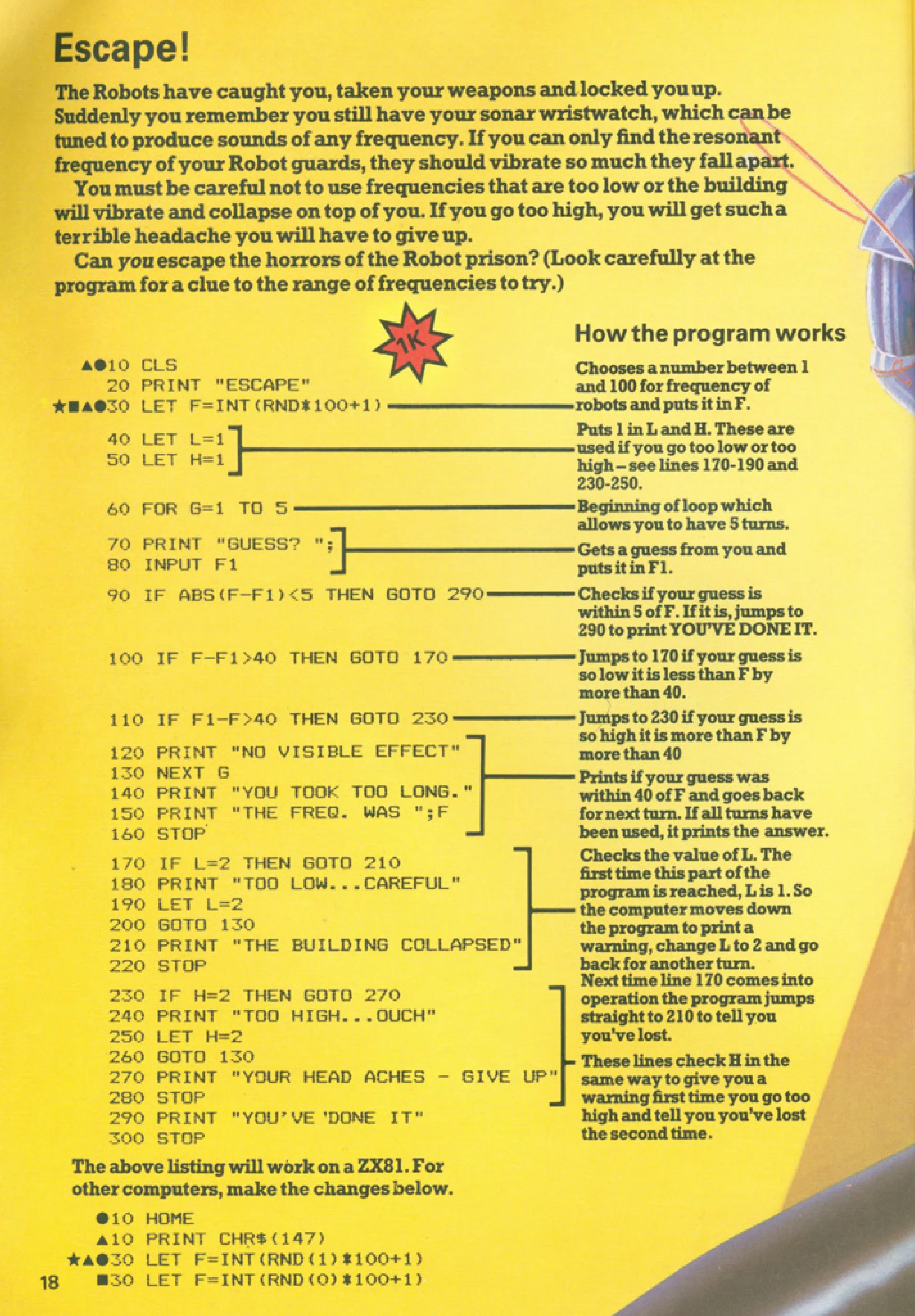
The Robots have captured you, taken your weapons, and locked you up. Suddenly, you remember that you still have your sonar wristwatch, which can produce sounds of any frequency. By discovering the resonant frequency of the Robot guards, you can cause them to vibrate and collapse.
However, you must avoid frequencies that are too low or too high, as they can collapse the building or give you a terrible headache. You only have five chances to guess the correct frequency and escape the horrors of the Robot prison.
Pseudocode
STARTPRINT "ESCAPE!"SET target frequency (F) to a random value between 1 and 100INITIALIZE variables L=1 and H=1 for warningsFOR 5 attempts:    PROMPT "GUESS?"    INPUT frequency guess (F1)
    IF absolute difference between F1 and F < 5 THEN        PRINT "YOU'VE DONE IT"        END GAME
    IF F1 > F THEN        IF F1 - F > 40 THEN            PRINT "TOO HIGH...OUCH"            IF H == 2 THEN                PRINT "YOUR HEAD ACHES - GIVE UP"                END GAME            END IF            SET H = 2        ELSE            PRINT "NO VISIBLE EFFECT"    END IF
    IF F1 < F THEN        IF F - F1 > 40 THEN            PRINT "TOO LOW...CAREFUL"            IF L == 2 THEN                PRINT "THE BUILDING COLLAPSED"                END GAME            END IF            SET L = 2        ELSE            PRINT "NO VISIBLE EFFECT"    END IF
PRINT "DISASTER - YOU FAILED"END
Flowchart
graph TD
    Start --> Display[Display 'ESCAPE!']
    Display --> InitTarget[Set random target frequency]
    InitTarget --> InitVariables[Initialize L and H for warnings]
    InitVariables --> Attempts[Loop for 5 attempts]
    Attempts --> GetInput[Prompt for frequency guess]
    GetInput --> CheckClose[Check if guess is within 5 of target]
    CheckClose -->|Yes| Success[Display 'YOU'VE DONE IT']
    CheckClose -->|No| CheckHigh[Check if guess is higher than target]
    CheckHigh -->|Yes| TooHigh[Check if guess is too high >40]
    TooHigh -->|Yes| WarnHeadache[Warn or End if H=2]
    TooHigh -->|No| FeedbackHigh[Display 'NO VISIBLE EFFECT']
    CheckHigh -->|No| CheckLow[Check if guess is lower than target]
    CheckLow -->|Yes| TooLow[Check if guess is too low >40]
    TooLow -->|Yes| WarnCollapse[Warn or End if L=2]
    TooLow -->|No| FeedbackLow[Display 'NO VISIBLE EFFECT']
    Attempts -->|Out of tries| Failure[Display 'DISASTER - YOU FAILED']
    Success --> End[End]
    Failure --> End
Code
Pages
ZX-81 BASIC
10 CLS20 PRINT "ESCAPE"30 LET F=INT(RND*100+1)40 LET L=150 LET H=160 FOR G=1 TO 570 PRINT "GUESS? ";80 INPUT F190 IF ABS(F-F1)<5 THEN GOTO 290100 IF F-F1>40 THEN GOTO 170110 IF F1-F>40 THEN GOTO 230120 PRINT "NO VISIBLE EFFECT"130 NEXT G140 PRINT "YOU TOOK TOO LONG"150 PRINT "THE FREQ. WAS ";F160 STOP170 IF L=2 THEN GOTO 210180 PRINT "TOO LOW...CAREFUL"190 LET L=2200 GOTO 130210 PRINT "THE BUILDING COLLAPSED"220 STOP230 IF H=2 THEN GOTO 270240 PRINT "TOO HIGH...OUCH"250 LET H=2260 GOTO 130270 PRINT "YOUR HEAD ACHES - GIVE UP"280 STOP290 PRINT "YOU'VE DONE IT"300 STOPC#
using System;
class Escape{    static void Main()    {        Console.WriteLine("ESCAPE!");        Random random = new Random();        int targetFrequency = random.Next(1, 101);        int lowWarning = 1, highWarning = 1;
        for (int attempts = 1; attempts <= 5; attempts++)        {            int playerGuess;            do            {                Console.Write("GUESS? ");            } while (!int.TryParse(Console.ReadLine(), out playerGuess));
            if (Math.Abs(targetFrequency - playerGuess) < 5)            {                Console.WriteLine("YOU'VE DONE IT");                return;            }
            if (playerGuess < targetFrequency)            {                if (targetFrequency - playerGuess > 40)                {                    if (lowWarning == 2)                    {                        Console.WriteLine("THE BUILDING COLLAPSED");                        return;                    }                    Console.WriteLine("TOO LOW...CAREFUL");                    lowWarning = 2;                }                else                {                    Console.WriteLine("NO VISIBLE EFFECT");                }            }            else            {                if (playerGuess - targetFrequency > 40)                {                    if (highWarning == 2)                    {                        Console.WriteLine("YOUR HEAD ACHES - GIVE UP");                        return;                    }                    Console.WriteLine("TOO HIGH...OUCH");                    highWarning = 2;                }                else                {                    Console.WriteLine("NO VISIBLE EFFECT");                }            }        }
        Console.WriteLine("DISASTER - YOU FAILED");        Console.WriteLine("THE FREQ. WAS {0}", targetFrequency);    }}
Python
import random
print("ESCAPE!")
frequency = random.randint(1, 100)low_warning = 1high_warning = 1
for attempt in range(5):    guess = int(input("GUESS? "))
    if abs(frequency - guess) < 5:        print("YOU'VE DONE IT")        break
    if guess < frequency:        if frequency - guess > 40:            if low_warning == 2:                print("THE BUILDING COLLAPSED")                break            print("TOO LOW...CAREFUL")            low_warning = 2        else:            print("NO VISIBLE EFFECT")    else:        if guess - frequency > 40:            if high_warning == 2:                print("YOUR HEAD ACHES - GIVE UP")                break            print("TOO HIGH...OUCH")            high_warning = 2        else:            print("NO VISIBLE EFFECT")else:    print("DISASTER - YOU FAILED")    print(f"THE FREQ. WAS {frequency}")
Java
import java.util.Scanner;import java.util.Random;
public class Escape {    public static void main(String[] args) {        System.out.println("ESCAPE!");
        Random random = new Random();        Scanner scanner = new Scanner(System.in);
        int frequency = random.nextInt(100) + 1;        int lowWarning = 1, highWarning = 1;
        for (int attempt = 1; attempt <= 5; attempt++) {            System.out.print("GUESS? ");            int guess = scanner.nextInt();
            if (Math.abs(frequency - guess) < 5) {                System.out.println("YOU'VE DONE IT");                return;            }
            if (guess < frequency) {                if (frequency - guess > 40) {                    if (lowWarning == 2) {                        System.out.println("THE BUILDING COLLAPSED");                        return;                    }                    System.out.println("TOO LOW...CAREFUL");                    lowWarning = 2;                } else {                    System.out.println("NO VISIBLE EFFECT");                }            } else {                if (guess - frequency > 40) {                    if (highWarning == 2) {                        System.out.println("YOUR HEAD ACHES - GIVE UP");                        return;                    }                    System.out.println("TOO HIGH...OUCH");                    highWarning = 2;                } else {                    System.out.println("NO VISIBLE EFFECT");                }            }        }
        System.out.println("DISASTER - YOU FAILED");        System.out.printf("THE FREQ. WAS %d\n", frequency);    }}
Go
package main
import (  "fmt"  "math"  "math/rand"  "time")
func main() {  fmt.Println("ESCAPE!")  rand.Seed(time.Now().UnixNano())  frequency := rand.Intn(100) + 1  lowWarning := 1  highWarning := 1
  for attempt := 0; attempt < 5; attempt++ {    var guess int    fmt.Print("GUESS? ")    fmt.Scan(&guess)
    if math.Abs(float64(frequency-guess)) < 5 {      fmt.Println("YOU'VE DONE IT")      return    }
    if guess < frequency {      if frequency-guess > 40 {        if lowWarning == 2 {          fmt.Println("THE BUILDING COLLAPSED")          return        }        fmt.Println("TOO LOW...CAREFUL")        lowWarning = 2      } else {        fmt.Println("NO VISIBLE EFFECT")      }    } else {      if guess-frequency > 40 {        if highWarning == 2 {          fmt.Println("YOUR HEAD ACHES - GIVE UP")          return        }        fmt.Println("TOO HIGH...OUCH")        highWarning = 2      } else {        fmt.Println("NO VISIBLE EFFECT")      }    }  }
  fmt.Println("DISASTER - YOU FAILED")  fmt.Printf("THE FREQ. WAS %d\n", frequency)}
C++
#include <iostream>#include <cmath>#include <cstdlib>#include <ctime>
using namespace std;
int main() {    cout << "ESCAPE!" << endl;    srand(time(0));
    int frequency = rand() % 100 + 1;    int lowWarning = 1, highWarning = 1;
    for (int attempt = 0; attempt < 5; attempt++) {        int guess;        cout << "GUESS? ";        cin >> guess;
        if (abs(frequency - guess) < 5) {            cout << "YOU'VE DONE IT" << endl;            return 0;        }
        if (guess < frequency) {            if (frequency - guess > 40) {                if (lowWarning == 2) {                    cout << "THE BUILDING COLLAPSED" << endl;                    return 0;                }                cout << "TOO LOW...CAREFUL" << endl;                lowWarning = 2;            } else {                cout << "NO VISIBLE EFFECT" << endl;            }        } else {            if (guess - frequency > 40) {                if (highWarning == 2) {                    cout << "YOUR HEAD ACHES - GIVE UP" << endl;                    return 0;                }                cout << "TOO HIGH...OUCH" << endl;                highWarning = 2;            } else {                cout << "NO VISIBLE EFFECT" << endl;            }        }    }
    cout << "DISASTER - YOU FAILED" << endl;    cout << "THE FREQ. WAS " << frequency << endl;    return 0;}
Explanation
In “Escape!” the player must guess the resonant frequency of the Robot guards to escape. The game gives feedback based on the player’s guess, warning them if the guess is too low or too high and within dangerous thresholds. The player has five attempts to guess the correct frequency.
Challenges
- Increase Difficulty: Reduce the number of attempts to three or lower.
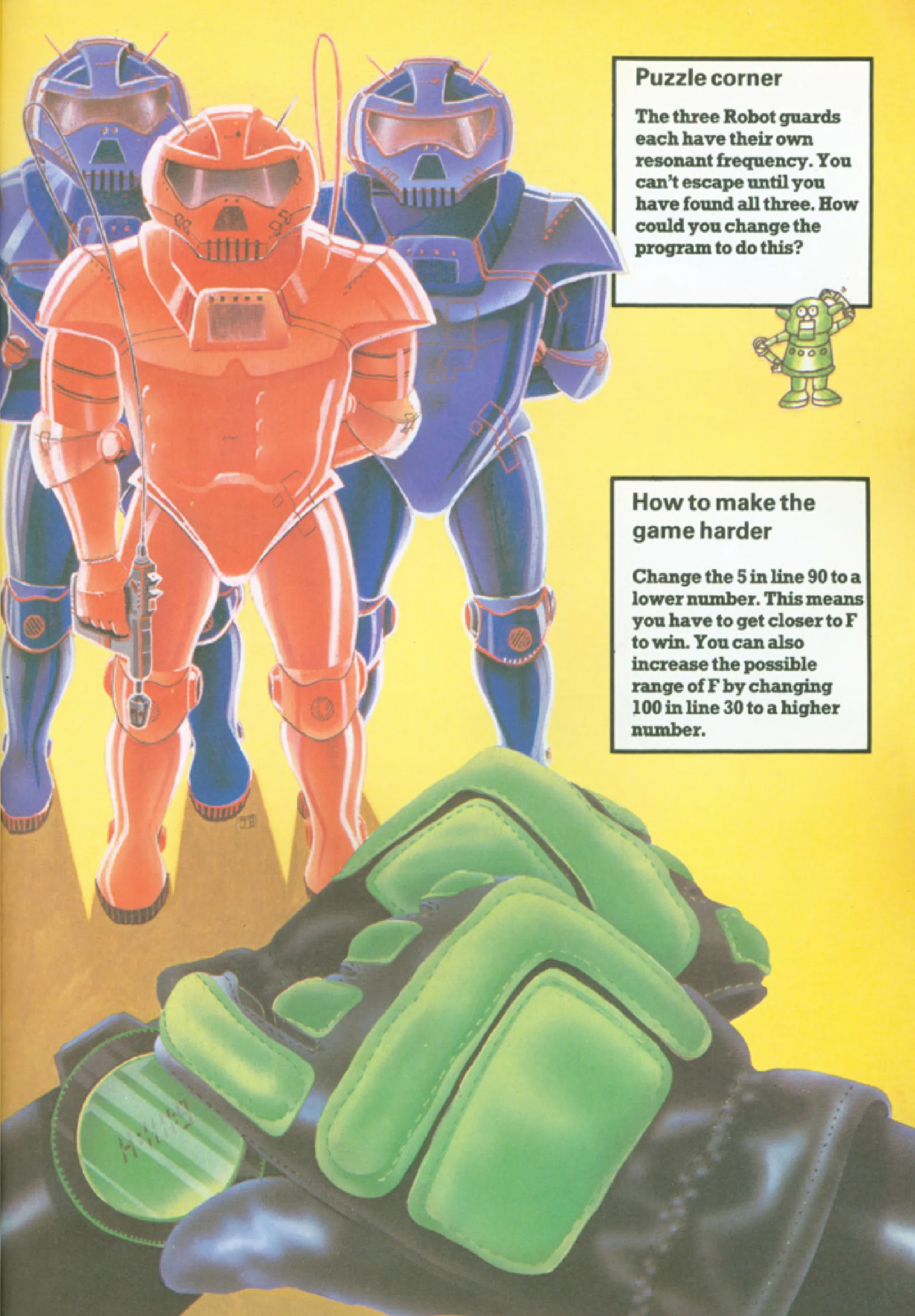
- Add Features: Introduce multiple robots with different frequencies to guess.
- Customize: Allow players to adjust the frequency range or number of attempts.
Copyright
These programs are adaptations of the original Usborne Computer Guides published in the 1980s. The books are free to download for personal or educational use from Usborne’s Computer and Coding Books. Programs and adaptations may not be used for commercial purposes.
Return to Computer Battlegames.