Shootout
Book: Computer Battlegames
Author: Usborne Publishing
Translator: Marcus Medina
Story
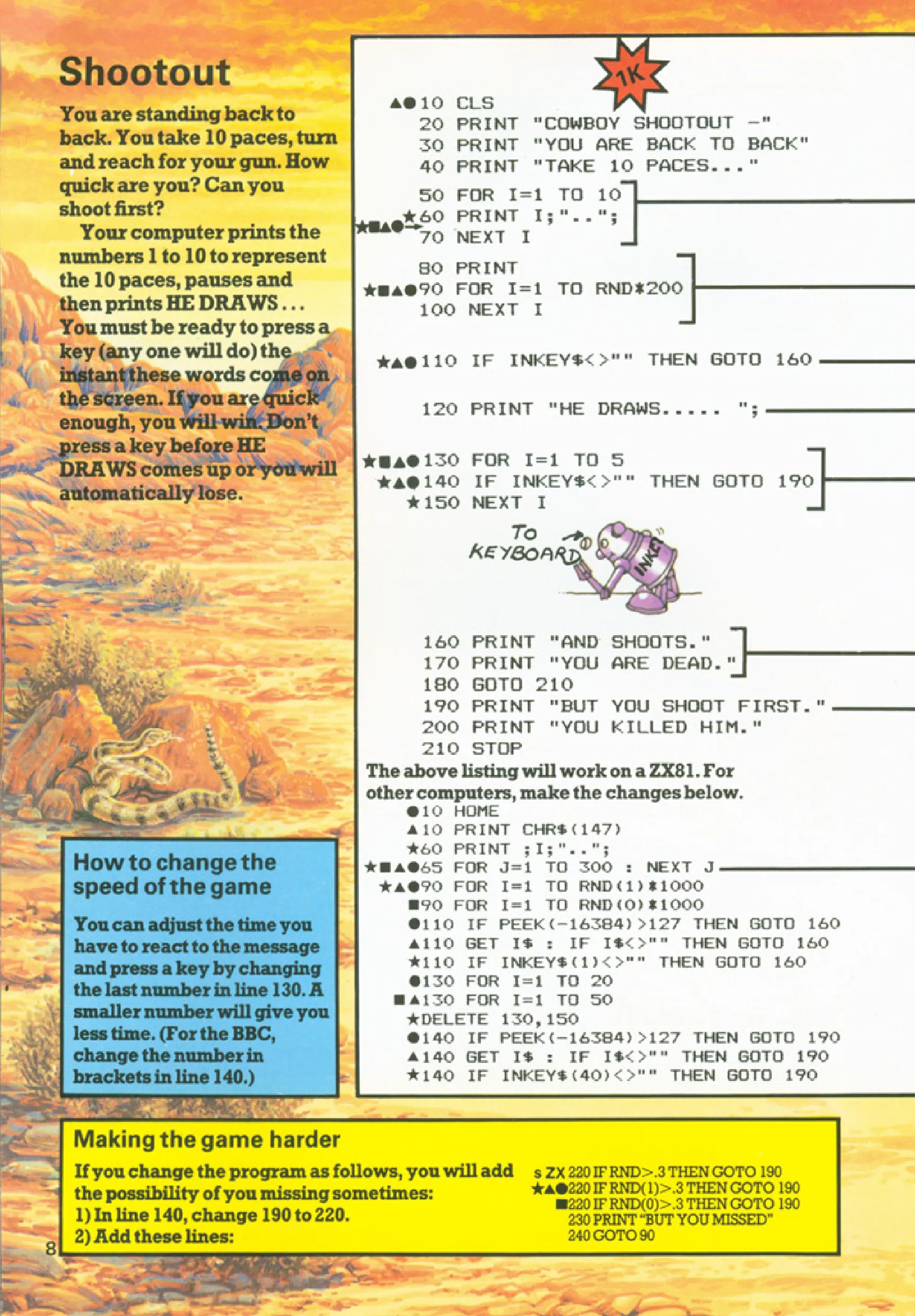
You are standing back to back with an opponent in the ultimate cowboy duel. You take 10 paces, turn, and reach for your gun. Can you shoot faster than your opponent? Or will you be too slow?
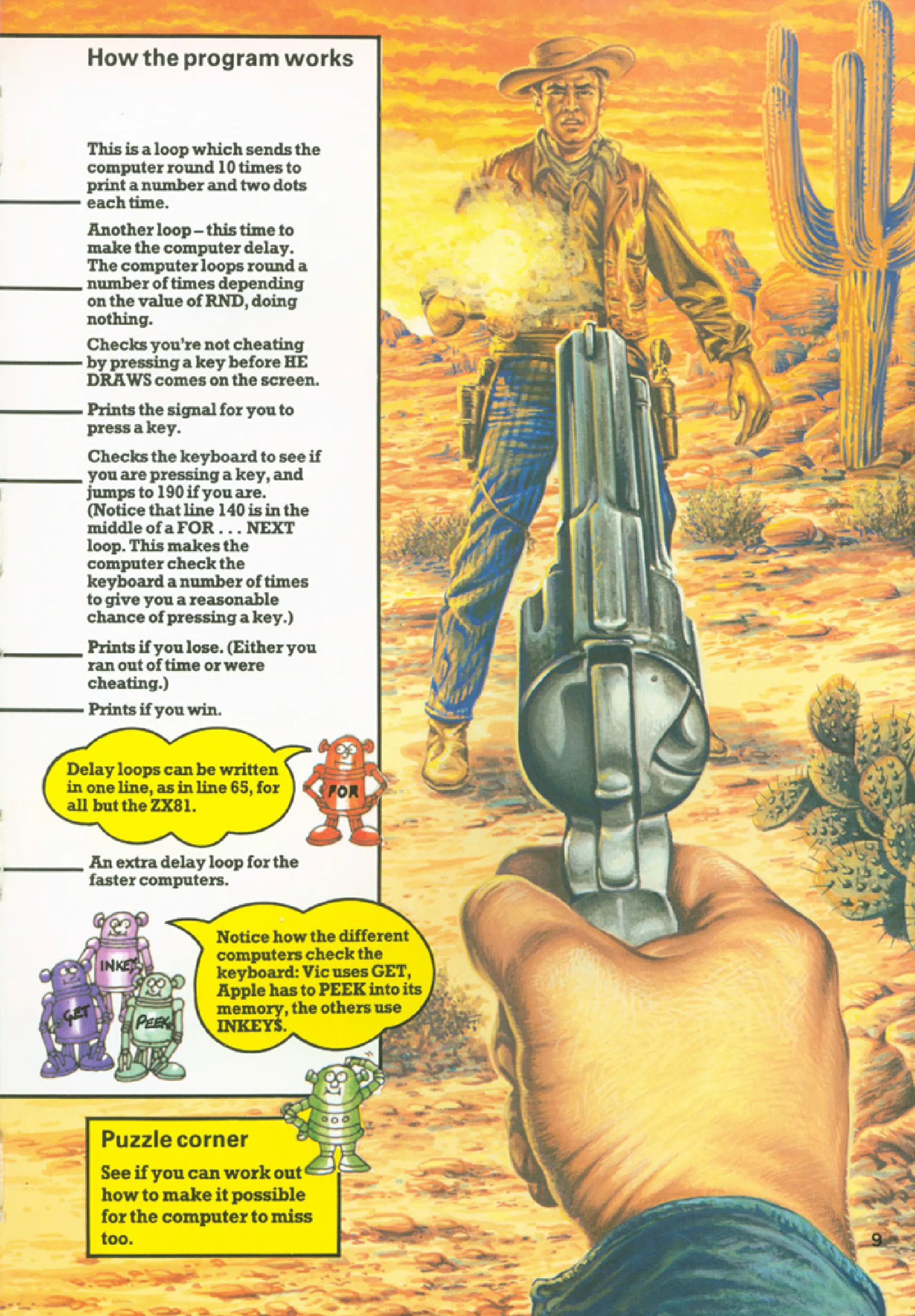
Your computer prints the numbers 1 to 10 to represent your 10 paces, pauses, and then prints “HE DRAWS…”. You must press any key the moment this appears. If you are quick enough, you win. But if you press too early or wait too long, you lose.
Pseudocode
STARTClear screenDisplay game title and instructionsPrint numbers 1 to 10 to simulate pacesPause for a random amount of timeIF key is pressed during pause THEN Display "Cheating! You lose." End gameENDIFDisplay "HE DRAWS...."Start timer to check for inputIF key is pressed quickly THEN Display "You shoot first. You win!" End gameELSE Display "You are too slow. You lose." End gameENDIFENDFlowchart
flowchart TD
    Start --> ClearScreen["Clear screen"]
    ClearScreen --> Title["Display game title and instructions"]
    Title --> Paces["Print numbers 1 to 10"]
    Paces --> Pause["Pause for random time"]
    Pause --> CheckEarly["Check if key pressed during pause"]
    CheckEarly -->|Yes| Cheating["Display 'Cheating! You lose.'"]
    Cheating --> End
    CheckEarly -->|No| Draws["Display 'HE DRAWS....'"]
    Draws --> Reaction["Check reaction time"]
    Reaction -->|Quick| Win["Display 'You shoot first. You win!'"]
    Reaction -->|Slow| Lose["Display 'You are too slow. You lose.'"]
    Win --> End
    Lose --> End
Code
Pages
ZX-81 BASIC
10 CLS20 PRINT "COWBOY SHOOTOUT -"30 PRINT "YOU ARE BACK TO BACK"40 PRINT "TAKE 10 PACES..."50 FOR I=1 TO 1060 PRINT I;"..";70 NEXT I80 PRINT90 FOR I=1 TO RND*200100 NEXT I110 IF INKEY$<>"" THEN GOTO 160120 PRINT "HE DRAWS..... ";130 FOR I=1 TO 5140 IF INKEY$<>"" THEN GOTO 190150 NEXT I160 PRINT "AND SHOOTS."170 PRINT "YOU ARE DEAD."180 GOTO 210190 PRINT "BUT YOU SHOOT FIRST."200 PRINT "YOU KILLED HIM."210 STOPC#
using System;using System.Threading;
class Program{    static void Main()    {        Console.Clear();        Console.WriteLine("COWBOY SHOOTOUT");        Console.WriteLine("YOU ARE BACK TO BACK");        Console.WriteLine("TAKE 10 PACES...");
        for (int i = 1; i <= 10; i++)        {            Console.Write(i + "  ");            Thread.Sleep(500); // Simulate pacing        }
        Random rand = new Random();        Thread.Sleep(rand.Next(1000, 3000)); // Random pause
        if (Console.KeyAvailable)        {            Console.WriteLine("\nCheating! You lose.");            return;        }
        Console.WriteLine("\nHE DRAWS....");
        DateTime startTime = DateTime.Now;        while (!Console.KeyAvailable)        {            if ((DateTime.Now - startTime).TotalMilliseconds > 2000)            {                Console.WriteLine("You are too slow. You lose.");                return;            }        }
        Console.ReadKey(true); // Clear the input buffer        Console.WriteLine("You shoot first. You win!");    }}
Python
import timeimport randomimport keyboard
def main():    print("COWBOY SHOOTOUT")    print("YOU ARE BACK TO BACK")    print("TAKE 10 PACES...")
    for i in range(1, 11):        print(i, end="  ", flush=True)        time.sleep(0.5)  # Simulate pacing
    time.sleep(random.uniform(1, 3))  # Random pause
    if keyboard.is_pressed('any'):  # Detect early input        print("\nCheating! You lose.")        return
    print("\nHE DRAWS....")    start_time = time.time()
    while not keyboard.is_pressed('any'):        if time.time() - start_time > 2:  # Too slow            print("You are too slow. You lose.")            return
    print("You shoot first. You win!")
if __name__ == "__main__":    main()
Java
import java.util.Scanner;import java.util.Random;
public class Shootout {    public static void main(String[] args) {        Scanner scanner = new Scanner(System.in);        Random random = new Random();
        System.out.println("COWBOY SHOOTOUT");        System.out.println("YOU ARE BACK TO BACK");        System.out.println("TAKE 10 PACES...");
        for (int i = 1; i <= 10; i++) {            System.out.print(i + "  ");            try {                Thread.sleep(500); // Simulate pacing            } catch (InterruptedException e) {                e.printStackTrace();            }        }
        try {            Thread.sleep(random.nextInt(2000) + 1000); // Random pause        } catch (InterruptedException e) {            e.printStackTrace();        }
        if (System.in.available() > 0) {            System.out.println("\nCheating! You lose.");            return;        }
        System.out.println("\nHE DRAWS....");        long startTime = System.currentTimeMillis();
        while (System.in.available() == 0) {            if (System.currentTimeMillis() - startTime > 2000) {                System.out.println("You are too slow. You lose.");                return;            }        }
        System.out.println("You shoot first. You win!");    }}
Go
package main
import (  "fmt"  "math/rand"  "time")
func main() {  rand.Seed(time.Now().UnixNano())  fmt.Println("COWBOY SHOOTOUT")  fmt.Println("YOU ARE BACK TO BACK")  fmt.Println("TAKE 10 PACES...")
  for i := 1; i <= 10; i++ {    fmt.Printf("%d  ", i)    time.Sleep(500 * time.Millisecond)  }
  time.Sleep(time.Duration(rand.Intn(2000)+1000) * time.Millisecond) // Random pause
  fmt.Println("\nHE DRAWS....")  start := time.Now()
  var input string  fmt.Scanln(&input)  elapsed := time.Since(start)
  if elapsed.Seconds() > 2 {    fmt.Println("You are too slow. You lose.")    return  }
  fmt.Println("You shoot first. You win!")}
C++
#include <iostream>#include <thread>#include <chrono>#include <cstdlib>#include <ctime>
int main() {    std::cout << "COWBOY SHOOTOUT" << std::endl;    std::cout << "YOU ARE BACK TO BACK" << std::endl;    std::cout << "TAKE 10 PACES..." << std::endl;
    for (int i = 1; i <= 10; i++) {        std::cout << i << "  ";        std::this_thread::sleep_for(std::chrono::milliseconds(500));    }
    srand(time(0));    std::this_thread::sleep_for(std::chrono::milliseconds(rand() % 2000 + 1000)); // Random pause
    std::cout << "\nHE DRAWS...." << std::endl;
    auto start = std::chrono::steady_clock::now();
    std::string input;    std::getline(std::cin, input);
    auto end = std::chrono::steady_clock::now();    auto elapsed = std::chrono::duration_cast<std::chrono::milliseconds>(end - start);
    if (elapsed.count() > 2000) {        std::cout << "You are too slow. You lose." << std::endl;    } else {        std::cout << "You shoot first. You win!" << std::endl;    }
    return 0;}
Explanation
- This game simulates a cowboy shootout by requiring quick reflexes from the player.
- The numbers 1 to 10 represent the paces before the duel.
- Random pauses create suspense and unpredictability.
- The game penalizes players for reacting too early (cheating).
- If the player reacts quickly enough after “HE DRAWS…” is displayed, they win. Otherwise, they lose.
Challenges
- Increase Difficulty:
- Reduce the reaction time window from 2 seconds to 1 second.
- Add distractions during the pacing phase.
- Add Features:
- Allow for multiplayer mode where two players compete.
- Introduce a scoring system based on reaction times.
- Customize:
- Add difficulty levels with varying random pause durations.
- Include sound effects for added immersion.
Copyright
These programs are adaptations of the original Usborne Computer Guides published in the 1980s. The books are free to download for personal or educational use from Usborne’s Computer and Coding Books. Programs and adaptations may not be used for commercial purposes.
Return to Computer Battlegames.