Moonlander
Book: Computer Spacegames
Author: Usborne Publishing
Translator: Marcus Medina
Story
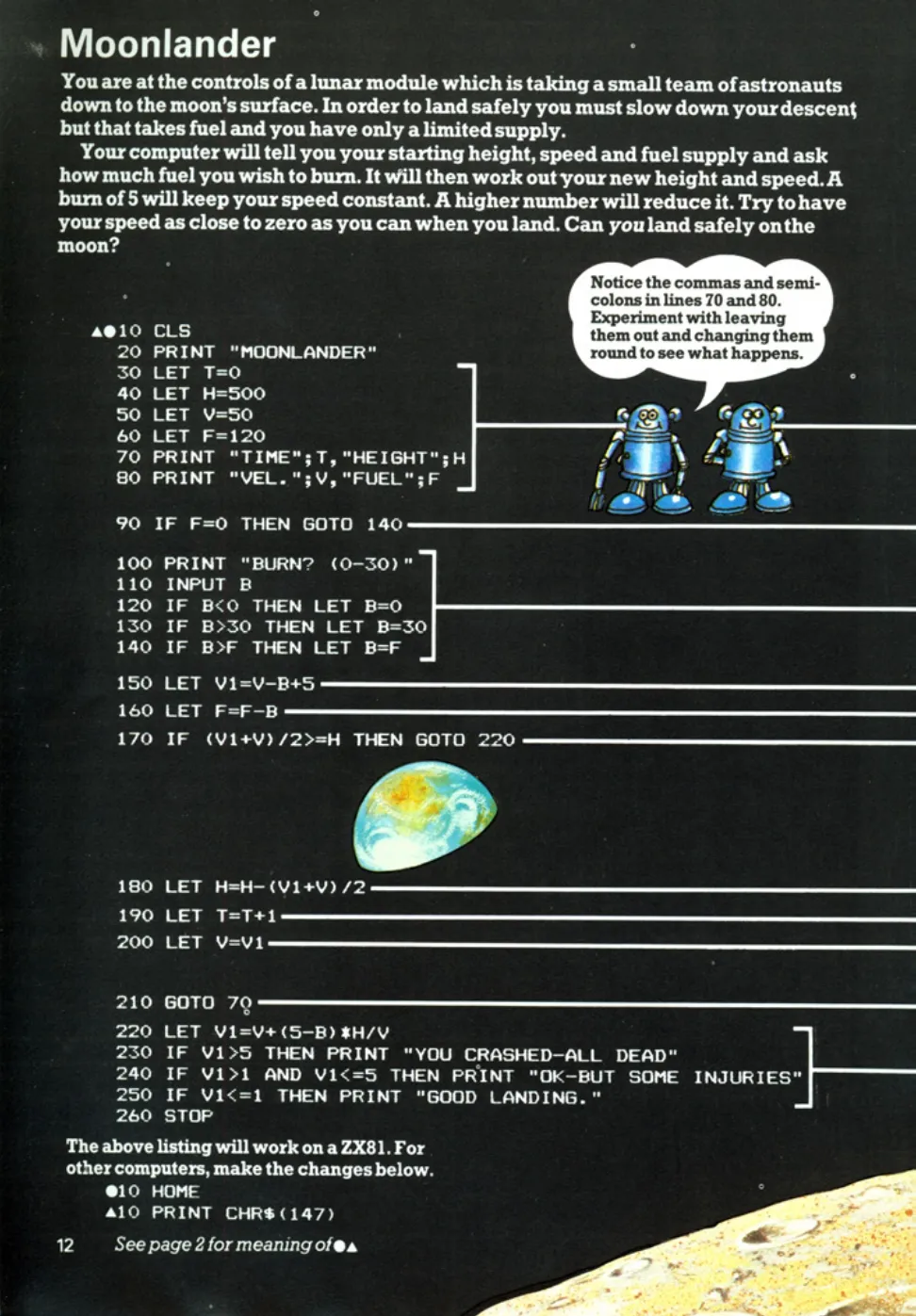
You are at the controls of a lunar module that is taking a small team of astronauts down to the moon’s surface. In order to land safely, you must slow down your descent, but that takes fuel, and you have only a limited supply.
Your computer will tell you your starting height, speed, and fuel supply and ask how much fuel you wish to burn. It will then calculate your new height and speed. A burn of 5 will keep your speed constant, while a higher number will reduce it. Try to have your speed as close to zero as you can when you land. Can you land safely on the moon?
Pseudocode
START INITIALIZE time, height, velocity, fuel WHILE fuel > 0 AND height > 0 DISPLAY time, height, velocity, fuel PROMPT player for burn amount VALIDATE burn amount CALCULATE new velocity UPDATE height and fuel CHECK if height is zero IF TRUE THEN DETERMINE landing outcome END WHILE PRINT landing resultENDFlowchart
flowchart TD
    Start[Start] --> InitValues["Initialize time, height, velocity, fuel"]
    InitValues --> WhileLoop["While fuel > 0 AND height > 0"]
    WhileLoop --> DisplayStatus["Display time, height, velocity, fuel"]
    DisplayStatus --> GetBurn["Prompt player for burn amount"]
    GetBurn --> ValidateBurn["Validate burn amount"]
    ValidateBurn --> CalcVelocity["Calculate new velocity"]
    CalcVelocity --> UpdateStatus["Update height and fuel"]
    UpdateStatus --> CheckHeight["Check if height = 0"]
    CheckHeight -->|Yes| LandingOutcome["Determine landing outcome"]
    CheckHeight -->|No| WhileLoop
    LandingOutcome --> End[End]
Code
Pages
ZX-81 BASIC
10 CLS20 PRINT "MOONLANDER"30 LET T=040 LET H=50050 LET V=12060 LET F=12070 PRINT "TIME";T,"HEIGHT";H80 PRINT "VEL.";V,"FUEL";F90 IF F=0 THEN GOTO 140100 PRINT "BURN? (0-30)"110 INPUT B120 IF B<0 THEN LET B=0130 IF B>30 THEN LET B=30140 IF B>F THEN LET B=F150 LET V1=V+(5-B)160 LET F=F-B170 IF (V1+V)/2>=H THEN GOTO 220180 LET H=H-(V1+V)/2190 LET T=T+1200 LET V=V1210 GOTO 70220 LET V1=V+(5-B)230 IF V1>5 THEN PRINT "YOU CRASHED-ALL DEAD"240 IF V1>1 AND V1<=5 THEN PRINT "OK-BUT SOME INJURIES"250 IF V1<=1 THEN PRINT "GOOD LANDING."260 STOPC#
using System;
class Moonlander{    static void Main()    {        int time = 0, height = 500, velocity = 120, fuel = 120;        Console.WriteLine("MOONLANDER");
        while (fuel > 0 && height > 0)        {            Console.WriteLine($"TIME: {time} HEIGHT: {height} VEL.: {velocity} FUEL: {fuel}");
            int burn;            do            {                Console.Write("BURN? (0-30): ");            } while (!int.TryParse(Console.ReadLine(), out burn));
            if (burn < 0) burn = 0;            if (burn > 30) burn = 30;            if (burn > fuel) burn = fuel;
            int newVelocity = velocity + (5 - burn);            fuel -= burn;
            if ((velocity + newVelocity) / 2 >= height)            {                if (newVelocity > 5)                    Console.WriteLine("YOU CRASHED-ALL DEAD");                else if (newVelocity > 1)                    Console.WriteLine("OK-BUT SOME INJURIES");                else                    Console.WriteLine("GOOD LANDING.");                return;            }
            height -= (velocity + newVelocity) / 2;            velocity = newVelocity;            time++;        }
        Console.WriteLine("OUT OF FUEL. CRASH!");    }}
Python
def main():    time, height, velocity, fuel = 0, 500, 120, 120    print("MOONLANDER")
    while fuel > 0 and height > 0:        print(f"TIME: {time} HEIGHT: {height} VEL.: {velocity} FUEL: {fuel}")        burn = int(input("BURN? (0-30): "))
        burn = max(0, min(30, burn))        if burn > fuel:            burn = fuel
        new_velocity = velocity + (5 - burn)        fuel -= burn
        if (velocity + new_velocity) / 2 >= height:            if new_velocity > 5:                print("YOU CRASHED-ALL DEAD")            elif new_velocity > 1:                print("OK-BUT SOME INJURIES")            else:                print("GOOD LANDING.")            return
        height -= (velocity + new_velocity) / 2        velocity = new_velocity        time += 1
    print("OUT OF FUEL. CRASH!")
if __name__ == "__main__":    main()
Java
import java.util.Scanner;
public class Moonlander {    public static void main(String[] args) {        Scanner scanner = new Scanner(System.in);        int time = 0, height = 500, velocity = 120, fuel = 120;        System.out.println("MOONLANDER");
        while (fuel > 0 && height > 0) {            System.out.printf("TIME: %d HEIGHT: %d VEL.: %d FUEL: %d\n", time, height, velocity, fuel);            System.out.print("BURN? (0-30): ");            int burn = scanner.nextInt();
            burn = Math.max(0, Math.min(30, burn));            if (burn > fuel) burn = fuel;
            int newVelocity = velocity + (5 - burn);            fuel -= burn;
            if ((velocity + newVelocity) / 2 >= height) {                if (newVelocity > 5)                    System.out.println("YOU CRASHED-ALL DEAD");                else if (newVelocity > 1)                    System.out.println("OK-BUT SOME INJURIES");                else                    System.out.println("GOOD LANDING.");                return;            }
            height -= (velocity + newVelocity) / 2;            velocity = newVelocity;            time++;        }
        System.out.println("OUT OF FUEL. CRASH!");    }}
Go
package main
import (  "fmt"  "math")
func main() {  time, height, velocity, fuel := 0, 500, 120, 120  fmt.Println("MOONLANDER")
  for fuel > 0 && height > 0 {    fmt.Printf("TIME: %d HEIGHT: %d VEL.: %d FUEL: %d\n", time, height, velocity, fuel)    var burn int    fmt.Print("BURN? (0-30): ")    fmt.Scan(&burn)
    burn = int(math.Max(0, math.Min(30, float64(burn))))    if burn > fuel {      burn = fuel    }
    newVelocity := velocity + (5 - burn)    fuel -= burn
    if (velocity+newVelocity)/2 >= height {      if newVelocity > 5 {        fmt.Println("YOU CRASHED-ALL DEAD")      } else if newVelocity > 1 {        fmt.Println("OK-BUT SOME INJURIES")      } else {        fmt.Println("GOOD LANDING.")      }      return    }
    height -= (velocity + newVelocity) / 2    velocity = newVelocity    time++  }
  fmt.Println("OUT OF FUEL. CRASH!")}
C++
#include <iostream>#include <algorithm>
using namespace std;
int main() {    int time = 0, height = 500, velocity = 120, fuel = 120;    cout << "MOONLANDER" << endl;
    while (fuel > 0 && height > 0) {        cout << "TIME: " << time << " HEIGHT: " << height << " VEL.: " << velocity << " FUEL: " << fuel << endl;        int burn;        cout << "BURN? (0-30): ";        cin >> burn;
        burn = max(0, min(30, burn));        if (burn > fuel) burn = fuel;
        int newVelocity = velocity + (5 - burn);        fuel -= burn;
        if ((velocity + newVelocity) / 2 >= height) {            if (newVelocity > 5)                cout << "YOU CRASHED-ALL DEAD" << endl;            else if (newVelocity > 1)                cout << "OK-BUT SOME INJURIES" << endl;            else                cout << "GOOD LANDING." << endl;            return 0;        }
        height -= (velocity + newVelocity) / 2;        velocity = newVelocity;        time++;    }
    cout << "OUT OF FUEL. CRASH!" << endl;    return 0;}
Explanation
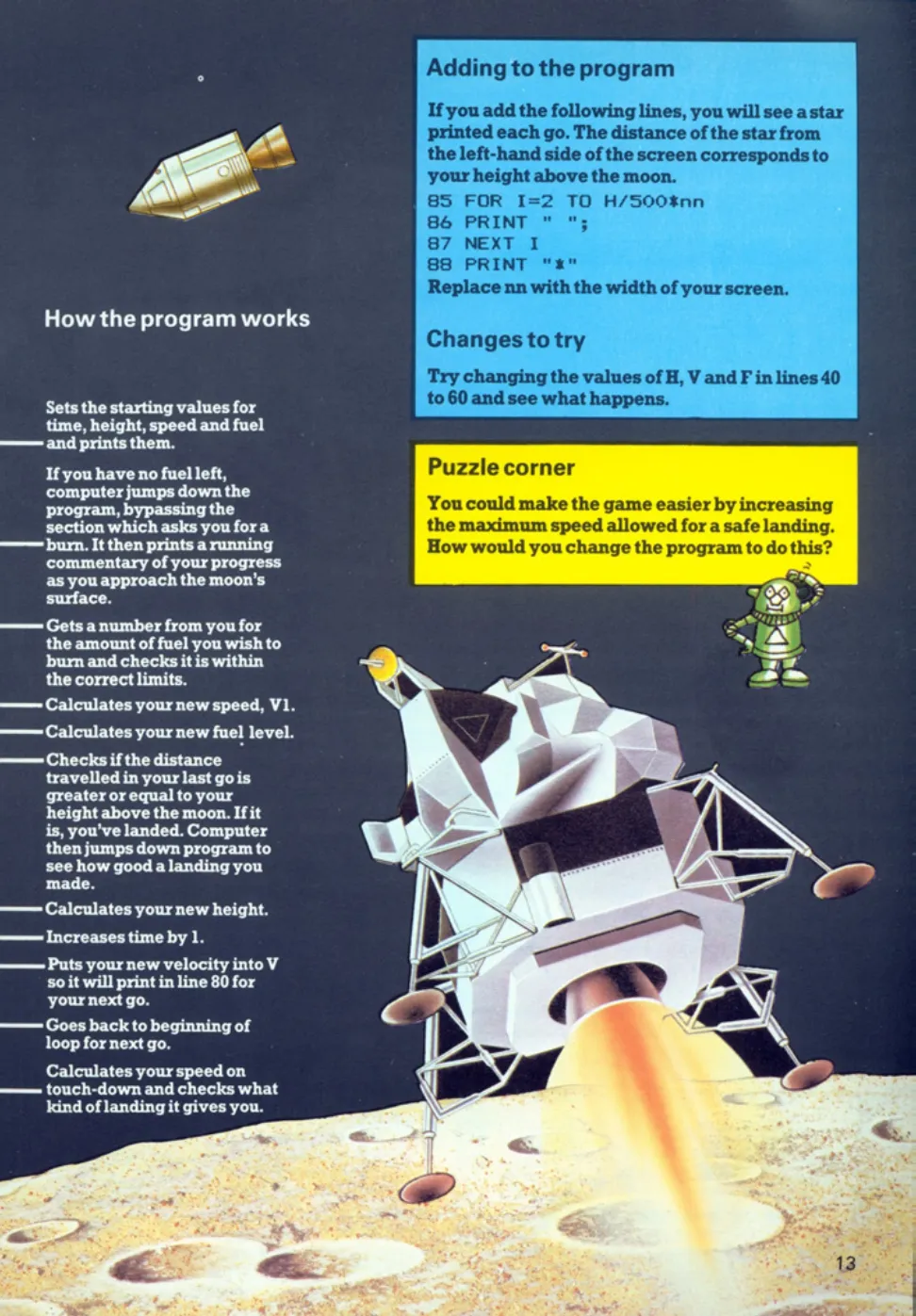
In Moonlander, the player must control the descent of a lunar module by managing its fuel and velocity. Each turn, the player specifies how much fuel to burn, which impacts the velocity and the descent. The goal is to land with a velocity close to zero. If the velocity is too high, the module will crash.
Challenges
- Fuel Limit: Experiment with reducing or increasing the initial fuel supply to adjust difficulty.
- Velocity Tolerance: Change the thresholds for a safe landing.
- Height Variation: Start from a different initial height to make the game easier or harder.
Copyright
These programs are adaptations of the original Usborne Computer Guides published in the 1980s. The books are free to download for personal or educational use from Usborne’s Computer and Coding Books. Programs and adaptations may not be used for commercial purposes.
Return to Computer Spacegames.