Robospy
Book: Computer Spy Games
Author: Jenny Tyler and Chris Oxlade
Translator: Marcus Medina
Story
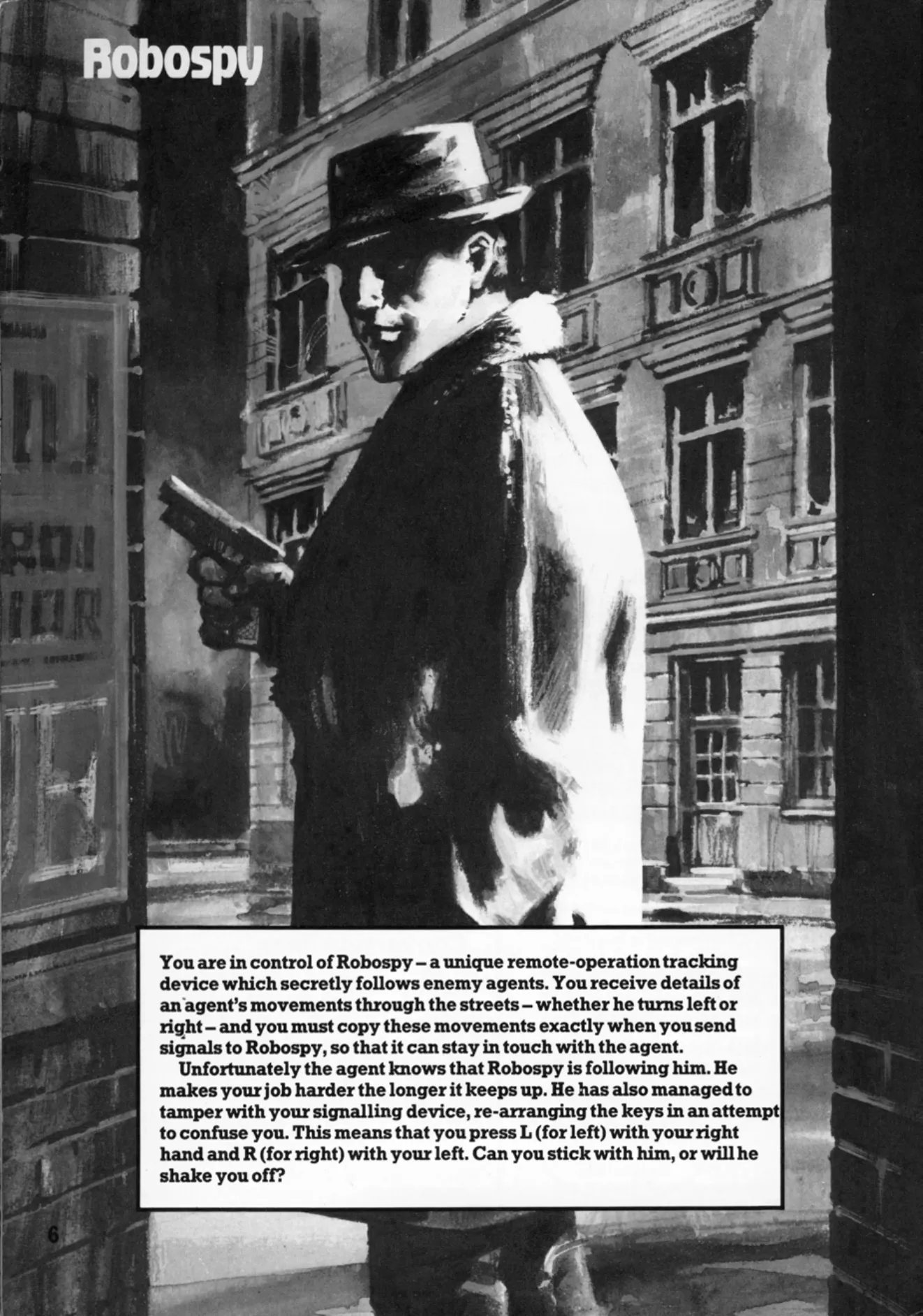
You are in control of Robospy — a unique remote-operation tracking device which secretly follows enemy agents. You receive details of an agent’s movements through the streets — whether he turns left or right — and you must copy these movements exactly when you send signals to Robospy, so that it can stay in touch with the agent.
Unfortunately the agent knows that Robospy is following him. He makes your job harder the longer it keeps up. He has also managed to tamper with your signalling device, re-arranging the keys in an attempt to confuse you. This means that you press L (for left) with your right hand and R (for right) with your left. Can you stick with him, or will he shake you off?
Pseudocode
SET high_score = 0LOOP forever SET score = 0, sequence_length = 1, rounds_since_increase = 0 LOOP until mistake IF 5 rounds have passed at this length THEN increase sequence_length GENERATE random sequence of Left/Right of current length DISPLAY the sequence ASK player to repeat the directions, one at a time IF any direction wrong THEN PRINT "YOU LOST HIM! SOME SPY!" mark mistake ELSE ADD sequence_length to score IF score > high_score THEN update high_score END IF PRINT score and high score END LOOPEND LOOPFlowchart
flowchart TD
    Start --> Init[Set high score to 0]
    Init --> NewGame[Reset score, length 1]
    NewGame --> Grow{5 rounds at this length?}
    Grow -->|Yes| Longer[Increase sequence length]
    Grow -->|No| Gen
    Longer --> Gen[Generate random Left/Right sequence]
    Gen --> Show[Display the sequence]
    Show --> Ask[Ask player to repeat it]
    Ask --> Check{All correct?}
    Check -->|Yes| Add[Add length to score, update high score]
    Add --> NewGame
    Check -->|No| Lost["Print: YOU LOST HIM! SOME SPY!"]
    Lost --> Scores[Show score and high score]
    Scores --> NewGame
Code
Pages
ZX-81 BASIC
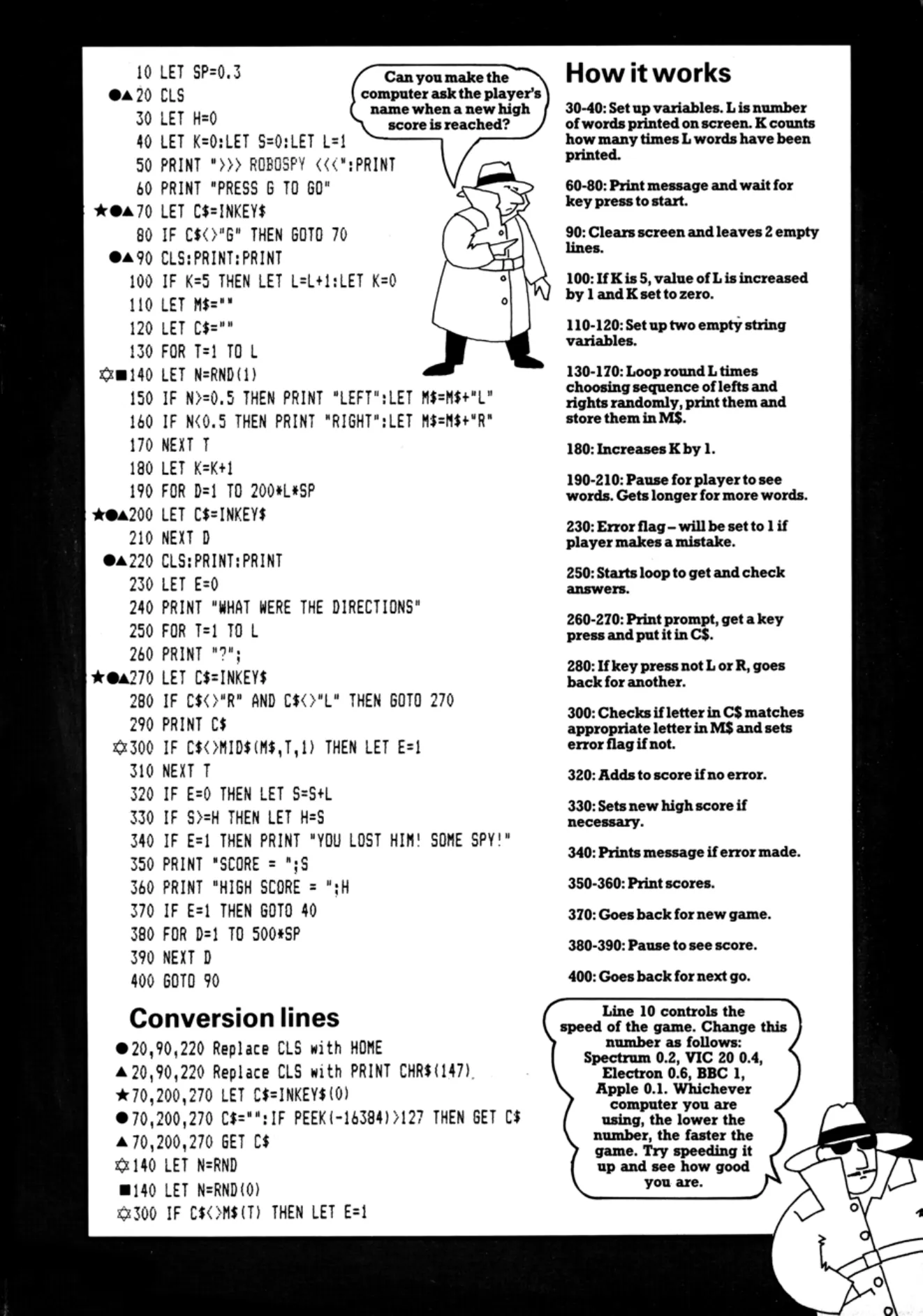
10 LET SP=0.320 CLS30 LET H=040 LET K=0:LET S=0:LET L=150 PRINT ">>> ROBOSPY <<<":PRINT60 PRINT "PRESS G TO GO"70 LET C$=INKEY$80 IF C$<>"G" THEN GOTO 7090 CLS:PRINT:PRINT100 IF K=5 THEN LET L=L+1:LET K=0110 LET M$=""120 LET C$=""130 FOR T=1 TO L140 LET N=RND(1)150 IF N>=0.5 THEN PRINT "LEFT":LET M$=M$+"L"160 IF N<0.5 THEN PRINT "RIGHT":LET M$=M$+"R"170 NEXT T180 LET K=K+1190 FOR D=1 TO 200*L*SP200 LET C$=INKEY$210 NEXT D220 CLS:PRINT:PRINT230 LET E=0240 PRINT "WHAT WERE THE DIRECTIONS"250 FOR T=1 TO L260 PRINT "?";270 LET C$=INKEY$280 IF C$<>"R" AND C$<>"L" THEN GOTO 270290 PRINT C$300 IF C$<>MID$(M$,T,1) THEN LET E=1310 NEXT T320 IF E=0 THEN LET S=S+L330 IF S>=H THEN LET H=S340 IF E=1 THEN PRINT "YOU LOST HIM! SOME SPY!"350 PRINT "SCORE = ";S360 PRINT "HIGH SCORE = ";H370 IF E=1 THEN GOTO 40380 FOR D=1 TO 500*SP390 NEXT D400 GOTO 90C#
using System;
class Robospy{    static Random rnd = new Random();
    static void Main()    {        int high = 0;
        while (true)        {            int score = 0, length = 1, roundsAtLength = 0;            bool mistake = false;
            while (!mistake)            {                if (roundsAtLength == 5) { length++; roundsAtLength = 0; }
                string sequence = "";                Console.WriteLine("Watch the agent:");                for (int t = 0; t < length; t++)                {                    bool left = rnd.NextDouble() >= 0.5;                    Console.WriteLine(left ? "LEFT" : "RIGHT");                    sequence += left ? "L" : "R";                }                roundsAtLength++;
                Console.WriteLine("\nWhat were the directions?");                bool error = false;                for (int t = 0; t < length; t++)                {                    Console.Write("? ");                    string input = Console.ReadLine()?.Trim().ToUpper();                    if (input == null) return;                    char c = input.Length > 0 ? input[0] : ' ';                    if (c != 'L' && c != 'R') { t--; continue; }                    if (c != sequence[t]) error = true;                }
                if (!error) score += length;                if (score >= high) high = score;
                if (error)                {                    Console.WriteLine("YOU LOST HIM! SOME SPY!");                    mistake = true;                }                Console.WriteLine($"SCORE = {score}");                Console.WriteLine($"HIGH SCORE = {high}");            }        }    }}
Python
import random
def robospy():    high = 0
    while True:        score = 0        length = 1        rounds_at_length = 0        mistake = False
        while not mistake:            if rounds_at_length == 5:                length += 1                rounds_at_length = 0
            sequence = ""            print("Watch the agent:")            for _ in range(length):                left = random.random() >= 0.5                print("LEFT" if left else "RIGHT")                sequence += "L" if left else "R"            rounds_at_length += 1
            print("\nWhat were the directions?")            error = False            t = 0            while t < length:                c = input("? ").strip().upper()                c = c[0] if c else ""                if c not in ("L", "R"):                    continue                if c != sequence[t]:                    error = True                t += 1
            if not error:                score += length            if score >= high:                high = score
            if error:                print("YOU LOST HIM! SOME SPY!")                mistake = True            print(f"SCORE = {score}")            print(f"HIGH SCORE = {high}")
if __name__ == "__main__":    robospy()
Java
import java.util.Random;import java.util.Scanner;
public class Robospy {    static Random rnd = new Random();    static Scanner scanner = new Scanner(System.in);
    public static void main(String[] args) {        int high = 0;
        while (true) {            int score = 0, length = 1, roundsAtLength = 0;            boolean mistake = false;
            while (!mistake) {                if (roundsAtLength == 5) { length++; roundsAtLength = 0; }
                StringBuilder sequence = new StringBuilder();                System.out.println("Watch the agent:");                for (int t = 0; t < length; t++) {                    boolean left = rnd.nextDouble() >= 0.5;                    System.out.println(left ? "LEFT" : "RIGHT");                    sequence.append(left ? 'L' : 'R');                }                roundsAtLength++;
                System.out.println("\nWhat were the directions?");                boolean error = false;                int t = 0;                while (t < length) {                    System.out.print("? ");                    if (!scanner.hasNextLine()) return;                    String input = scanner.nextLine().trim().toUpperCase();                    char c = input.isEmpty() ? ' ' : input.charAt(0);                    if (c != 'L' && c != 'R') continue;                    if (c != sequence.charAt(t)) error = true;                    t++;                }
                if (!error) score += length;                if (score >= high) high = score;
                if (error) {                    System.out.println("YOU LOST HIM! SOME SPY!");                    mistake = true;                }                System.out.println("SCORE = " + score);                System.out.println("HIGH SCORE = " + high);            }        }    }}
Go
package main
import (  "bufio"  "fmt"  "math/rand"  "os"  "strings"  "time")
func main() {  rand.Seed(time.Now().UnixNano())  reader := bufio.NewReader(os.Stdin)  high := 0
  for {    score, length, roundsAtLength := 0, 1, 0    mistake := false
    for !mistake {      if roundsAtLength == 5 {        length++        roundsAtLength = 0      }
      var sequence strings.Builder      fmt.Println("Watch the agent:")      for t := 0; t < length; t++ {        left := rand.Float64() >= 0.5        if left {          fmt.Println("LEFT")          sequence.WriteByte('L')        } else {          fmt.Println("RIGHT")          sequence.WriteByte('R')        }      }      roundsAtLength++      seq := sequence.String()
      fmt.Println("\nWhat were the directions?")      error := false      t := 0      for t < length {        fmt.Print("? ")        line, err := reader.ReadString('\n')        if err != nil {          return        }        input := strings.ToUpper(strings.TrimSpace(line))        if input == "" {          continue        }        c := input[0]        if c != 'L' && c != 'R' {          continue        }        if c != seq[t] {          error = true        }        t++      }
      if !error {        score += length      }      if score >= high {        high = score      }
      if error {        fmt.Println("YOU LOST HIM! SOME SPY!")        mistake = true      }      fmt.Printf("SCORE = %d\n", score)      fmt.Printf("HIGH SCORE = %d\n", high)    }  }}
C++
#include <iostream>#include <string>#include <cstdlib>#include <ctime>#include <algorithm>
int main() {    srand(time(0));    int high = 0;
    while (true) {        int score = 0, length = 1, roundsAtLength = 0;        bool mistake = false;
        while (!mistake) {            if (roundsAtLength == 5) { length++; roundsAtLength = 0; }
            std::string sequence;            std::cout << "Watch the agent:" << std::endl;            for (int t = 0; t < length; t++) {                bool left = (rand() % 2) == 0;                std::cout << (left ? "LEFT" : "RIGHT") << std::endl;                sequence += left ? 'L' : 'R';            }            roundsAtLength++;
            std::cout << "\nWhat were the directions?" << std::endl;            bool error = false;            int t = 0;            while (t < length) {                std::cout << "? ";                std::string input;                if (!std::getline(std::cin, input)) return 0;                std::transform(input.begin(), input.end(), input.begin(), ::toupper);                if (input.empty()) continue;                char c = input[0];                if (c != 'L' && c != 'R') continue;                if (c != sequence[t]) error = true;                t++;            }
            if (!error) score += length;            if (score >= high) high = score;
            if (error) {                std::cout << "YOU LOST HIM! SOME SPY!" << std::endl;                mistake = true;            }            std::cout << "SCORE = " << score << std::endl;            std::cout << "HIGH SCORE = " << high << std::endl;        }    }}
Explanation
The agent turns left or right a number of times, and you must watch and repeat his exact sequence of turns. Every five successful rounds, the sequence grows by one step. One wrong direction and you lose him — but your best run is kept as a high score for the rest of the session.
Challenges
- Name the high score: Ask for the player’s name when a new high score is reached, as the book itself suggests.
- Speed control: Make the reveal speed increase as the sequence grows.
- Two agents: Track two independent sequences at once.
Copyright
These programs are adaptations of the original Usborne Computer Guides published in the 1980s. The books are free to download for personal or educational use from Usborne’s Computer and Coding Books. Programs and adaptations may not be used for commercial purposes.
Return to Computer Spy Games.