Intergalactic Games
Book: Computer Spacegames
Author: Usborne Publishing
Translator: Marcus Medina
Story
You are the engineer in charge of launching a satellite into orbit for New Century TV during the First Intergalactic Games. The crucial decisions about the angle and speed of the rocket rest entirely on your shoulders. Can you successfully place the satellite into orbit?
Pseudocode
START PRINT game title "INTERGALACTIC GAMES" GENERATE random height (H) for the satellite (1 to 100) DISPLAY the target height for the satellite LOOP for 8 attempts INPUT angle (A) INPUT speed (V) CALCULATE deviation from correct angle (A) CALCULATE deviation from correct speed (V) IF deviations within acceptable limits THEN PRINT success message EXIT loop ELSE PROVIDE feedback on errors END LOOP PRINT failure message if unsuccessfulENDFlowchart
flowchart TD
    Start[Start] --> PrintTitle["Print 'INTERGALACTIC GAMES'"]
    PrintTitle --> RandomHeight["Generate random height (H)"]
    RandomHeight --> PrintHeight["Print target height"]
    PrintHeight --> AttemptsLoop["For 1 to 8 attempts"]
    AttemptsLoop --> InputAngle["Input angle (A)"]
    InputAngle --> InputSpeed["Input speed (V)"]
    InputSpeed --> CalculateAngle["Calculate angle deviation"]
    CalculateAngle --> CalculateSpeed["Calculate speed deviation"]
    CalculateSpeed --> CheckSuccess["Are deviations within limits?"]
    CheckSuccess -->|Yes| Success["Print success and exit"]
    CheckSuccess -->|No| Feedback["Provide feedback"]
    Feedback --> AttemptsLoop
    AttemptsLoop -->|After 8 Attempts| Failure["Print failure"]
    Success --> End["End"]
    Failure --> End
Code
Pages
ZX-81 BASIC
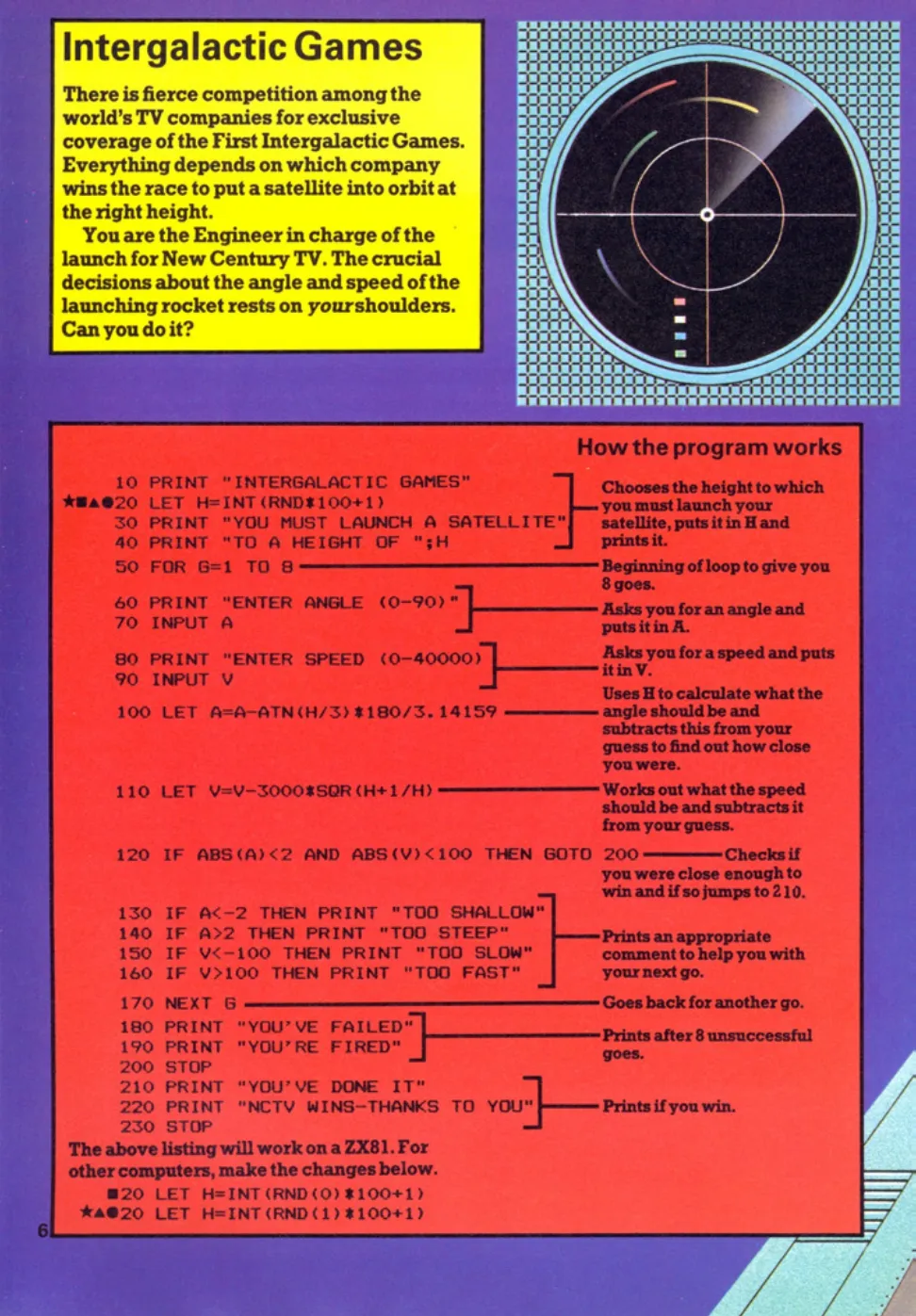
10 PRINT "INTERGALACTIC GAMES"20 LET H=INT(RND*100+1)30 PRINT "YOU MUST LAUNCH A SATELLITE"40 PRINT "TO A HEIGHT OF ";H50 FOR G=1 TO 860 PRINT "ENTER ANGLE (0-90)";70 INPUT A80 PRINT "ENTER SPEED (0-40000)";90 INPUT V100 LET A=A-ATN(H/3)*180/3.14159110 LET V=V-3000*SQR(H+1/H)120 IF ABS(A)<2 AND ABS(V)<100 THEN GOTO 200130 IF A<-2 THEN PRINT "TOO SHALLOW"140 IF A>2 THEN PRINT "TOO STEEP"150 IF V<-100 THEN PRINT "TOO SLOW"160 IF V>100 THEN PRINT "TOO FAST"170 NEXT G180 PRINT "YOU'VE FAILED"190 PRINT "YOU'RE FIRED"200 PRINT "YOU'VE DONE IT"210 PRINT "NCTV WINS-THANKS TO YOU"220 STOPC#
using System;
class IntergalacticGames{    static void Main()    {        Random rnd = new Random();        int height = rnd.Next(1, 101); // Random height between 1 and 100
        Console.WriteLine("INTERGALACTIC GAMES");        Console.WriteLine("YOU MUST LAUNCH A SATELLITE");        Console.WriteLine($"TO A HEIGHT OF {height}");
        for (int attempts = 1; attempts <= 8; attempts++)        {            Console.Write("ENTER ANGLE (0-90): ");            double angle = Convert.ToDouble(Console.ReadLine());
            Console.Write("ENTER SPEED (0-40000): ");            double speed = Convert.ToDouble(Console.ReadLine());
            double correctAngle = Math.Atan(height / 3.0) * (180 / Math.PI);            double correctSpeed = 3000 * Math.Sqrt(height + (1.0 / height));
            double angleDeviation = angle - correctAngle;            double speedDeviation = speed - correctSpeed;
            if (Math.Abs(angleDeviation) < 2 && Math.Abs(speedDeviation) < 100)            {                Console.WriteLine("YOU'VE DONE IT");                Console.WriteLine("NCTV WINS-THANKS TO YOU");                return;            }
            if (angleDeviation < -2)                Console.WriteLine("TOO SHALLOW");            else if (angleDeviation > 2)                Console.WriteLine("TOO STEEP");
            if (speedDeviation < -100)                Console.WriteLine("TOO SLOW");            else if (speedDeviation > 100)                Console.WriteLine("TOO FAST");        }
        Console.WriteLine("YOU'VE FAILED");        Console.WriteLine("YOU'RE FIRED");    }}
Python
import mathimport random
def main():    height = random.randint(1, 100)  # Random height between 1 and 100
    print("INTERGALACTIC GAMES")    print("YOU MUST LAUNCH A SATELLITE")    print(f"TO A HEIGHT OF {height}")
    for attempt in range(1, 9):        angle = float(input("ENTER ANGLE (0-90): "))        speed = float(input("ENTER SPEED (0-40000): "))
        correct_angle = math.atan(height / 3.0) * (180 / math.pi)        correct_speed = 3000 * math.sqrt(height + (1.0 / height))
        angle_deviation = angle - correct_angle        speed_deviation = speed - correct_speed
        if abs(angle_deviation) < 2 and abs(speed_deviation) < 100:            print("YOU'VE DONE IT")            print("NCTV WINS-THANKS TO YOU")            return
        if angle_deviation < -2:            print("TOO SHALLOW")        elif angle_deviation > 2:            print("TOO STEEP")
        if speed_deviation < -100:            print("TOO SLOW")        elif speed_deviation > 100:            print("TOO FAST")
    print("YOU'VE FAILED")    print("YOU'RE FIRED")
if __name__ == "__main__":    main()
Java
import java.util.Scanner;import java.util.Random;
public class IntergalacticGames {    public static void main(String[] args) {        Random rnd = new Random();        int height = rnd.nextInt(100) + 1; // Random height between 1 and 100
        System.out.println("INTERGALACTIC GAMES");        System.out.println("YOU MUST LAUNCH A SATELLITE");        System.out.println("TO A HEIGHT OF " + height);
        Scanner scanner = new Scanner(System.in);
        for (int attempts = 1; attempts <= 8; attempts++) {            System.out.print("ENTER ANGLE (0-90): ");            double angle = scanner.nextDouble();
            System.out.print("ENTER SPEED (0-40000): ");            double speed = scanner.nextDouble();
            double correctAngle = Math.atan(height / 3.0) * (180 / Math.PI);            double correctSpeed = 3000 * Math.sqrt(height + (1.0 / height));
            double angleDeviation = angle - correctAngle;            double speedDeviation = speed - correctSpeed;
            if (Math.abs(angleDeviation) < 2 && Math.abs(speedDeviation) < 100) {                System.out.println("YOU'VE DONE IT");                System.out.println("NCTV WINS-THANKS TO YOU");                return;            }
            if (angleDeviation < -2) {                System.out.println("TOO SHALLOW");            } else if (angleDeviation > 2) {                System.out.println("TOO STEEP");            }
            if (speedDeviation < -100) {                System.out.println("TOO SLOW");            } else if (speedDeviation > 100) {                System.out.println("TOO FAST");            }        }
        System.out.println("YOU'VE FAILED");        System.out.println("YOU'RE FIRED");    }}
Go
package main
import (    "fmt"    "math"    "math/rand"    "time")
func main() {    rand.Seed(time.Now().UnixNano())    height := rand.Intn(100) + 1 // Random height between 1 and 100
    fmt.Println("INTERGALACTIC GAMES")    fmt.Println("YOU MUST LAUNCH A SATELLITE")    fmt.Printf("TO A HEIGHT OF %d\n", height)
    for attempts := 1; attempts <= 8; attempts++ {        var angle, speed float64        fmt.Print("ENTER ANGLE (0-90): ")        fmt.Scan(&angle)        fmt.Print("ENTER SPEED (0-40000): ")        fmt.Scan(&speed)
        correctAngle := math.Atan(float64(height)/3.0) * (180 / math.Pi)        correctSpeed := 3000 * math.Sqrt(float64(height)+(1.0/float64(height)))
        angleDeviation := angle - correctAngle        speedDeviation := speed - correctSpeed
        if math.Abs(angleDeviation) < 2 && math.Abs(speedDeviation) < 100 {            fmt.Println("YOU'VE DONE IT")            fmt.Println("NCTV WINS-THANKS TO YOU")            return        }
        if angleDeviation < -2 {            fmt.Println("TOO SHALLOW")        } else if angleDeviation > 2 {            fmt.Println("TOO STEEP")        }
        if speedDeviation < -100 {            fmt.Println("TOO SLOW")        } else if speedDeviation > 100 {            fmt.Println("TOO FAST")        }    }
    fmt.Println("YOU'VE FAILED")    fmt.Println("YOU'RE FIRED")}
C++
#include <iostream>#include <cmath>#include <cstdlib>#include <ctime>
using namespace std;
int main() {    srand(time(0));    int height = rand() % 100 + 1; // Random height between 1 and 100
    cout << "INTERGALACTIC GAMES" << endl;    cout << "YOU MUST LAUNCH A SATELLITE" << endl;    cout << "TO A HEIGHT OF " << height << endl;
    for (int attempts = 1; attempts <= 8; attempts++) {        double angle, speed;        cout << "ENTER ANGLE (0-90): ";        cin >> angle;        cout << "ENTER SPEED (0-40000): ";        cin >> speed;
        double correctAngle = atan(height / 3.0) * (180 / M_PI);        double correctSpeed = 3000 * sqrt(height + (1.0 / height));
        double angleDeviation = angle - correctAngle;        double speedDeviation = speed - correctSpeed;
        if (fabs(angleDeviation) < 2 && fabs(speedDeviation) < 100) {            cout << "YOU'VE DONE IT" << endl;            cout << "NCTV WINS-THANKS TO YOU" << endl;            return 0;        }
        if (angleDeviation < -2) {            cout << "TOO SHALLOW" << endl;        } else if (angleDeviation > 2) {            cout << "TOO STEEP" << endl;        }
        if (speedDeviation < -100) {            cout << "TOO SLOW" << endl;        } else if (speedDeviation > 100) {            cout << "TOO FAST" << endl;        }    }
    cout << "YOU'VE FAILED" << endl;    cout << "YOU'RE FIRED" << endl;
    return 0;}
Explanation
This game simulates launching a satellite by guessing the correct angle and speed. The program compares the player’s inputs with the calculated ideal values and provides feedback. The player has up to 8 attempts to achieve a successful launch.
Challenges
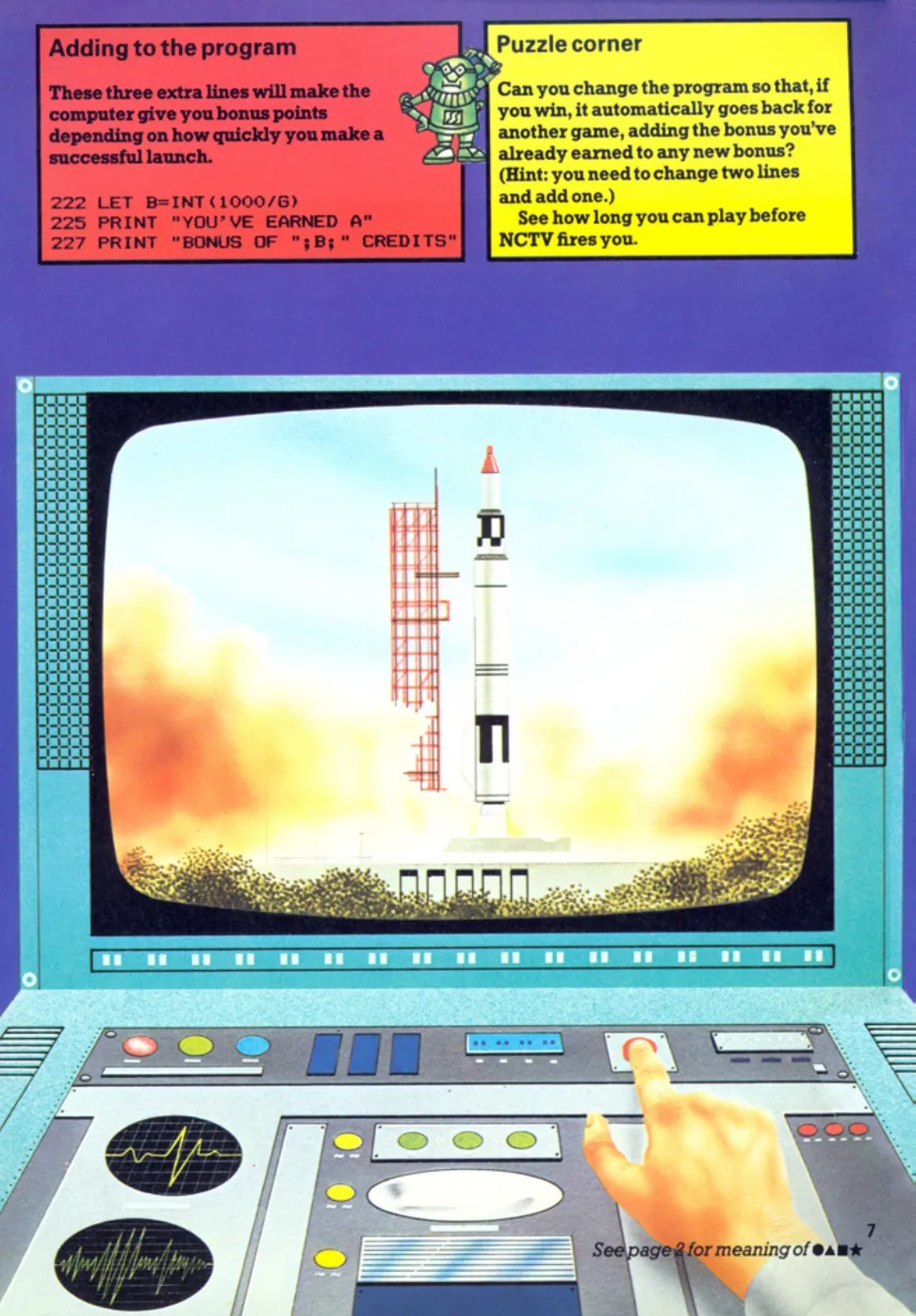
- Bonus Points: Add a scoring system that rewards fewer attempts.
- Replayability: Modify the game to allow restarting after a win.
- Difficulty Levels: Introduce variable target heights for added challenge.
Copyright
These programs are adaptations of the original Usborne Computer Guides published in the 1980s. The books are free to download for personal or educational use from Usborne’s Computer and Coding Books. Programs and adaptations may not be used for commercial purposes.
Return to Computer Spacegames.