Alien Snipers
Book: Computer Spacegames
Author: Usborne Publishing
Translator: Marcus Medina
Story
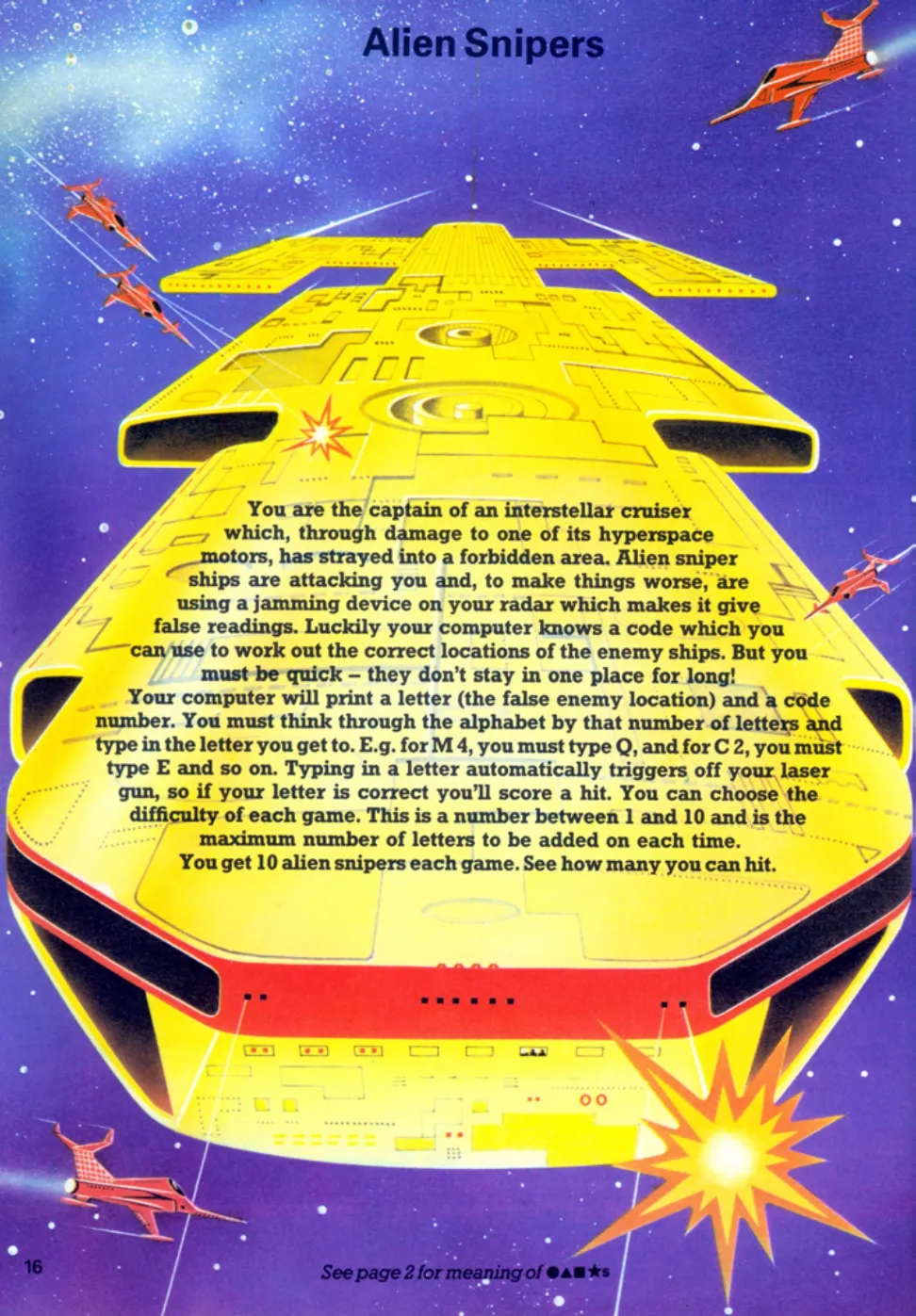
You are the captain of an interstellar cruiser which, through damage to one of its hyperspace motors, has strayed into a forbidden area. Alien sniper ships are attacking you and, to make things worse, are using a jamming device on your radar which makes it give false readings. Luckily your computer knows a code which you can use to work out the correct locations of the enemy ships. But you must be quick — they don’t stay in one place for long! You get 10 alien snipers each game. See how many you can hit.
Pseudocode
BEGIN Clear screen Display "Alien snipers" Prompt for difficulty level (1-10) IF difficulty out of range THEN prompt again Set score to 0 FOR each alien sniper (1 to 10): Generate a random letter (L) within range based on difficulty Generate a random number (N) between 1 and difficulty Clear screen Display L and N Start timer WHILE timer not expired: Check for user input IF input is correct THEN increment score and break loop END WHILE END FOR Display final scoreENDFlowchart
flowchart TD
  Start[Start]
  ClearScreen[Clear screen]
  DisplayTitle[Display 'Alien snipers']
  PromptDifficulty[Prompt for difficulty 1-10]
  ValidateDifficulty{Difficulty valid?}
  SetScore[Set score to 0]
  AlienLoop[FOR each alien sniper 1 to 10]
  GenerateLetter[Generate random letter L]
  GenerateNumber[Generate random number N]
  ClearScreen2[Clear screen]
  DisplayLN[Display L and N]
  Timer[Start timer]
  InputCheck{Input correct?}
  IncrementScore[Increment score]
  DisplayScore[Display final score]
  End[End]

  Start --> ClearScreen --> DisplayTitle --> PromptDifficulty --> ValidateDifficulty
  ValidateDifficulty -->|Yes| SetScore --> AlienLoop
  AlienLoop --> GenerateLetter --> GenerateNumber --> ClearScreen2 --> DisplayLN --> Timer
  Timer --> InputCheck
  InputCheck -->|Yes| IncrementScore --> AlienLoop
  InputCheck -->|No| Timer
  AlienLoop -->|End loop| DisplayScore --> End
  ValidateDifficulty -->|No| PromptDifficulty
Code
Pages
ZX-81 BASIC
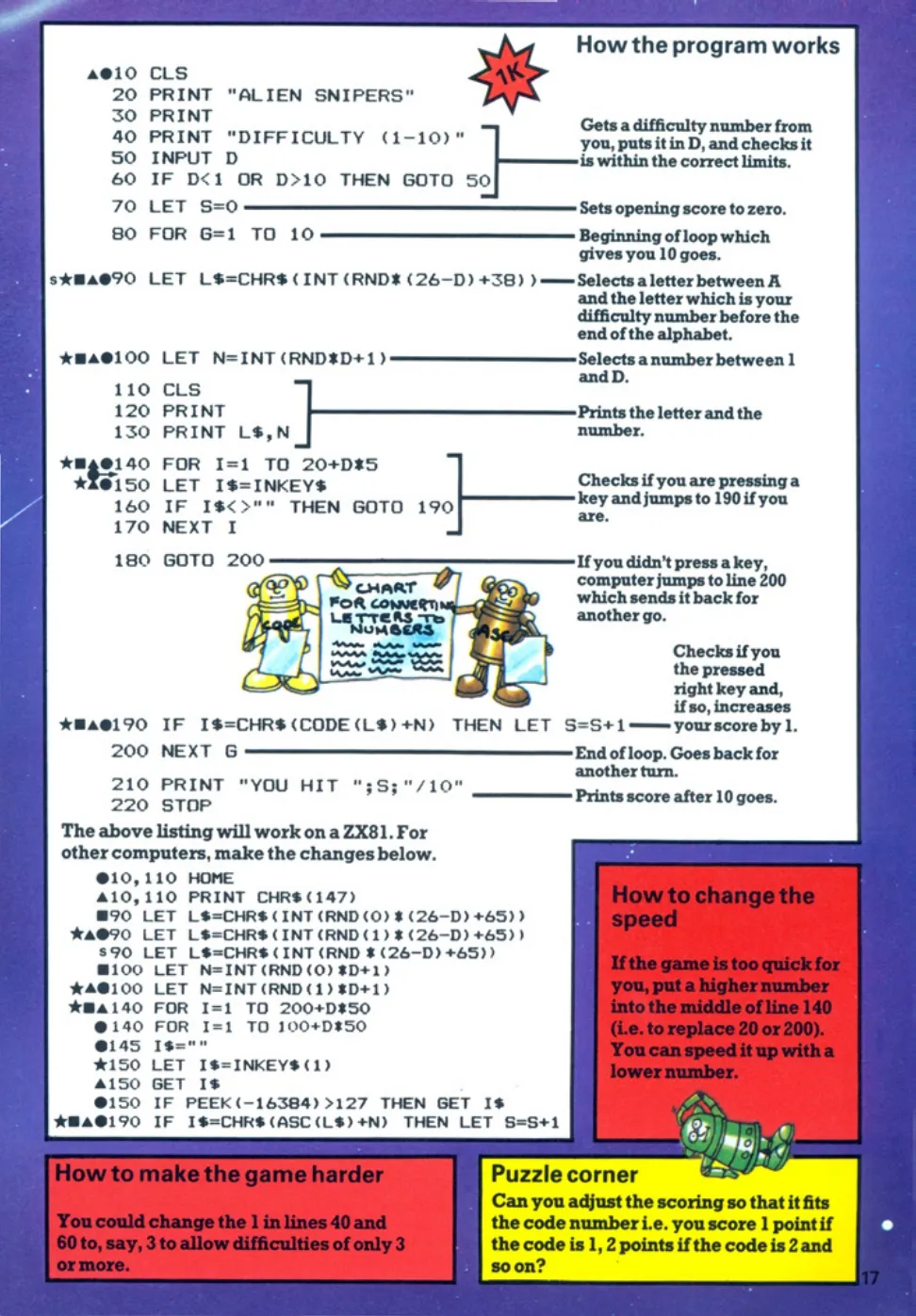
10 CLS20 PRINT "ALIEN SNIPERS"30 PRINT "DIFFICULTY (1-10)"40 INPUT D50 IF D<1 OR D>10 THEN GOTO 5060 LET S=070 FOR G=1 TO 1080 LET L$=CHR$(INT(RND*(26-D)+38))90 LET N=INT(RND*D+1)100 CLS110 PRINT L$,N120 FOR I=1 TO 20+D*5130 LET I$=INKEY$140 IF I$<>"" THEN GOTO 190150 NEXT I160 GOTO 200170 IF I$=CHR$(CODE(L$)+N) THEN LET S=S+1180 GOTO 200190 NEXT G200 PRINT "YOU HIT ";S;"/10"210 STOPC#
using System;
class AlienSnipers{    static void Main()    {        Console.Clear();        Console.WriteLine("Alien snipers");
        int difficulty;        do        {            Console.Write("Difficulty (1-10): ");        } while (!int.TryParse(Console.ReadLine(), out difficulty) || difficulty < 1 || difficulty > 10);
        int score = 0;        Random random = new Random();
        for (int i = 0; i < 10; i++)        {            char letter = (char)(random.Next(26 - difficulty) + 65);            int offset = random.Next(1, difficulty + 1);
            Console.Clear();            Console.WriteLine($"{letter} {offset}");
            var startTime = DateTime.Now;            bool correct = false;
            while ((DateTime.Now - startTime).TotalMilliseconds < (200 + difficulty * 50))            {                if (Console.KeyAvailable)                {                    char input = Console.ReadKey(true).KeyChar;                    if (input == (char)(letter + offset))                    {                        score++;                        correct = true;                        break;                    }                }            }
            if (!correct)            {                Console.WriteLine("Too slow!");            }        }
        Console.WriteLine($"You hit {score}/10");    }}
Python
import randomimport time
print("Alien snipers")
while True:    try:        difficulty = int(input("Difficulty (1-10): "))        if 1 <= difficulty <= 10:            break    except ValueError:        pass
score = 0
for _ in range(10):    letter = chr(random.randint(65, 65 + (26 - difficulty)))    offset = random.randint(1, difficulty)
    print(f"{letter} {offset}")    start_time = time.time()
    correct = False    while time.time() - start_time < (2 + difficulty * 0.1):        try:            user_input = input("Enter your guess: ").strip().upper()            if len(user_input) == 1 and user_input == chr(ord(letter) + offset):                score += 1                correct = True                break        except EOFError:            pass
    if not correct:        print("Too slow!")
print(f"You hit {score}/10")
Java
import java.util.Random;import java.util.Scanner;
public class AlienSnipers {    public static void main(String[] args) {        Scanner scanner = new Scanner(System.in);        Random random = new Random();
        System.out.println("Alien snipers");        int difficulty;        do {            System.out.print("Difficulty (1-10): ");            difficulty = scanner.nextInt();        } while (difficulty < 1 || difficulty > 10);
        int score = 0;
        for (int i = 0; i < 10; i++) {            char letter = (char) (random.nextInt(26 - difficulty) + 'A');            int offset = random.nextInt(difficulty) + 1;
            System.out.println(letter + " " + offset);            long startTime = System.currentTimeMillis();            boolean correct = false;
            while (System.currentTimeMillis() - startTime < 200 + difficulty * 50) {                try {                    Scanner inputScanner = new Scanner(System.in);                    char input = inputScanner.next().charAt(0);                    if (input == letter + offset) {                        score++;                        correct = true;                        break;                    }                } catch (Exception e) {                    // Ignore incorrect inputs                }            }
            if (!correct) {                System.out.println("Too slow!");            }        }
        System.out.println("You hit " + score + "/10");    }}
Go
package main
import (  "bufio"  "fmt"  "math/rand"  "os"  "strconv"  "strings"  "time")
func main() {  rand.Seed(time.Now().UnixNano())  reader := bufio.NewReader(os.Stdin)
  fmt.Println("Alien snipers")  var difficulty int  for {    fmt.Print("Difficulty (1-10): ")    input, _ := reader.ReadString('\n')    input = strings.TrimSpace(input)    difficulty, _ = strconv.Atoi(input)    if difficulty >= 1 && difficulty <= 10 {      break    }  }
  score := 0
  for i := 0; i < 10; i++ {    letter := rune(rand.Intn(26-difficulty) + 'A')    offset := rand.Intn(difficulty) + 1
    fmt.Printf("%c %d\n", letter, offset)    start := time.Now()    correct := false
    for time.Since(start).Milliseconds() < int64(200+difficulty*50) {      input, _ := reader.ReadString('\n')      input = strings.TrimSpace(input)      if len(input) == 1 && input[0] == byte(letter)+byte(offset) {        score++        correct = true        break      }    }
    if !correct {      fmt.Println("Too slow!")    }  }
  fmt.Printf("You hit %d/10\n", score)}
C++
#include <iostream>#include <cstdlib>#include <ctime>#include <conio.h>
using namespace std;
int main() {    srand(time(0));    cout << "Alien snipers" << endl;
    int difficulty;    do {        cout << "Difficulty (1-10): ";        cin >> difficulty;    } while (difficulty < 1 || difficulty > 10);
    int score = 0;
    for (int i = 0; i < 10; i++) {        char letter = 'A' + (rand() % (26 - difficulty));        int offset = 1 + (rand() % difficulty);
        cout << letter << " " << offset << endl;        clock_t start_time = clock();        bool correct = false;
        while (double(clock() - start_time) / CLOCKS_PER_SEC < 2 + (0.1 * difficulty)) {            if (_kbhit()) {                char input = _getch();                if (input == letter + offset) {                    score++;                    correct = true;                    break;                }            }        }
        if (!correct) {            cout << "Too slow!" << endl;        }    }
    cout << "You hit " << score << "/10" << endl;
    return 0;}
Explanation
In Alien Snipers, you must find the correct letter by calculating its position based on the random letter (L) displayed and an offset (N). The difficulty determines the range of letters and offsets. The game provides a limited time to input the correct answer, testing both speed and accuracy.
Challenges
- Increase Difficulty: Reduce the time limit for each turn.
- Score Multiplier: Award more points for higher difficulties.
- Multiple Levels: Add stages with increasing difficulty.
Copyright
These programs are adaptations of the original Usborne Computer Guides published in the 1980s. The books are free to download for personal or educational use from Usborne’s Computer and Coding Books. Programs and adaptations may not be used for commercial purposes.
Return to Computer Spacegames.