Searchlight
Book: Computer Spy Games
Author: Jenny Tyler and Chris Oxlade
Translator: Marcus Medina
Story
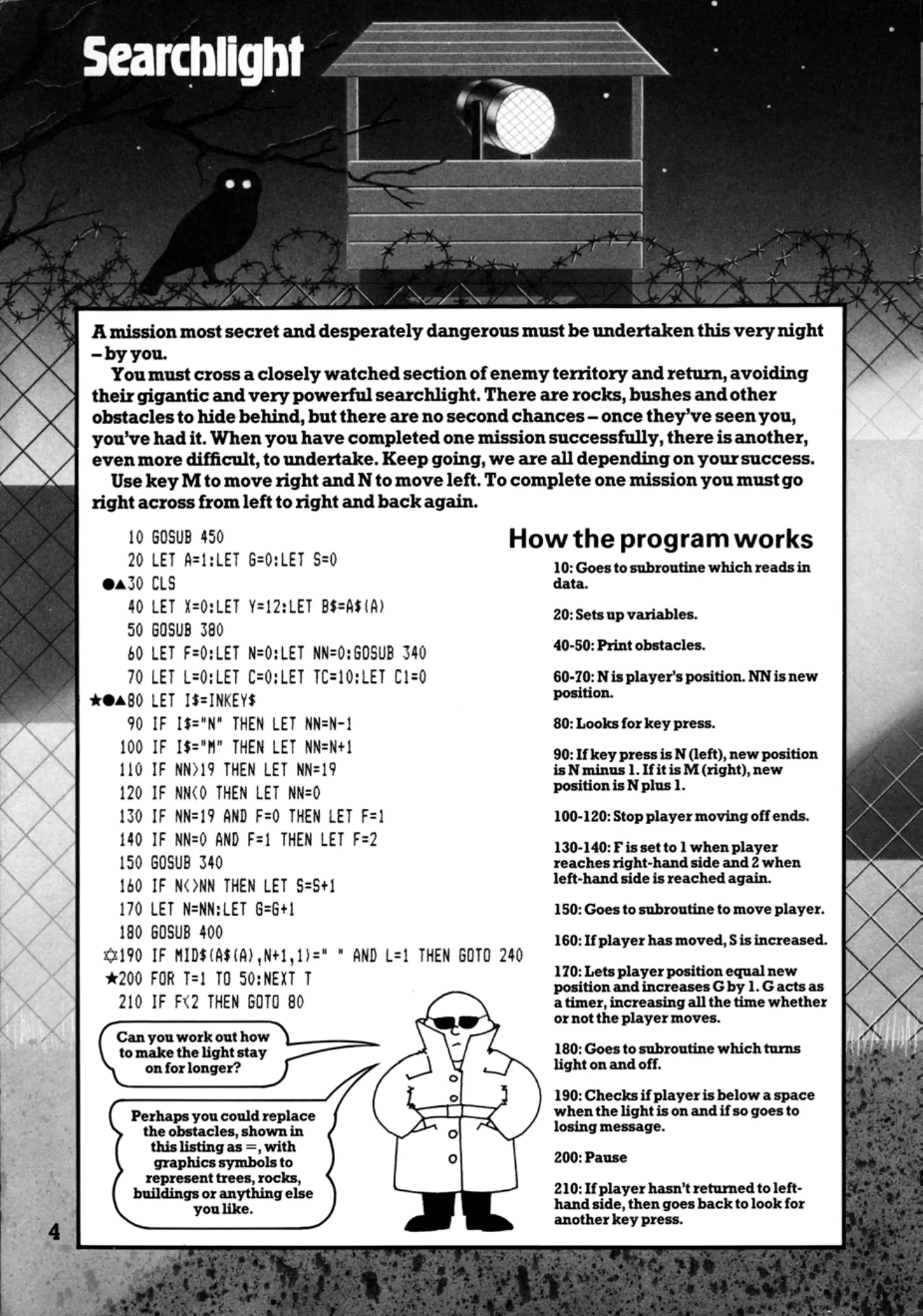
A mission most secret and desperately dangerous must be undertaken this very night — by you.
You must cross a closely watched section of enemy territory and return, avoiding their gigantic and very powerful searchlight. There are rocks, bushes and other obstacles to hide behind, but there are no second chances — once they’ve seen you, you’ve had it. When you have completed one mission successfully, there is another, even more difficult, to undertake. Keep going, we are all depending on your success.
Use key M to move right and N to move left. To complete one mission you must go right across from left to right and back again.
Pseudocode
SET level = 1, score_moves = 0, score_ticks = 0LOOP forever SET position = 0, progress = 0 (not yet crossed) SET light = off, with random on/off timers scaled by level LOOP until caught or mission complete DISPLAY strip with player position and light state READ move (N = left, M = right) UPDATE position, clamp to track ends IF position reached right end THEN progress = 1 IF position reached left end AND progress = 1 THEN progress = complete UPDATE light timers (toggle on/off on schedule) IF moved THEN increase score_moves INCREASE score_ticks IF light is on AND no cover at position THEN PRINT "YOU HAVE BEEN SEEN" PRINT score based on level and move ratio ASK "ANOTHER GO?" IF yes THEN reset everything and restart ELSE end END IF END LOOP INCREASE level (max 7)END LOOPFlowchart
flowchart TD
    Start --> Init[Set level 1, scores to 0]
    Init --> Round[Reset position and light timers for this level]
    Round --> Show[Display strip and light state]
    Show --> Read[Read move: N or M]
    Read --> Update[Update position and progress]
    Update --> Light[Update light on/off timers]
    Light --> Caught{Light on and no cover here?}
    Caught -->|Yes| Seen["Print: YOU HAVE BEEN SEEN"]
    Seen --> Score[Show score]
    Score --> Again{Another go?}
    Again -->|Yes| Init
    Again -->|No| End[End]
    Caught -->|No| Done{Crossed and returned?}
    Done -->|Yes| Levelup[Increase level, max 7]
    Levelup --> Round
    Done -->|No| Show
Code
Pages
ZX-81 BASIC
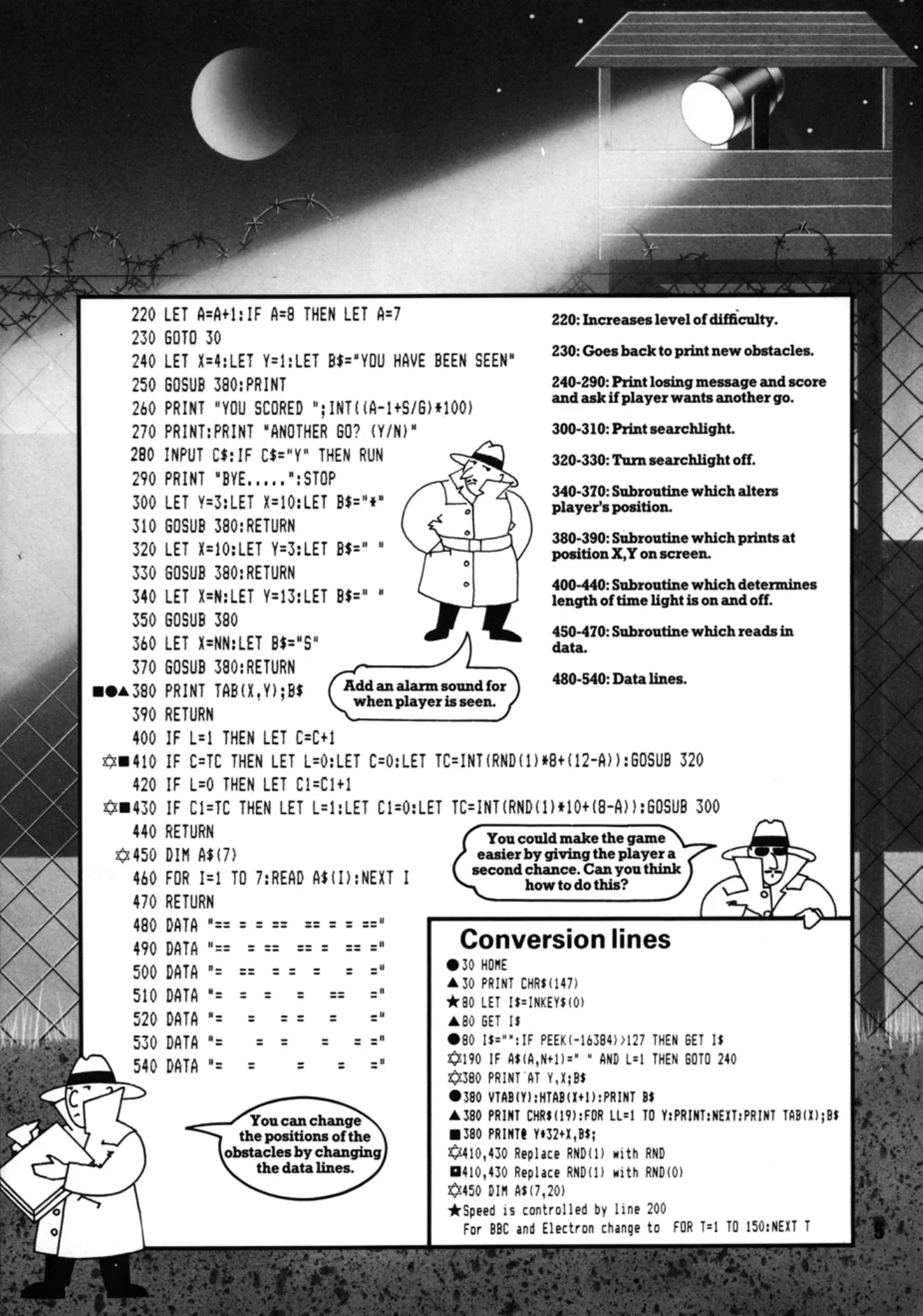
10 GOSUB 45020 LET A=1:LET G=0:LET S=030 CLS40 LET X=0:LET Y=12:LET B$=A$(A)50 GOSUB 38060 LET F=0:LET N=0:LET NN=0:GOSUB 34070 LET L=0:LET C=0:LET TC=10:LET C1=080 LET I$=INKEY$90 IF I$="N" THEN LET NN=N-1100 IF I$="M" THEN LET NN=N+1110 IF NN>19 THEN LET NN=19120 IF NN<0 THEN LET NN=0130 IF NN=19 AND F=0 THEN LET F=1140 IF NN=0 AND F=1 THEN LET F=2150 GOSUB 340160 IF N<>NN THEN LET S=S+1170 LET N=NN:LET G=G+1180 GOSUB 400190 IF MID$(A$(A),N+1,1)=" " AND L=1 THEN GOTO 240200 FOR T=1 TO 50:NEXT T210 IF F<2 THEN GOTO 80220 LET A=A+1:IF A=8 THEN LET A=7230 GOTO 30240 LET X=4:LET Y=1:LET B$="YOU HAVE BEEN SEEN"250 GOSUB 380:PRINT260 PRINT "YOU SCORED ";INT((A-1+S/G)*100)270 PRINT:PRINT "ANOTHER GO? (Y/N)"280 INPUT C$:IF C$="Y" THEN RUN290 PRINT "BYE.....":STOP300 LET Y=3:LET X=10:LET B$="*"310 GOSUB 380:RETURN320 LET X=10:LET Y=3:LET B$=" "330 GOSUB 380:RETURN340 LET X=N:LET Y=13:LET B$=" "350 GOSUB 380360 LET X=NN:LET B$="S"370 GOSUB 380:RETURN380 PRINT TAB(X,Y);B$390 RETURN400 IF L=1 THEN LET C=C+1410 IF C=TC THEN LET L=0:LET C=0:LET TC=INT(RND(1)*8+(12-A)):GOSUB 320420 IF L=0 THEN LET C1=C1+1430 IF C1=TC THEN LET L=1:LET C1=0:LET TC=INT(RND(1)*10+(8-A)):GOSUB 300440 RETURN450 DIM A$(7)460 FOR I=1 TO 7:READ A$(I):NEXT I470 RETURN480 DATA "== = = == == = = =="490 DATA "== = == == = == ="500 DATA "= == = = = = ="510 DATA "= = = = == "520 DATA "= = = = = "530 DATA "= = = = =="540 DATA "= = = = = "C#
using System;
class Searchlight{    static string[] rows = {        "== = = ==  == = = ==",        "==  = ==  == =  == =",        "=  ==  = =  =    = =",        "=  =  =   =    ==   ",        "=    =    = =  =    ",        "=     =  =    =   ==",        "=  =     =   =    = ",    };    static Random rnd = new Random();
    static void Main()    {        int level = 0;        long score = 0, ticks = 0;
        while (true)        {            int n = 0, progress = 0;            bool light = false;            int c = 0, c1 = 0, tc = 10;
            while (true)            {                Console.Write("[");                for (int i = 0; i < 20; i++)                    Console.Write(i == n ? "P" : ".");                Console.WriteLine(light ? "] LIGHT ON" : "] light off");
                Console.Write("Move (N=left, M=right): ");                string key = Console.ReadLine()?.Trim().ToUpper();                if (key == null) return;
                int nn = n;                if (key == "N") nn = n - 1;                if (key == "M") nn = n + 1;                nn = Math.Clamp(nn, 0, 19);
                if (nn == 19 && progress == 0) progress = 1;                if (nn == 0 && progress == 1) progress = 2;
                if (light) c++;                if (c == tc) { light = false; c = 0; tc = rnd.Next(8) + (12 - (level + 1)); }                if (!light) c1++;                if (c1 == tc) { light = true; c1 = 0; tc = rnd.Next(10) + (8 - (level + 1)); }
                if (n != nn) score++;                n = nn;                ticks++;
                if (rows[level][n] == ' ' && light)                {                    Console.WriteLine("\nYOU HAVE BEEN SEEN");                    Console.WriteLine($"YOU SCORED {(int)((level + (double)score / ticks) * 100)}");                    Console.Write("Another go? (Y/N): ");                    string again = Console.ReadLine()?.Trim().ToUpper();                    if (again == "Y")                    {                        level = 0; score = 0; ticks = 0;                        goto restart;                    }                    Console.WriteLine("BYE.....");                    return;                }
                if (progress == 2) break;            }
            level++;            if (level > 6) level = 6;            restart: ;        }    }}
Python
import random
ROWS = [    "== = = ==  == = = ==",    "==  = ==  == =  == =",    "=  ==  = =  =    = =",    "=  =  =   =    ==   ",    "=    =    = =  =    ",    "=     =  =    =   ==",    "=  =     =   =    = ",]
def searchlight():    level = 0    score = 0    ticks = 0
    while True:        n = 0        progress = 0        light = False        c = 0        c1 = 0        tc = 10
        while True:            strip = "".join("P" if i == n else "." for i in range(20))            print(f"[{strip}] {'LIGHT ON' if light else 'light off'}")
            key = input("Move (N=left, M=right): ").strip().upper()
            nn = n            if key == "N":                nn = n - 1            elif key == "M":                nn = n + 1            nn = max(0, min(19, nn))
            if nn == 19 and progress == 0:                progress = 1            if nn == 0 and progress == 1:                progress = 2
            if light:                c += 1            if c == tc:                light = False                c = 0                tc = random.randint(0, 7) + (12 - (level + 1))            if not light:                c1 += 1            if c1 == tc:                light = True                c1 = 0                tc = random.randint(0, 9) + (8 - (level + 1))
            if n != nn:                score += 1            n = nn            ticks += 1
            if ROWS[level][n] == " " and light:                print("\nYOU HAVE BEEN SEEN")                print(f"YOU SCORED {int((level + score / ticks) * 100)}")                again = input("Another go? (Y/N): ").strip().upper()                if again == "Y":                    level, score, ticks = 0, 0, 0                    break                print("BYE.....")                return
            if progress == 2:                level = min(level + 1, 6)                break        else:            continue
if __name__ == "__main__":    searchlight()
Java
import java.util.Random;import java.util.Scanner;
public class Searchlight {    static String[] rows = {        "== = = ==  == = = ==",        "==  = ==  == =  == =",        "=  ==  = =  =    = =",        "=  =  =   =    ==   ",        "=    =    = =  =    ",        "=     =  =    =   ==",        "=  =     =   =    = ",    };    static Random rnd = new Random();    static Scanner scanner = new Scanner(System.in);
    public static void main(String[] args) {        int level = 0;        long score = 0, ticks = 0;
        outer:        while (true) {            int n = 0, progress = 0;            boolean light = false;            int c = 0, c1 = 0, tc = 10;
            while (true) {                StringBuilder strip = new StringBuilder();                for (int i = 0; i < 20; i++) strip.append(i == n ? 'P' : '.');                System.out.println("[" + strip + "] " + (light ? "LIGHT ON" : "light off"));
                System.out.print("Move (N=left, M=right): ");                if (!scanner.hasNextLine()) return;                String key = scanner.nextLine().trim().toUpperCase();
                int nn = n;                if (key.equals("N")) nn = n - 1;                if (key.equals("M")) nn = n + 1;                nn = Math.max(0, Math.min(19, nn));
                if (nn == 19 && progress == 0) progress = 1;                if (nn == 0 && progress == 1) progress = 2;
                if (light) c++;                if (c == tc) { light = false; c = 0; tc = rnd.nextInt(8) + (12 - (level + 1)); }                if (!light) c1++;                if (c1 == tc) { light = true; c1 = 0; tc = rnd.nextInt(10) + (8 - (level + 1)); }
                if (n != nn) score++;                n = nn;                ticks++;
                if (rows[level].charAt(n) == ' ' && light) {                    System.out.println("\nYOU HAVE BEEN SEEN");                    System.out.println("YOU SCORED " + (int) ((level + (double) score / ticks) * 100));                    System.out.print("Another go? (Y/N): ");                    if (!scanner.hasNextLine()) return;                    String again = scanner.nextLine().trim().toUpperCase();                    if (again.equals("Y")) {                        level = 0; score = 0; ticks = 0;                        continue outer;                    }                    System.out.println("BYE.....");                    return;                }
                if (progress == 2) break;            }
            level = Math.min(level + 1, 6);        }    }}
Go
package main
import (  "bufio"  "fmt"  "math/rand"  "os"  "strings"  "time")
var rows = []string{  "== = = ==  == = = ==",  "==  = ==  == =  == =",  "=  ==  = =  =    = =",  "=  =  =   =    ==   ",  "=    =    = =  =    ",  "=     =  =    =   ==",  "=  =     =   =    = ",}
func main() {  rand.Seed(time.Now().UnixNano())  reader := bufio.NewReader(os.Stdin)
  level := 0  var score, ticks int64
outer:  for {    n, progress := 0, 0    light := false    c, c1, tc := 0, 0, 10
    for {      strip := make([]byte, 20)      for i := range strip {        if i == n {          strip[i] = 'P'        } else {          strip[i] = '.'        }      }      state := "light off"      if light {        state = "LIGHT ON"      }      fmt.Printf("[%s] %s\n", string(strip), state)
      fmt.Print("Move (N=left, M=right): ")      line, err := reader.ReadString('\n')      if err != nil {        return      }      key := strings.ToUpper(strings.TrimSpace(line))
      nn := n      if key == "N" {        nn = n - 1      }      if key == "M" {        nn = n + 1      }      if nn < 0 {        nn = 0      }      if nn > 19 {        nn = 19      }
      if nn == 19 && progress == 0 {        progress = 1      }      if nn == 0 && progress == 1 {        progress = 2      }
      if light {        c++      }      if c == tc {        light = false        c = 0        tc = rand.Intn(8) + (12 - (level + 1))      }      if !light {        c1++      }      if c1 == tc {        light = true        c1 = 0        tc = rand.Intn(10) + (8 - (level + 1))      }
      if n != nn {        score++      }      n = nn      ticks++
      if rows[level][n] == ' ' && light {        fmt.Println("\nYOU HAVE BEEN SEEN")        fmt.Printf("YOU SCORED %d\n", int(float64(level)+float64(score)/float64(ticks)*100+float64(level)*0))        fmt.Printf("YOU SCORED %d\n", int((float64(level)+float64(score)/float64(ticks))*100))        fmt.Print("Another go? (Y/N): ")        line, err := reader.ReadString('\n')        if err != nil {          return        }        if strings.ToUpper(strings.TrimSpace(line)) == "Y" {          level, score, ticks = 0, 0, 0          continue outer        }        fmt.Println("BYE.....")        return      }
      if progress == 2 {        break      }    }
    level++    if level > 6 {      level = 6    }  }}
C++
#include <iostream>#include <string>#include <cstdlib>#include <ctime>#include <algorithm>
std::string rows[7] = {    "== = = ==  == = = ==",    "==  = ==  == =  == =",    "=  ==  = =  =    = =",    "=  =  =   =    ==   ",    "=    =    = =  =    ",    "=     =  =    =   ==",    "=  =     =   =    = ",};
int main() {    srand(time(0));    int level = 0;    long score = 0, ticks = 0;
    while (true) {        int n = 0, progress = 0;        bool light = false;        int c = 0, c1 = 0, tc = 10;        bool caught = false;
        while (true) {            std::string strip(20, '.');            strip[n] = 'P';            std::cout << "[" << strip << "] " << (light ? "LIGHT ON" : "light off") << std::endl;
            std::cout << "Move (N=left, M=right): ";            std::string key;            if (!std::getline(std::cin, key)) return 0;            std::transform(key.begin(), key.end(), key.begin(), ::toupper);
            int nn = n;            if (key == "N") nn = n - 1;            if (key == "M") nn = n + 1;            nn = std::max(0, std::min(19, nn));
            if (nn == 19 && progress == 0) progress = 1;            if (nn == 0 && progress == 1) progress = 2;
            if (light) c++;            if (c == tc) { light = false; c = 0; tc = rand() % 8 + (12 - (level + 1)); }            if (!light) c1++;            if (c1 == tc) { light = true; c1 = 0; tc = rand() % 10 + (8 - (level + 1)); }
            if (n != nn) score++;            n = nn;            ticks++;
            if (rows[level][n] == ' ' && light) {                std::cout << "\nYOU HAVE BEEN SEEN" << std::endl;                std::cout << "YOU SCORED " << (int)((level + (double)score / ticks) * 100) << std::endl;                std::cout << "Another go? (Y/N): ";                if (!std::getline(std::cin, key)) return 0;                std::transform(key.begin(), key.end(), key.begin(), ::toupper);                if (key == "Y") {                    level = 0; score = 0; ticks = 0;                    caught = true;                    break;                }                std::cout << "BYE....." << std::endl;                return 0;            }
            if (progress == 2) break;        }
        if (!caught) {            level++;            if (level > 6) level = 6;        }    }}
Explanation
You creep along a 20-step strip of enemy territory, ducking between the gaps in your cover as an enemy searchlight cycles on and off on its own unpredictable schedule. Reach the far end and make it back to start to clear a mission — but if the light catches you standing in the open, it’s over. Each mission you clear raises the difficulty and shortens your margin for error.
Challenges
- Longer light: Work out how to make the light stay on for longer, as the book itself suggests.
- New obstacles: Change the cover patterns for each level.
- Second chance: Give the player one extra life before the mission ends.
Copyright
These programs are adaptations of the original Usborne Computer Guides published in the 1980s. The books are free to download for personal or educational use from Usborne’s Computer and Coding Books. Programs and adaptations may not be used for commercial purposes.
Return to Computer Spy Games.