Gravedigger
Book: Creepy Computer Games
Author: Brendon Kavanagh, Colin Reynolds, Val Robinson, Alan Ramsey, Keith Campbell, Chris Oxlade
Translator: Marcus Medina
Story
It’s dark, cold, and windy — not the kind of night to get lost in a graveyard. But that’s exactly where you are. Skeletons roam the shadows, rattling their bones and waiting to scare you to death.
You must dig holes to trap the skeletons before they reach you. But be careful — digging is exhausting, and you can only dig five holes per game. If you dig too many or fall into your own traps, you’ll never make it to dawn.
Gravestones (marked +) and graveyard walls (:) block your path. Your holes are marked 0, you are *, and the skeletons are X. Find your way out before midnight — or join them forever…
Pseudocode
CREATE a 10×20 grid and fill with empty spacesSET number of holes = 5DEFINE symbols: + = gravestone, : = wall, 0 = hole, * = player, X = skeleton
PLACE walls and gravestones randomlyPLACE player (*) and skeletons (X) in starting positions
REPEAT until escaped or dead:    DISPLAY the graveyard    ASK for movement (N, S, E, W)    MOVE player if possible    IF player moves into wall or gravestone → print "That way's blocked"    IF player steps into skeleton → player dies    IF player steps into hole → player falls and dies    CHECK if player escaped → print "You're free!"    OPTIONALLY dig a hole (Y/N)    MOVE skeletons toward player    CHECK collisions againEND LOOP
PRINT outcome and performance rating
Flowchart
flowchart TD
    A[Start Game] --> B[Initialize 10×20 Grid]
    B --> C[Place walls, gravestones, player, skeletons]
    C --> D[Display Graveyard]
    D --> E[Player Move N/S/E/W]
    E --> F[Blocked by wall or gravestone?]
    F -->|Yes| D
    F -->|No| G[Move player]
    G --> H[Check if stepped into skeleton or hole]
    H -->|Yes| I[Print Death Message]
    H -->|No| J["Ask to dig hole (Y/N)"]
    J -->|Y| K[Add hole at current position]
    J -->|N| L[Move Skeletons]
    K --> L
    L --> M[Check collisions again]
    M -->|Skeleton caught| N[Increase score]
    M -->|Player caught| I
    M -->|Escaped| O["Print: You're Free!"]
    I --> P[Game Over]
    O --> P
Code
Pages
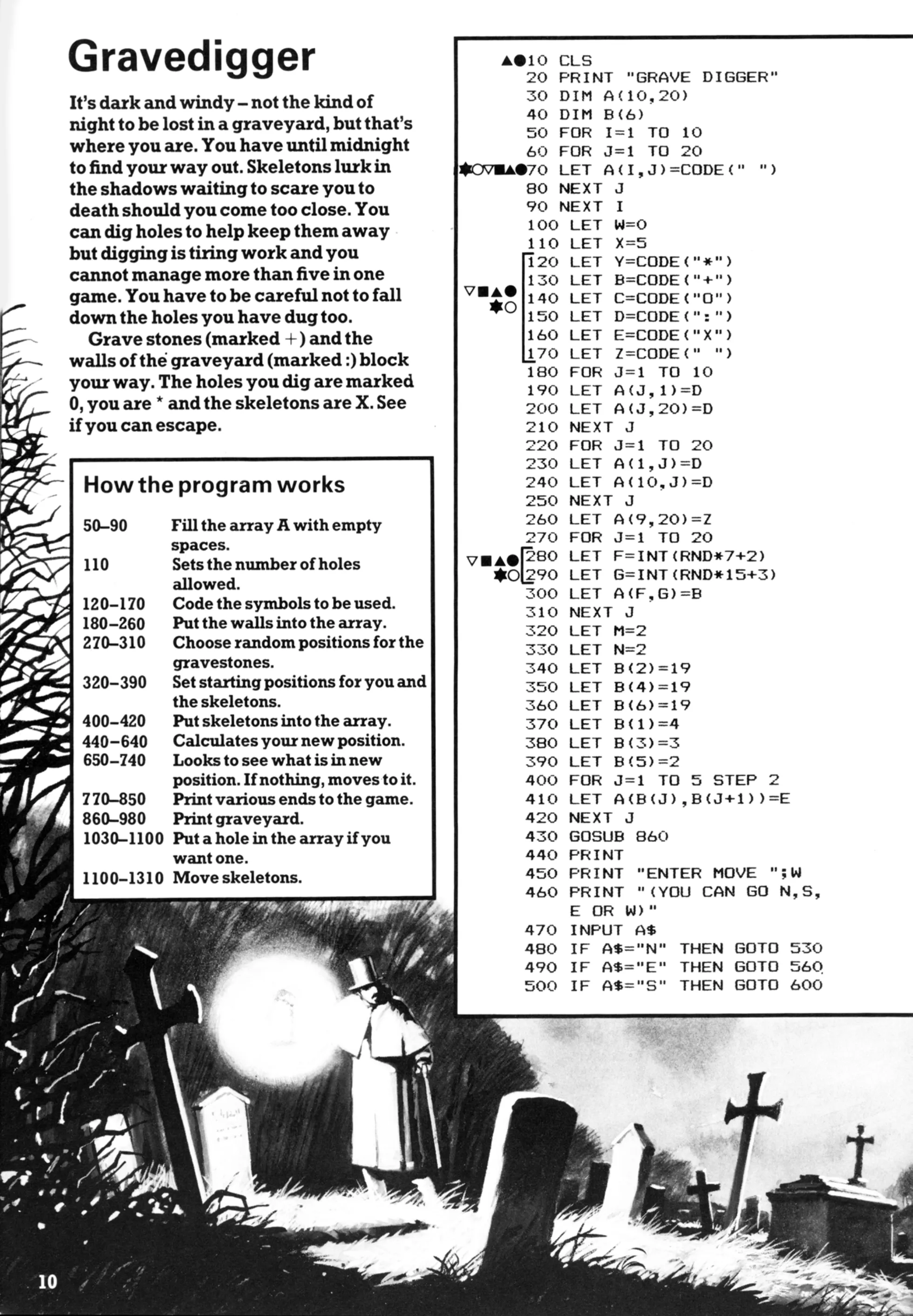
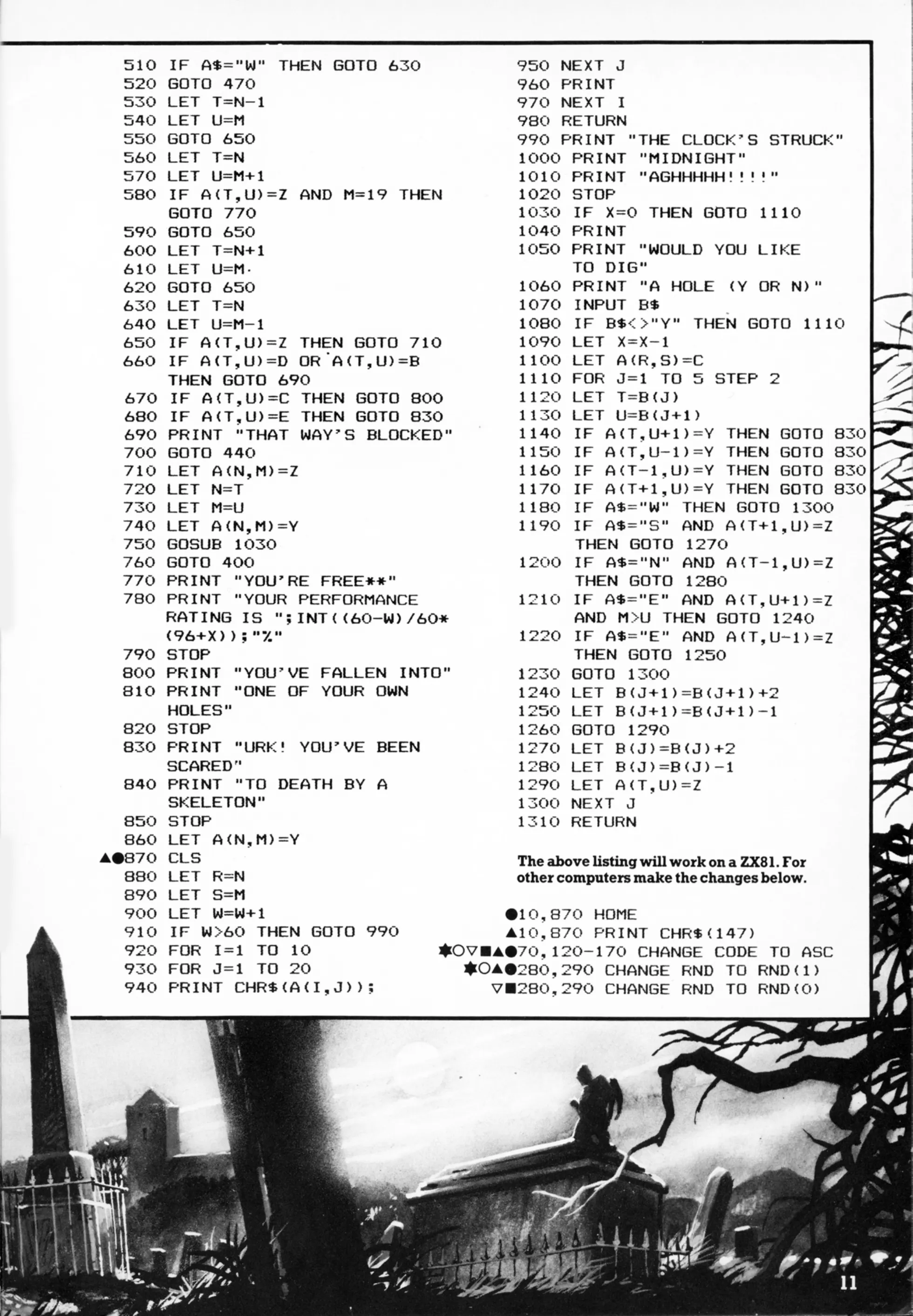
ZX-81 BASIC
10 CLS20 PRINT "GRAVE DIGGER"30 DIM A(10,20)40 DIM B(6)50 FOR I=1 TO 1060 FOR J=1 TO 2070 LET A(I,J)=CODE(" ")80 NEXT J90 NEXT I100 LET W=0110 LET X=5120 LET Y=CODE("*")130 LET B=CODE("+")140 LET C=CODE("0")150 LET D=CODE(":")160 LET E=CODE("X")170 LET Z=CODE(" ")180 FOR J=1 TO 10190 LET A(J,1)=D200 LET A(J,20)=D210 NEXT J220 FOR J=1 TO 20230 LET A(1,J)=D240 LET A(10,J)=D250 NEXT J260 LET A(9,20)=Z270 FOR J=1 TO 20280 LET F=INT(RND*7+2)290 LET G=INT(RND*15+3)300 LET A(F,G)=B310 NEXT J320 LET M=2330 LET N=2340 LET B(2)=19350 LET B(4)=19360 LET B(6)=19370 LET B(1)=4380 LET B(3)=3390 LET B(5)=2400 FOR J=1 TO 5 STEP 2410 LET A(B(J),B(J+1))=E420 NEXT J430 GOSUB 860440 PRINT450 PRINT "ENTER MOVE: ";460 PRINT "(YOU CAN GO N,S,E OR W)"470 INPUT A$480 IF A$="N" THEN GOTO 530490 IF A$="E" THEN GOTO 560500 IF A$="S" THEN GOTO 600510 IF A$="W" THEN GOTO 630520 GOTO 470530 LET N=N-1540 LET U=M550 GOTO 650560 LET T=N570 LET M=M+1580 IF A(T,U)=Z AND M=19 THEN GOTO 770590 GOTO 650600 LET T=N+1610 LET U=M620 GOTO 650630 LET T=N640 LET U=M-1650 IF A(T,U)=Z THEN GOTO 710660 IF A(T,U)=D OR A(T,U)=B THEN GOTO 690670 IF A(T,U)=C THEN GOTO 800680 IF A(T,U)=E THEN GOTO 830690 PRINT "THAT WAY'S BLOCKED"700 GOTO 440710 LET A(N,M)=Z720 LET N=T730 LET M=U740 LET A(N,M)=Y750 GOSUB 1030760 GOTO 400770 PRINT "**YOU'RE FREE**"780 PRINT "YOUR PERFORMANCE RATING IS ";INT((60-W)/60*(96+X));"%"790 STOP800 PRINT "YOU'VE FALLEN INTO"810 PRINT "ONE OF YOUR OWN HOLES"820 STOP830 PRINT "URK! YOU'VE BEEN SCARED"840 PRINT "TO DEATH BY A SKELETON"850 STOP860 LET A(N,M)=Y870 CLS880 LET R=N890 LET S=M900 LET W=W+1910 IF W>60 THEN GOTO 990920 FOR I=1 TO 10930 FOR J=1 TO 20940 PRINT CHR$(A(I,J));950 NEXT J960 PRINT970 NEXT I980 RETURN990 PRINT "THE CLOCK'S STRUCK"1000 PRINT "MIDNIGHT!"1010 PRINT "AGHHHHHH!"1020 STOP1030 IF X=0 THEN GOTO 11101040 PRINT1050 PRINT "WOULD YOU LIKE TO DIG?"1060 PRINT "(Y OR N)"1070 INPUT B$1080 IF B$<>"Y" THEN GOTO 11101090 LET X=X-11100 LET A(N,M)=C1110 FOR J=1 TO 5 STEP 21120 LET T=B(J)1130 LET U=B(J+1)1140 IF A(T,U)=Y THEN GOTO 8301150 IF A(T,U)=Y THEN GOTO 8301160 IF A(T+1,U)=Y THEN GOTO 8301170 IF A(T-1,U)=Y THEN GOTO 8301180 IF A$="W" THEN GOTO 13001190 IF A$="S" AND A(T+1,U)=Z THEN GOTO 12701200 IF A$="N" AND A(T-1,U)=Z THEN GOTO 12801210 IF A$="E" AND A(T,U+1)=Z AND M>U THEN GOTO 12401220 IF A$="E" AND A(T,U-1)=Z THEN GOTO 12501230 GOTO 13001240 LET B(J+1)=B(J+1)+21250 LET B(J+1)=B(J+1)-11260 GOTO 12901270 LET B(J)=B(J)+21280 LET B(J)=B(J)-11290 LET A(T,U)=Z1300 NEXT J1310 RETURNC#
using System;
class Gravedigger{    const int Rows = 10, Cols = 20;    static char[,] grid = new char[Rows, Cols];    static Random rnd = new Random();    static int playerRow = 2, playerCol = 2;    static int holesLeft = 5;    static int turns = 0;    static (int r, int c)[] skeletons = new (int, int)[3];
    static void Main()    {        InitGrid();        PlaceSkeletons();        Play();    }
    static void InitGrid()    {        for (int r = 0; r < Rows; r++)            for (int c = 0; c < Cols; c++)                grid[r, c] = ' ';
        for (int r = 0; r < Rows; r++)        {            grid[r, 0] = ':';            grid[r, Cols - 1] = ':';        }        for (int c = 0; c < Cols; c++)        {            grid[0, c] = ':';            grid[Rows - 1, c] = ':';        }
        for (int i = 0; i < 25; i++)            grid[rnd.Next(1, Rows - 1), rnd.Next(1, Cols - 1)] = '+';        grid[Rows - 2, Cols - 1] = ' ';    }
    static void PlaceSkeletons()    {        for (int i = 0; i < skeletons.Length; i++)        {            skeletons[i] = (rnd.Next(1, Rows - 1), rnd.Next(1, Cols - 1));            grid[skeletons[i].r, skeletons[i].c] = 'X';        }        grid[playerRow, playerCol] = '*';    }
    static void Play()    {        while (true)        {            Console.Clear();            Draw();            Console.WriteLine($"\nHoles left: {holesLeft}");            Console.Write("Move (N,S,E,W): ");            char move = char.ToUpper(Console.ReadKey(true).KeyChar);
            int newR = playerRow, newC = playerCol;            if (move == 'N') newR--;            if (move == 'S') newR++;            if (move == 'W') newC--;            if (move == 'E') newC++;
            if (grid[newR, newC] == ':' || grid[newR, newC] == '+')            {                Console.WriteLine("\nThat way’s blocked!");                Console.ReadKey();                continue;            }            if (grid[newR, newC] == '0')            {                Console.WriteLine("\nYou’ve fallen into your own hole!");                return;            }            if (grid[newR, newC] == 'X')            {                Console.WriteLine("\nURK! You’ve been scared to death by a skeleton!");                return;            }
            grid[playerRow, playerCol] = ' ';            playerRow = newR; playerCol = newC;            grid[playerRow, playerCol] = '*';
            if (playerCol == Cols - 1)            {                Console.WriteLine("\nYou’re free! Congratulations!");                return;            }
            Console.Write("\nDo you want to dig a hole? (Y/N): ");            if (holesLeft > 0 && Console.ReadKey(true).KeyChar is 'Y' or 'y')            {                grid[playerRow, playerCol] = '0';                holesLeft--;            }
            MoveSkeletons();            turns++;
            if (turns > 60)            {                Console.WriteLine("\nThe clock’s struck midnight! AGHHHHH!");                return;            }        }    }
    static void Draw()    {        for (int r = 0; r < Rows; r++)        {            for (int c = 0; c < Cols; c++)                Console.Write(grid[r, c]);            Console.WriteLine();        }    }
    static void MoveSkeletons()    {        for (int i = 0; i < skeletons.Length; i++)        {            var (r, c) = skeletons[i];            grid[r, c] = ' ';            int dr = Math.Sign(playerRow - r);            int dc = Math.Sign(playerCol - c);            int newR = r + dr;            int newC = c + dc;
            if (grid[newR, newC] == '*')            {                Console.WriteLine("\nA skeleton caught you!");                Environment.Exit(0);            }            if (grid[newR, newC] == '0')                continue; // Skeleton falls in hole            grid[newR, newC] = 'X';            skeletons[i] = (newR, newC);        }    }}
Python
import randomimport osimport time
ROWS, COLS = 10, 20
def print_grid(grid):    os.system("cls" if os.name == "nt" else "clear")    for row in grid:        print("".join(row))
def gravedigger():    grid = [[" " for _ in range(COLS)] for _ in range(ROWS)]    for i in range(ROWS):        grid[i][0] = grid[i][-1] = ":"    for j in range(COLS):        grid[0][j] = grid[-1][j] = ":"    for _ in range(25):        grid[random.randint(1, ROWS-2)][random.randint(1, COLS-2)] = "+"    grid[ROWS-2][COLS-1] = " "
    player = [2, 2]    skeletons = [[4, 4], [3, 18], [7, 15]]    for r, c in skeletons: grid[r][c] = "X"    grid[player[0]][player[1]] = "*"    holes = 5    turns = 0
    while True:        print_grid(grid)        print(f"Holes left: {holes}")        move = input("Move (N,S,E,W): ").upper()        dr, dc = {"N":(-1,0),"S":(1,0),"E":(0,1),"W":(0,-1)}.get(move,(0,0))        nr, nc = player[0]+dr, player[1]+dc
        if grid[nr][nc] in [":","+"]:            print("That way’s blocked!"); time.sleep(1); continue        if grid[nr][nc] == "0":            print("You fell into your own hole!"); break        if grid[nr][nc] == "X":            print("A skeleton got you!"); break
        grid[player[0]][player[1]] = " "        player = [nr, nc]        grid[player[0]][player[1]] = "*"
        if player[1] == COLS-1:            print("You’re free!"); break
        if holes > 0 and input("Dig a hole? (Y/N): ").upper() == "Y":            grid[player[0]][player[1]] = "0"            holes -= 1
        # Move skeletons        for s in skeletons:            r, c = s            grid[r][c] = " "            dr = (player[0] > r) - (player[0] < r)            dc = (player[1] > c) - (player[1] < c)            nr, nc = r+dr, c+dc            if grid[nr][nc] == "*":                print("A skeleton caught you!"); return            if grid[nr][nc] == "0":                continue            grid[nr][nc] = "X"            s[:] = [nr, nc]
        turns += 1        if turns > 60:            print("The clock’s struck midnight! AGHHHHH!"); break
if __name__ == "__main__":    gravedigger()
Java
import java.util.Random;import java.util.Scanner;
public class Gravedigger {    static final int ROWS = 10, COLS = 20;    static char[][] grid = new char[ROWS][COLS];    static Random rnd = new Random();    static int playerRow = 2, playerCol = 2;    static int holesLeft = 5;    static int turns = 0;    static int[][] skeletons = {{4, 4}, {3, 18}, {7, 15}};    static Scanner scanner = new Scanner(System.in);
    public static void main(String[] args) {        initGrid();        placeSkeletons();        play();    }
    static void initGrid() {        for (int r = 0; r < ROWS; r++)            for (int c = 0; c < COLS; c++)                grid[r][c] = ' ';
        for (int r = 0; r < ROWS; r++) {            grid[r][0] = ':';            grid[r][COLS - 1] = ':';        }        for (int c = 0; c < COLS; c++) {            grid[0][c] = ':';            grid[ROWS - 1][c] = ':';        }
        for (int i = 0; i < 25; i++)            grid[1 + rnd.nextInt(ROWS - 2)][1 + rnd.nextInt(COLS - 2)] = '+';        grid[ROWS - 2][COLS - 1] = ' ';    }
    static void placeSkeletons() {        for (int[] s : skeletons)            grid[s[0]][s[1]] = 'X';        grid[playerRow][playerCol] = '*';    }
    static void play() {        while (true) {            draw();            System.out.println("\nHoles left: " + holesLeft);            System.out.print("Move (N,S,E,W): ");            if (!scanner.hasNextLine()) return;            String moveLine = scanner.nextLine().trim().toUpperCase();            if (moveLine.isEmpty()) continue;            char move = moveLine.charAt(0);
            int newR = playerRow, newC = playerCol;            if (move == 'N') newR--;            else if (move == 'S') newR++;            else if (move == 'W') newC--;            else if (move == 'E') newC++;            else continue;
            if (grid[newR][newC] == ':' || grid[newR][newC] == '+') {                System.out.println("\nThat way's blocked!");                continue;            }            if (grid[newR][newC] == '0') {                System.out.println("\nYou've fallen into your own hole!");                return;            }            if (grid[newR][newC] == 'X') {                System.out.println("\nURK! You've been scared to death by a skeleton!");                return;            }
            grid[playerRow][playerCol] = ' ';            playerRow = newR;            playerCol = newC;            grid[playerRow][playerCol] = '*';
            if (playerCol == COLS - 1) {                System.out.println("\nYou're free! Congratulations!");                return;            }
            if (holesLeft > 0) {                System.out.print("\nDo you want to dig a hole? (Y/N): ");                if (!scanner.hasNextLine()) return;                String dig = scanner.nextLine().trim().toUpperCase();                if (dig.equals("Y")) {                    grid[playerRow][playerCol] = '0';                    holesLeft--;                }            }
            if (!moveSkeletons()) return;            turns++;
            if (turns > 60) {                System.out.println("\nThe clock's struck midnight! AGHHHHH!");                return;            }        }    }
    static void draw() {        for (int r = 0; r < ROWS; r++) {            StringBuilder sb = new StringBuilder();            for (int c = 0; c < COLS; c++)                sb.append(grid[r][c]);            System.out.println(sb);        }    }
    static boolean moveSkeletons() {        for (int[] s : skeletons) {            int r = s[0], c = s[1];            grid[r][c] = ' ';            int dr = Integer.signum(playerRow - r);            int dc = Integer.signum(playerCol - c);            int newR = r + dr, newC = c + dc;
            if (grid[newR][newC] == '*') {                System.out.println("\nA skeleton caught you!");                return false;            }            if (grid[newR][newC] == '0') {                continue;            }            grid[newR][newC] = 'X';            s[0] = newR;            s[1] = newC;        }        return true;    }}
Go
package main
import (  "bufio"  "fmt"  "math/rand"  "os"  "strings"  "time")
const rows, cols = 10, 20
var grid [rows][cols]bytevar playerRow, playerCol = 2, 2var holesLeft = 5var turns = 0var skeletons = [3][2]int{{4, 4}, {3, 18}, {7, 15}}
func sign(x int) int {  if x > 0 {    return 1  }  if x < 0 {    return -1  }  return 0}
func initGrid() {  for r := 0; r < rows; r++ {    for c := 0; c < cols; c++ {      grid[r][c] = ' '    }  }  for r := 0; r < rows; r++ {    grid[r][0] = ':'    grid[r][cols-1] = ':'  }  for c := 0; c < cols; c++ {    grid[0][c] = ':'    grid[rows-1][c] = ':'  }  for i := 0; i < 25; i++ {    grid[1+rand.Intn(rows-2)][1+rand.Intn(cols-2)] = '+'  }  grid[rows-2][cols-1] = ' '}
func placeSkeletons() {  for _, s := range skeletons {    grid[s[0]][s[1]] = 'X'  }  grid[playerRow][playerCol] = '*'}
func draw() {  for r := 0; r < rows; r++ {    fmt.Println(string(grid[r][:]))  }}
func moveSkeletons() bool {  for i := range skeletons {    r, c := skeletons[i][0], skeletons[i][1]    grid[r][c] = ' '    dr := sign(playerRow - r)    dc := sign(playerCol - c)    newR, newC := r+dr, c+dc
    if grid[newR][newC] == '*' {      fmt.Println("\nA skeleton caught you!")      return false    }    if grid[newR][newC] == '0' {      continue    }    grid[newR][newC] = 'X'    skeletons[i][0] = newR    skeletons[i][1] = newC  }  return true}
func main() {  rand.Seed(time.Now().UnixNano())  initGrid()  placeSkeletons()  reader := bufio.NewReader(os.Stdin)
  for {    draw()    fmt.Printf("\nHoles left: %d\n", holesLeft)    fmt.Print("Move (N,S,E,W): ")    line, err := reader.ReadString('\n')    if err != nil {      return    }    moveLine := strings.ToUpper(strings.TrimSpace(line))    if moveLine == "" {      continue    }    move := moveLine[0]
    newR, newC := playerRow, playerCol    switch move {    case 'N':      newR--    case 'S':      newR++    case 'W':      newC--    case 'E':      newC++    default:      continue    }
    if grid[newR][newC] == ':' || grid[newR][newC] == '+' {      fmt.Println("\nThat way's blocked!")      continue    }    if grid[newR][newC] == '0' {      fmt.Println("\nYou've fallen into your own hole!")      return    }    if grid[newR][newC] == 'X' {      fmt.Println("\nURK! You've been scared to death by a skeleton!")      return    }
    grid[playerRow][playerCol] = ' '    playerRow, playerCol = newR, newC    grid[playerRow][playerCol] = '*'
    if playerCol == cols-1 {      fmt.Println("\nYou're free! Congratulations!")      return    }
    if holesLeft > 0 {      fmt.Print("\nDo you want to dig a hole? (Y/N): ")      line, err = reader.ReadString('\n')      if err != nil {        return      }      dig := strings.ToUpper(strings.TrimSpace(line))      if dig == "Y" {        grid[playerRow][playerCol] = '0'        holesLeft--      }    }
    if !moveSkeletons() {      return    }    turns++
    if turns > 60 {      fmt.Println("\nThe clock's struck midnight! AGHHHHH!")      return    }  }}
C++
#include <iostream>#include <string>#include <cstdlib>#include <ctime>#include <algorithm>
const int ROWS = 10, COLS = 20;char grid[ROWS][COLS];int playerRow = 2, playerCol = 2;int holesLeft = 5;int turns = 0;int skeletons[3][2] = {{4, 4}, {3, 18}, {7, 15}};
int sign(int x) {    if (x > 0) return 1;    if (x < 0) return -1;    return 0;}
void initGrid() {    for (int r = 0; r < ROWS; r++)        for (int c = 0; c < COLS; c++)            grid[r][c] = ' ';
    for (int r = 0; r < ROWS; r++) {        grid[r][0] = ':';        grid[r][COLS - 1] = ':';    }    for (int c = 0; c < COLS; c++) {        grid[0][c] = ':';        grid[ROWS - 1][c] = ':';    }
    for (int i = 0; i < 25; i++)        grid[1 + rand() % (ROWS - 2)][1 + rand() % (COLS - 2)] = '+';    grid[ROWS - 2][COLS - 1] = ' ';}
void placeSkeletons() {    for (auto &s : skeletons)        grid[s[0]][s[1]] = 'X';    grid[playerRow][playerCol] = '*';}
void draw() {    for (int r = 0; r < ROWS; r++) {        for (int c = 0; c < COLS; c++)            std::cout << grid[r][c];        std::cout << std::endl;    }}
bool moveSkeletons() {    for (auto &s : skeletons) {        int r = s[0], c = s[1];        grid[r][c] = ' ';        int dr = sign(playerRow - r);        int dc = sign(playerCol - c);        int newR = r + dr, newC = c + dc;
        if (grid[newR][newC] == '*') {            std::cout << "\nA skeleton caught you!" << std::endl;            return false;        }        if (grid[newR][newC] == '0') {            continue;        }        grid[newR][newC] = 'X';        s[0] = newR;        s[1] = newC;    }    return true;}
int main() {    srand(time(0));    initGrid();    placeSkeletons();
    while (true) {        draw();        std::cout << "\nHoles left: " << holesLeft << std::endl;        std::cout << "Move (N,S,E,W): ";        std::string line;        if (!std::getline(std::cin, line)) return 0;        std::transform(line.begin(), line.end(), line.begin(), ::toupper);        if (line.empty()) continue;        char move = line[0];
        int newR = playerRow, newC = playerCol;        if (move == 'N') newR--;        else if (move == 'S') newR++;        else if (move == 'W') newC--;        else if (move == 'E') newC++;        else continue;
        if (grid[newR][newC] == ':' || grid[newR][newC] == '+') {            std::cout << "\nThat way's blocked!" << std::endl;            continue;        }        if (grid[newR][newC] == '0') {            std::cout << "\nYou've fallen into your own hole!" << std::endl;            return 0;        }        if (grid[newR][newC] == 'X') {            std::cout << "\nURK! You've been scared to death by a skeleton!" << std::endl;            return 0;        }
        grid[playerRow][playerCol] = ' ';        playerRow = newR;        playerCol = newC;        grid[playerRow][playerCol] = '*';
        if (playerCol == COLS - 1) {            std::cout << "\nYou're free! Congratulations!" << std::endl;            return 0;        }
        if (holesLeft > 0) {            std::cout << "\nDo you want to dig a hole? (Y/N): ";            std::string dig;            if (!std::getline(std::cin, dig)) return 0;            std::transform(dig.begin(), dig.end(), dig.begin(), ::toupper);            if (dig == "Y") {                grid[playerRow][playerCol] = '0';                holesLeft--;            }        }
        if (!moveSkeletons()) return 0;        turns++;
        if (turns > 60) {            std::cout << "\nThe clock's struck midnight! AGHHHHH!" << std::endl;            return 0;        }    }
    return 0;}
Explanation
You navigate a graveyard filled with tombstones, skeletons, and danger. Each move takes effort, and digging holes can help you trap skeletons — but too many holes can trap you instead. Skeletons move after every turn, slowly closing in. Survive long enough to reach the graveyard’s edge before midnight.
Challenges
- More Skeletons – Add extra enemies for higher difficulty.
- Fatigue System – Reduce movement speed after digging holes.
- Night Mode – Randomly hide parts of the graveyard each turn.
- Treasure Graves – Occasionally hide rewards under gravestones.
- Skeleton Intelligence – Make skeletons move strategically toward you.
Copyright
These programs are adaptations of the original Usborne Computer Guides published in the 1980s. The books are free to download for personal or educational use from Usborne’s Computer and Coding Books. Programs and adaptations may not be used for commercial purposes.
Return to Creepy Computer Games.