Battle at Traitor’s Castle
Book: Computer Battlegames
Author: Usborne Publishing
Translator: Marcus Medina
Story
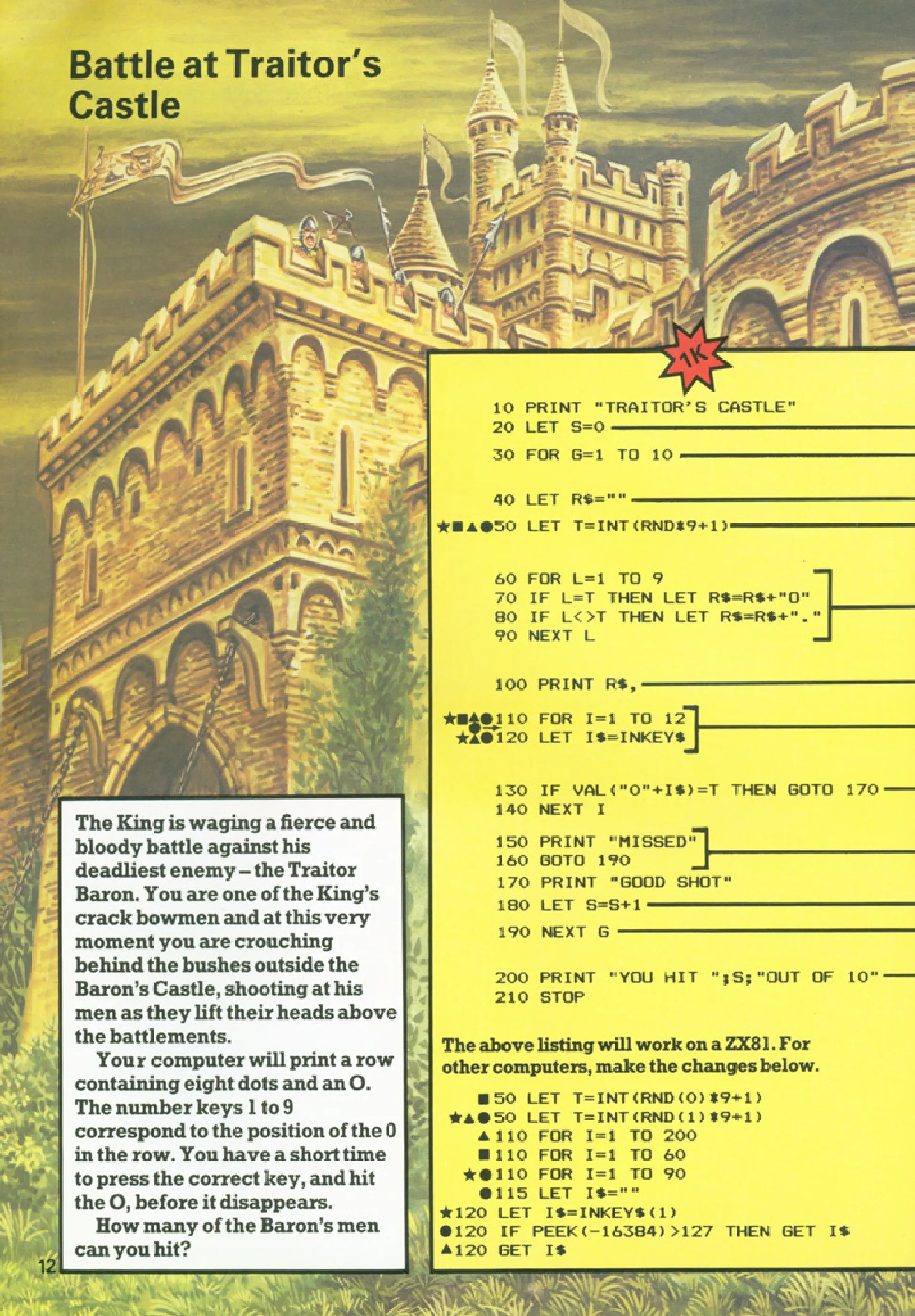
The King is waging a fierce and bloody battle against his deadliest enemy – the Traitor Baron. You are one of the King’s crack bowmen, crouched behind the bushes outside the Baron’s Castle. Your mission is to shoot at the Baron’s men as they lift their heads above the battlements. The computer will display a row with eight dots and an “O” representing a target. You must quickly press the correct number (1 to 9) corresponding to the position of “O” before it disappears. How many of the Baron’s men can you hit?
Pseudocode
STARTPRINT "TRAITOR'S CASTLE"SET score (S) to 0FOR 10 rounds:    SET an empty string (R$)    GENERATE a random number (T) between 1 and 9    FOR each position (L) from 1 to 9:        IF position matches T:            ADD "0" to R$        ELSE:            ADD "." to R$    PRINT the row R$
    WAIT for user input (I$) for 12 iterations:        IF user input matches T:            PRINT "GOOD SHOT"            INCREMENT score (S) by 1            BREAK loop        ELSE:            PRINT "MISSED"    END WAIT
PRINT "YOU HIT", S, "OUT OF 10"END
Flowchart
graph TD
    Start --> Display[Display 'TRAITOR'S CASTLE']
    Display --> InitScore[Initialize score to 0]
    InitScore --> Rounds[Repeat for 10 rounds]
    Rounds --> GenerateRow[Generate a row with 8 dots and an 'O']
    GenerateRow --> DisplayRow[Display the generated row]
    DisplayRow --> WaitInput[Wait for user input for 12 iterations]
    WaitInput --> Match[Check if input matches the position of 'O']
    Match -->|Yes| GoodShot[Display 'GOOD SHOT' and increment score]
    Match -->|No| Missed[Display 'MISSED']
    GoodShot --> Rounds
    Missed --> Rounds
    Rounds -->|After 10 rounds| DisplayScore[Display 'YOU HIT S OUT OF 10']
    DisplayScore --> End[End]
Code
Pages
ZX-81 BASIC
10 PRINT "TRAITOR'S CASTLE"20 LET S=030 FOR G=1 TO 1040 LET R$=""50 LET T=INT(RND*9)+160 FOR L=1 TO 970 IF L=T THEN LET R$=R$+"0"80 IF L<>T THEN LET R$=R$+"."90 NEXT L100 PRINT R$110 FOR I=1 TO 12120 LET I$=INKEY$130 IF VAL(I$) = T THEN GOTO 170140 NEXT I150 PRINT "MISSED"160 GOTO 180170 PRINT "GOOD SHOT"175 LET S=S+1180 NEXT G190 PRINT "YOU HIT ";S;" OUT OF 10"210 STOPC#
using System;
class TraitorsCastle{    static void Main()    {        Console.WriteLine("TRAITOR'S CASTLE");        int score = 0;
        Random random = new Random();
        for (int round = 1; round <= 10; round++)        {            string row = "";            int targetPosition = random.Next(1, 10);
            for (int position = 1; position <= 9; position++)            {                if (position == targetPosition)                {                    row += "0";                }                else                {                    row += ".";                }            }
            Console.WriteLine(row);
            bool hit = false;            for (int i = 0; i < 12; i++)            {                string input = Console.ReadLine();
                if (int.TryParse(input, out int userGuess) && userGuess == targetPosition)                {                    Console.WriteLine("GOOD SHOT");                    score++;                    hit = true;                    break;                }            }
            if (!hit)            {                Console.WriteLine("MISSED");            }        }
        Console.WriteLine($"YOU HIT {score} OUT OF 10");    }}
Python
import random
print("TRAITOR'S CASTLE")score = 0
for _ in range(10):    row = ""    target_position = random.randint(1, 9)
    for position in range(1, 10):        if position == target_position:            row += "0"        else:            row += "."
    print(row)
    hit = False    for _ in range(12):        try:            user_guess = int(input("Your guess: "))            if user_guess == target_position:                print("GOOD SHOT")                score += 1                hit = True                break        except ValueError:            pass
    if not hit:        print("MISSED")
print(f"YOU HIT {score} OUT OF 10")
Java
import java.util.Scanner;import java.util.Random;
public class TraitorsCastle {    public static void main(String[] args) {        System.out.println("TRAITOR'S CASTLE");        Scanner scanner = new Scanner(System.in);        Random random = new Random();        int score = 0;
        for (int round = 0; round < 10; round++) {            StringBuilder row = new StringBuilder();            int targetPosition = random.nextInt(9) + 1;
            for (int position = 1; position <= 9; position++) {                if (position == targetPosition) {                    row.append("0");                } else {                    row.append(".");                }            }
            System.out.println(row);
            boolean hit = false;            for (int i = 0; i < 12; i++) {                String input = scanner.nextLine();                try {                    int userGuess = Integer.parseInt(input);                    if (userGuess == targetPosition) {                        System.out.println("GOOD SHOT");                        score++;                        hit = true;                        break;                    }                } catch (NumberFormatException e) {                    // Ignore invalid input                }            }
            if (!hit) {                System.out.println("MISSED");            }        }
        System.out.printf("YOU HIT %d OUT OF 10\n", score);    }}
Go
package main
import (  "fmt"  "math/rand"  "time")
func main() {  fmt.Println("TRAITOR'S CASTLE")  rand.Seed(time.Now().UnixNano())  var score int
  for round := 0; round < 10; round++ {    row := ""    targetPosition := rand.Intn(9) + 1
    for position := 1; position <= 9; position++ {      if position == targetPosition {        row += "0"      } else {        row += "."      }    }
    fmt.Println(row)
    hit := false    for i := 0; i < 12; i++ {      var userGuess int      fmt.Scan(&userGuess)      if userGuess == targetPosition {        fmt.Println("GOOD SHOT")        score++        hit = true        break      }    }
    if !hit {      fmt.Println("MISSED")    }  }
  fmt.Printf("YOU HIT %d OUT OF 10\n", score)}
C++
#include <iostream>#include <string>#include <cstdlib>#include <ctime>
using namespace std;
int main() {    cout << "TRAITOR'S CASTLE" << endl;    srand(time(0));    int score = 0;
    for (int round = 0; round < 10; round++) {        string row = "";        int targetPosition = rand() % 9 + 1;
        for (int position = 1; position <= 9; position++) {            if (position == targetPosition) {                row += "0";            } else {                row += ".";            }        }
        cout << row << endl;
        bool hit = false;        for (int i = 0; i < 12; i++) {            int userGuess;            cin >> userGuess;            if (userGuess == targetPosition) {                cout << "GOOD SHOT" << endl;                score++;                hit = true;                break;            }        }
        if (!hit) {            cout << "MISSED" << endl;        }    }
    cout << "YOU HIT " << score << " OUT OF 10" << endl;    return 0;}
Explanation
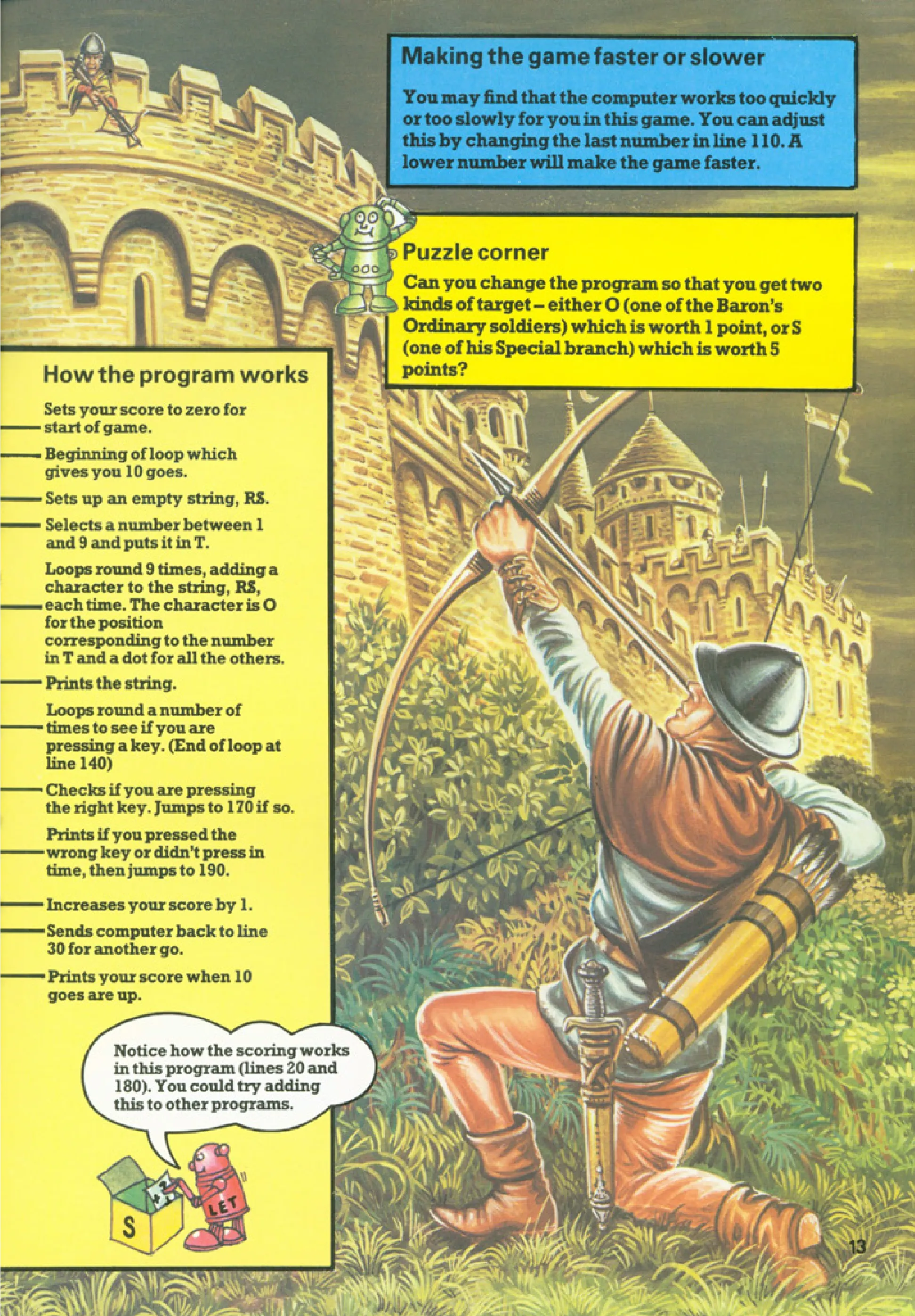
This game simulates an archer defending a castle. The program generates a random position for a target in a row of dots. The player has to guess the position of the target before it disappears. The game counts and displays the total number of hits after 10 rounds.
Challenges
- Increase Difficulty: Reduce the time available to input the guess.
- Add Features: Introduce different types of targets with varying points.
- Customize: Allow the player to adjust the number of rounds or the speed of the game.
Copyright
These programs are adaptations of the original Usborne Computer Guides published in the 1980s. The books are free to download for personal or educational use from Usborne’s Computer and Coding Books. Programs and adaptations may not be used for commercial purposes.
Return to Computer Battlegames.