Iceberg
Book: Computer Battlegames
Author: Usborne Publishing
Translator: Marcus Medina
Story
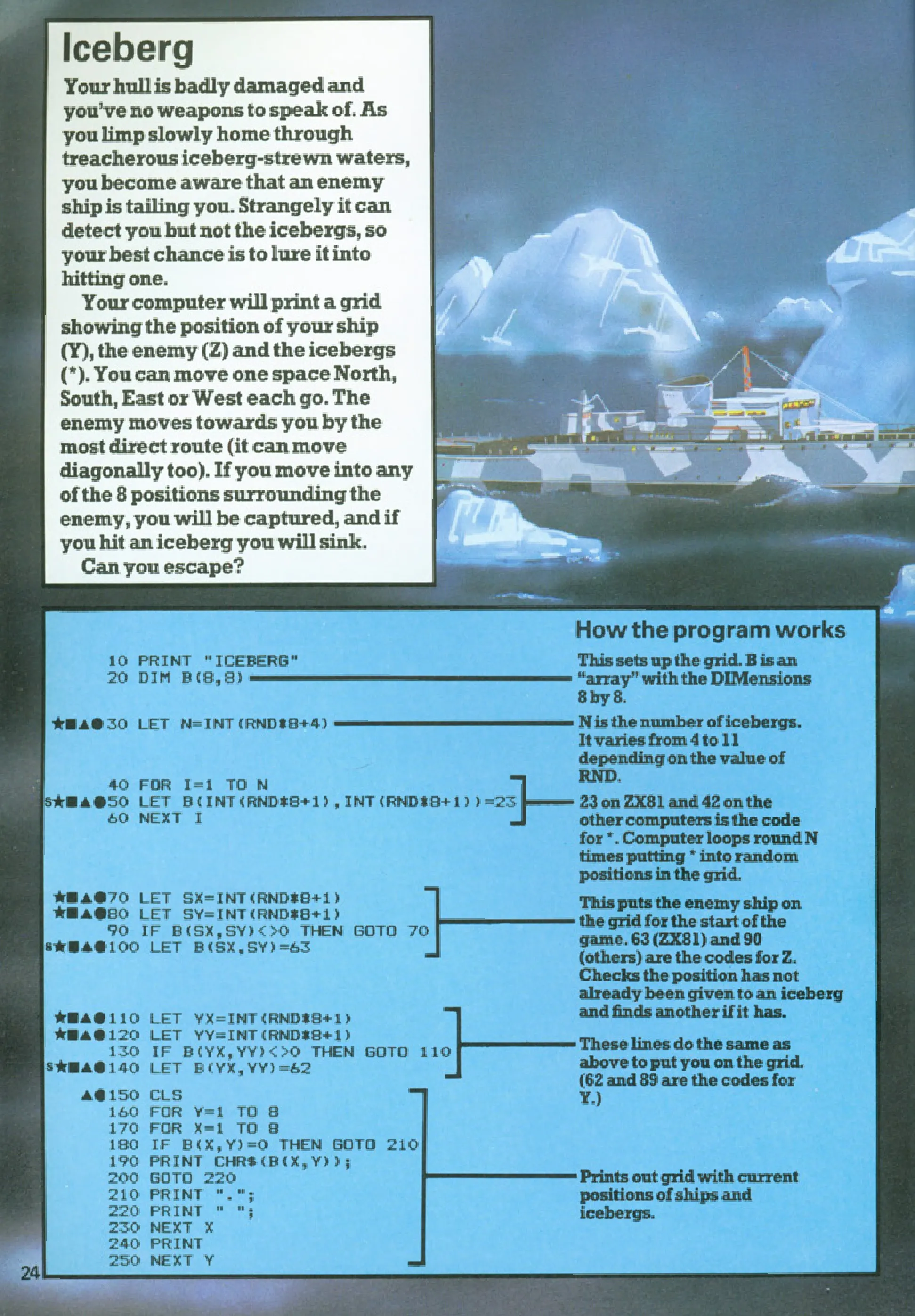
Your hull is badly damaged and you have no time to speak of. As you limp slowly home through treacherous frozen waters, you become aware that an enemy ship is after you. Strangely, it can only detect you if you stop moving. Your best chance is to lure it into an iceberg and escape. Can you escape?
Pseudocode
startinitialize grid and set positions for ship, enemy, and icebergsfor each turn: display grid get player move (north, south, east, west) update ship position check for collisions with icebergs or the enemy if collision: end game with failure message update enemy position if player escapes: display success message and end gameendFlowchart
graph TD
    Start --> Initialize[Initialize grid and positions]
    Initialize --> TurnLoop[FOR each turn]
    TurnLoop --> DisplayGrid[Display grid]
    DisplayGrid --> GetMove[Get player move]
    GetMove --> UpdatePlayer[Update player position]
    UpdatePlayer --> CheckCollision{Collision with iceberg or enemy?}
    CheckCollision -->|Yes| EndGame[End game with failure message]
    CheckCollision -->|No| UpdateEnemy[Update enemy position]
    UpdateEnemy --> Escape{Player escaped?}
    Escape -->|Yes| Success[Display success message]
    Escape -->|No| TurnLoop
    Success --> End
    EndGame --> End
Code
Pages
ZX-81 BASIC
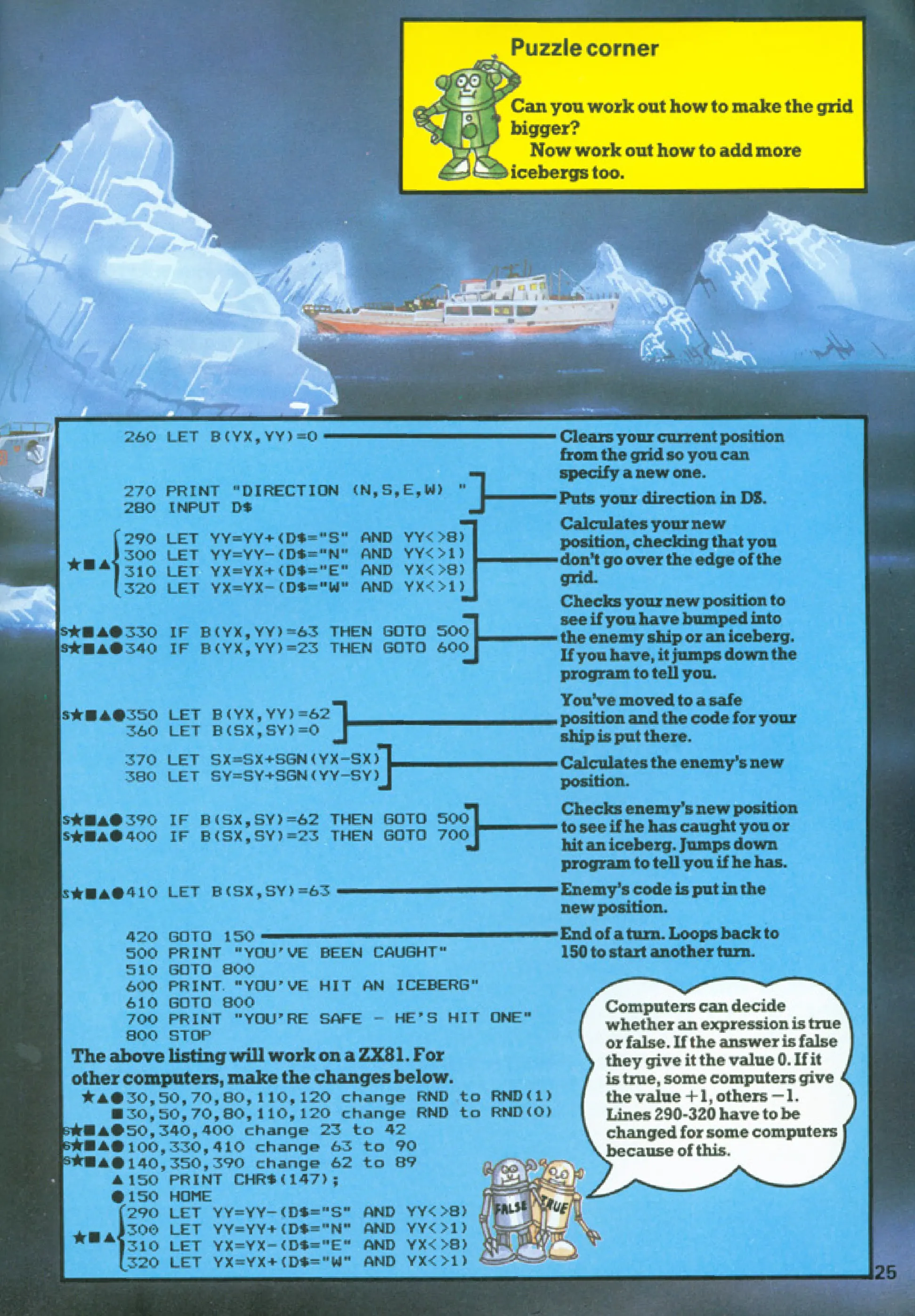
10 PRINT "ICEBERG"20 DIM B(8,8)30 LET N=INT(RND*4)+440 FOR I=1 TO N50 LET B(INT(RND*8)+1, INT(RND*8)+1)=2360 NEXT I70 LET SX=INT(RND*8)+180 LET SY=INT(RND*8)+190 IF B(SX,SY)<>0 THEN GOTO 70100 LET B(SX,SY)=63110 LET YX=INT(RND*8)+1120 LET YY=INT(RND*8)+1130 IF B(YX,YY)<>0 THEN GOTO 110140 LET B(YX,YY)=62150 CLS160 FOR Y=1 TO 8170 FOR X=1 TO 8180 IF B(X,Y)>0 THEN GOTO 210190 PRINT CHR$(B(X,Y));200 GOTO 220210 PRINT " ";220 NEXT X230 PRINT240 NEXT Y250 INPUT D$260 LET B(YX,YY)=0270 PRINT "DIRECTION (N,S,E,W) "280 INPUT D$290 LET YY=YY+(D$="S" AND YY<8)300 LET YY=YY-(D$="N" AND YY>1)310 LET YX=YX+(D$="E" AND YX<8)320 LET YX=YX-(D$="W" AND YX>1)330 IF B(YX,YY)=63 THEN GOTO 500340 IF B(YX,YY)=23 THEN GOTO 600350 LET B(SX,SY)=42360 LET B(SX,SY)=0370 LET SX=SX+SGN(YX-SX)380 LET SY=SY+SGN(YY-SY)390 IF B(SX,SY)=42 THEN GOTO 500400 IF B(SX,SY)=23 THEN GOTO 700410 LET B(SX,SY)=63420 GOTO 150500 PRINT "YOU'VE BEEN CAUGHT"510 GOTO 800600 PRINT "YOU'VE HIT AN ICEBERG"610 GOTO 800700 PRINT "YOU'RE SAFE - HE'S HIT ONE"800 STOPC#
using System;
class Iceberg{    static void Main()    {        Console.WriteLine("Iceberg");
        char[,] grid = new char[8, 8];        Random random = new Random();
        int playerX = random.Next(0, 8);        int playerY = random.Next(0, 8);        int enemyX = random.Next(0, 8);        int enemyY = random.Next(0, 8);
        // Add icebergs        int[,] icebergs = new int[8, 8];        for (int i = 0; i < 4; i++)        {            int x, y;            do            {                x = random.Next(0, 8);                y = random.Next(0, 8);            } while (icebergs[x, y] == 1 || (x == playerX && y == playerY) || (x == enemyX && y == enemyY));            icebergs[x, y] = 1;        }
        for (int i = 0; i < 10; i++)        {            Console.Clear();            DisplayGrid(grid, playerX, playerY, enemyX, enemyY, icebergs);
            Console.Write("Move (N/S/E/W): ");            char move = char.ToUpper(Console.ReadKey().KeyChar);
            switch (move)            {                case 'N': playerX = Math.Max(0, playerX - 1); break;                case 'S': playerX = Math.Min(7, playerX + 1); break;                case 'E': playerY = Math.Min(7, playerY + 1); break;                case 'W': playerY = Math.Max(0, playerY - 1); break;            }
            if (icebergs[playerX, playerY] == 1)            {                Console.WriteLine("You hit an iceberg!");                return;            }
            if (playerX == enemyX && playerY == enemyY)            {                Console.WriteLine("You've been caught!");                return;            }
            enemyX = Math.Max(0, Math.Min(7, enemyX + random.Next(-1, 2)));            enemyY = Math.Max(0, Math.Min(7, enemyY + random.Next(-1, 2)));
            if (icebergs[enemyX, enemyY] == 1)            {                Console.WriteLine("Enemy hit an iceberg! You're safe!");                return;            }        }
        Console.WriteLine("You escaped!");    }
    static void DisplayGrid(char[,] grid, int playerX, int playerY, int enemyX, int enemyY, int[,] icebergs)    {        for (int x = 0; x < 8; x++)        {            for (int y = 0; y < 8; y++)            {                if (x == playerX && y == playerY) Console.Write("P ");                else if (x == enemyX && y == enemyY) Console.Write("E ");                else if (icebergs[x, y] == 1) Console.Write("I ");                else Console.Write(". ");            }            Console.WriteLine();        }    }}
Python
import random
print("Iceberg")grid_size = 8player = [random.randint(0, grid_size - 1), random.randint(0, grid_size - 1)]enemy = [random.randint(0, grid_size - 1), random.randint(0, grid_size - 1)]icebergs = set()
# Place icebergsfor _ in range(4):    while True:        iceberg = (random.randint(0, grid_size - 1), random.randint(0, grid_size - 1))        if iceberg not in icebergs and iceberg != tuple(player) and iceberg != tuple(enemy):            icebergs.add(iceberg)            break
for turn in range(10):    for x in range(grid_size):        for y in range(grid_size):            if [x, y] == player:                print("P", end=" ")            elif [x, y] == enemy:                print("E", end=" ")            elif (x, y) in icebergs:                print("I", end=" ")            else:                print(".", end=" ")        print()
    move = input("Move (N/S/E/W): ").upper()    if move == 'N': player[0] = max(0, player[0] - 1)    elif move == 'S': player[0] = min(grid_size - 1, player[0] + 1)    elif move == 'E': player[1] = min(grid_size - 1, player[1] + 1)    elif move == 'W': player[1] = max(0, player[1] - 1)
    if tuple(player) in icebergs:        print("You hit an iceberg!")        break
    if player == enemy:        print("You've been caught!")        break
    enemy = [max(0, min(grid_size - 1, enemy[0] + random.randint(-1, 1))), max(0, min(grid_size - 1, enemy[1] + random.randint(-1, 1)))]
    if tuple(enemy) in icebergs:        print("Enemy hit an iceberg! You're safe!")        break
else:    print("You escaped!")
Java
import java.util.Random;import java.util.Scanner;import java.util.HashSet;
public class Iceberg {    public static void main(String[] args) {        Scanner scanner = new Scanner(System.in);        Random random = new Random();
        int gridSize = 8;        int playerX = random.nextInt(gridSize);        int playerY = random.nextInt(gridSize);        int enemyX = random.nextInt(gridSize);        int enemyY = random.nextInt(gridSize);
        HashSet<String> icebergs = new HashSet<>();        for (int i = 0; i < 4; i++) {            int x, y;            do {                x = random.nextInt(gridSize);                y = random.nextInt(gridSize);            } while (icebergs.contains(x + "," + y) || (x == playerX && y == playerY) || (x == enemyX && y == enemyY));            icebergs.add(x + "," + y);        }
        for (int turn = 0; turn < 10; turn++) {            for (int x = 0; x < gridSize; x++) {                for (int y = 0; y < gridSize; y++) {                    if (x == playerX && y == playerY) {                        System.out.print("P ");                    } else if (x == enemyX && y == enemyY) {                        System.out.print("E ");                    } else if (icebergs.contains(x + "," + y)) {                        System.out.print("I ");                    } else {                        System.out.print(". ");                    }                }                System.out.println();            }
            System.out.print("Move (N/S/E/W): ");            char move = scanner.next().toUpperCase().charAt(0);
            switch (move) {                case 'N': playerX = Math.max(0, playerX - 1); break;                case 'S': playerX = Math.min(gridSize - 1, playerX + 1); break;                case 'E': playerY = Math.min(gridSize - 1, playerY + 1); break;                case 'W': playerY = Math.max(0, playerY - 1); break;            }
            if (icebergs.contains(playerX + "," + playerY)) {                System.out.println("You hit an iceberg!");                break;            }
            if (playerX == enemyX && playerY == enemyY) {                System.out.println("You've been caught!");                break;            }
            enemyX = Math.max(0, Math.min(gridSize - 1, enemyX + random.nextInt(3) - 1));            enemyY = Math.max(0, Math.min(gridSize - 1, enemyY + random.nextInt(3) - 1));
            if (icebergs.contains(enemyX + "," + enemyY)) {                System.out.println("Enemy hit an iceberg! You're safe!");                break;            }        }
        scanner.close();    }}
Go
package main
import (  "fmt"  "math/rand"  "time")
func main() {  rand.Seed(time.Now().UnixNano())  gridSize := 8  playerX, playerY := rand.Intn(gridSize), rand.Intn(gridSize)  enemyX, enemyY := rand.Intn(gridSize), rand.Intn(gridSize)  icebergs := make(map[[2]int]bool)
  // Place icebergs  for i := 0; i < 4; i++ {    for {      x, y := rand.Intn(gridSize), rand.Intn(gridSize)      if !icebergs[[2]int{x, y}] && (x != playerX || y != playerY) && (x != enemyX || y != enemyY) {        icebergs[[2]int{x, y}] = true        break      }    }  }
  for turn := 0; turn < 10; turn++ {    for x := 0; x < gridSize; x++ {      for y := 0; y < gridSize; y++ {        switch {        case x == playerX && y == playerY:          fmt.Print("P ")        case x == enemyX && y == enemyY:          fmt.Print("E ")        case icebergs[[2]int{x, y}]:          fmt.Print("I ")        default:          fmt.Print(". ")        }      }      fmt.Println()    }
    var move string    fmt.Print("Move (N/S/E/W): ")    fmt.Scan(&move)
    switch move {    case "N":      if playerX > 0 {        playerX--      }    case "S":      if playerX < gridSize-1 {        playerX++      }    case "E":      if playerY < gridSize-1 {        playerY++      }    case "W":      if playerY > 0 {        playerY--      }    }
    if icebergs[[2]int{playerX, playerY}] {      fmt.Println("You hit an iceberg!")      return    }
    if playerX == enemyX && playerY == enemyY {      fmt.Println("You've been caught!")      return    }
    enemyX += rand.Intn(3) - 1    enemyY += rand.Intn(3) - 1
    if icebergs[[2]int{enemyX, enemyY}] {      fmt.Println("Enemy hit an iceberg! You're safe!")      return    }  }
  fmt.Println("You escaped!")}
C++
#include <iostream>#include <set>#include <utility>#include <cstdlib>#include <ctime>using namespace std;
int main() {    srand(static_cast<unsigned>(time(0)));
    const int gridSize = 8;    int playerX = rand() % gridSize;    int playerY = rand() % gridSize;    int enemyX = rand() % gridSize;    int enemyY = rand() % gridSize;
    set<pair<int, int>> icebergs;    for (int i = 0; i < 4; i++) {        int x, y;        do {            x = rand() % gridSize;            y = rand() % gridSize;        } while (icebergs.count({x, y}) || (x == playerX && y == playerY) || (x == enemyX && y == enemyY));        icebergs.insert({x, y});    }
    for (int turn = 0; turn < 10; turn++) {        for (int x = 0; x < gridSize; x++) {            for (int y = 0; y < gridSize; y++) {                if (x == playerX && y == playerY)                    cout << "P ";                else if (x == enemyX && y == enemyY)                    cout << "E ";                else if (icebergs.count({x, y}))                    cout << "I ";                else                    cout << ". ";            }            cout << endl;        }
        char move;        cout << "Move (N/S/E/W): ";        cin >> move;
        switch (toupper(move)) {            case 'N': if (playerX > 0) playerX--; break;            case 'S': if (playerX < gridSize - 1) playerX++; break;            case 'E': if (playerY < gridSize - 1) playerY++; break;            case 'W': if (playerY > 0) playerY--; break;        }
        if (icebergs.count({playerX, playerY})) {            cout << "You hit an iceberg!" << endl;            return 0;        }
        if (playerX == enemyX && playerY == enemyY) {            cout << "You've been caught!" << endl;            return 0;        }
        enemyX = max(0, min(gridSize - 1, enemyX + (rand() % 3 - 1)));        enemyY = max(0, min(gridSize - 1, enemyY + (rand() % 3 - 1)));
        if (icebergs.count({enemyX, enemyY})) {            cout << "Enemy hit an iceberg! You're safe!" << endl;            return 0;        }    }
    cout << "You escaped!" << endl;    return 0;}
Explanation
- Objective: Escape the grid without colliding with icebergs or the enemy ship.
- Gameplay: Players move on the grid using cardinal directions while the enemy ship attempts to follow.
- Win Condition: Successfully avoid obstacles and the enemy for 10 turns.
Challenges
-
Increase Difficulty:
- Add more icebergs to the grid.
- Reduce the number of safe turns required for escape.
-
Add Features:
- Introduce power-ups or safe zones.
- Add multiple enemy ships with varied movement patterns.
-
Customize:
- Change the grid size for more strategic gameplay.
- Introduce a dynamic grid where obstacles appear or move each turn.
Book Information
- Title: Computer Battlegames
- Publisher: Usborne Publishing
Copyright
These programs are adaptations of the original Usborne Computer Guides published in the 1980s. The books are free to download for personal or educational use from Usborne’s Computer and Coding Books. Programs and adaptations may not be used for commercial purposes.
Return to Computer Battlegames.