Secret Weapon
Book: Computer Battlegames
Author: Usborne Publishing
Translator: Marcus Medina
Story
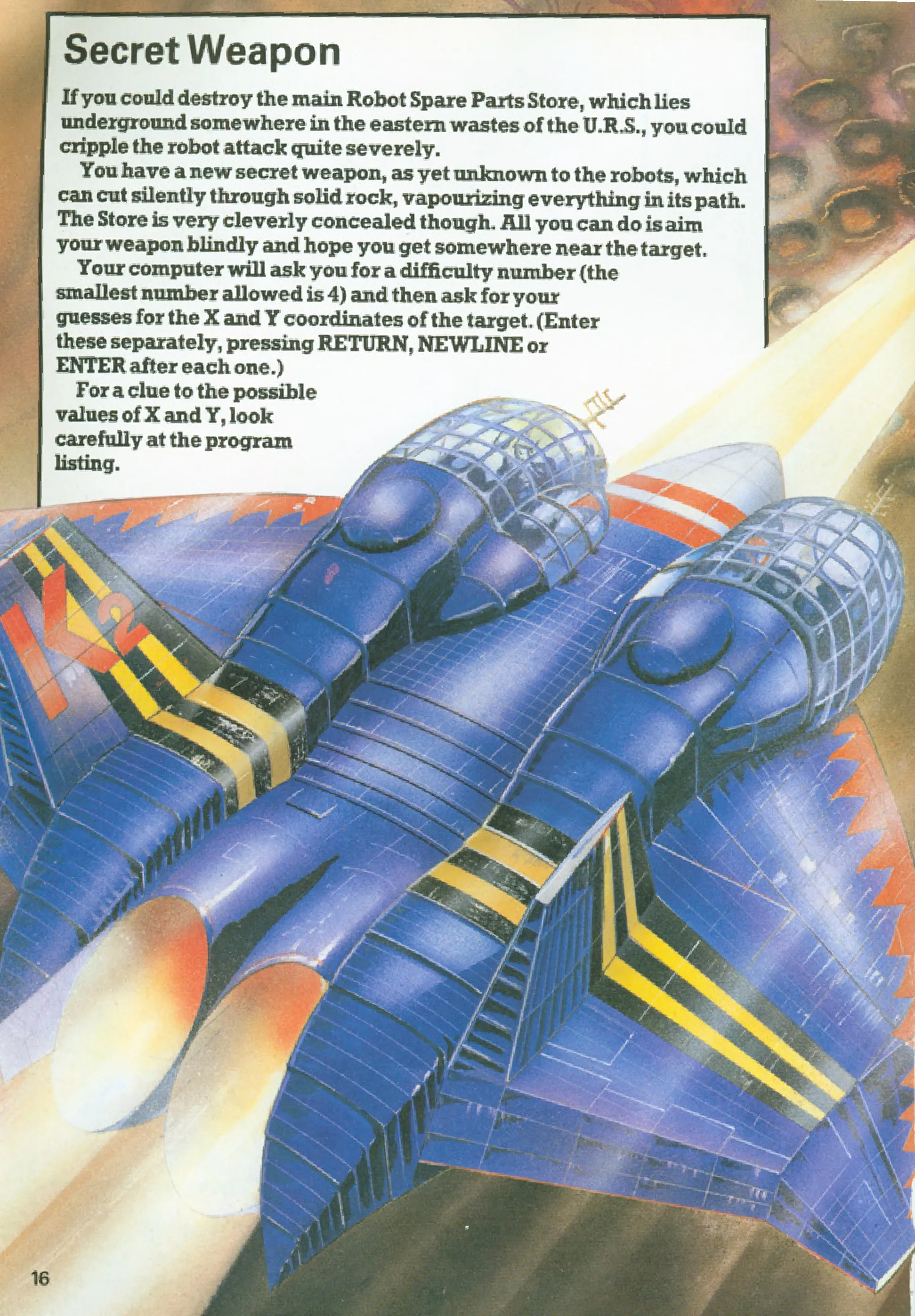
If you could destroy the main Robot Spare Parts Store, which lies underground somewhere in the eastern wastes of the U.R.S., you could cripple the robot attack quite severely.
You have a new secret weapon, as yet unknown to the robots, which can cut silently through solid rock, vaporizing everything in its path. The Store is very cleverly concealed though. All you can do is aim your weapon blindly and hope you get somewhere near the target.
Your computer will ask for a difficulty number (the smallest number allowed is 4) and then ask for your guesses for the X and Y coordinates of the target. (Enter these separately, pressing RETURN, NEWLINE or ENTER after each one.)
For a clue to the possible values of X and Y, look carefully at the program listing.
Pseudocode
STARTClear screenDisplay game title and instructionsPrompt player for difficulty level (D)Validate difficulty (D >= 4)Generate random coordinates X and Y within difficulty rangeFOR each guess (G) up to D+5: Prompt player to input X1 and Y1 Calculate distance Z = sqrt((X - X1)^2 + (Y - Y1)^2) IF Z == 0 THEN Display success message End game ELSE IF Z < 3 THEN Display "Close" ELSE Display "Not even close" ENDIFENDFORDisplay failure messageENDFlowchart
flowchart TD
    Start --> ClearScreen["Clear screen"]
    ClearScreen --> Title["Display game title and instructions"]
    Title --> Difficulty["Prompt player for difficulty level"]
    Difficulty --> Validate["Validate difficulty (D >= 4)"]
    Validate --> Generate["Generate random coordinates X and Y"]
    Generate --> GuessLoop["FOR each guess (G) up to D+5"]
    GuessLoop --> InputGuess["Prompt player for X1 and Y1"]
    InputGuess --> Calculate["Calculate distance Z"]
    Calculate -->|Z == 0| Success["Display success message"]
    Success --> End["End game"]
    Calculate -->|Z < 3| Close["Display 'Close'"]
    Close --> GuessLoop
    Calculate -->|Z >= 3| Far["Display 'Not even close'"]
    Far --> GuessLoop
    GuessLoop --> Failure["Display failure message"]
    Failure --> End
Code
Pages
ZX-81 BASIC
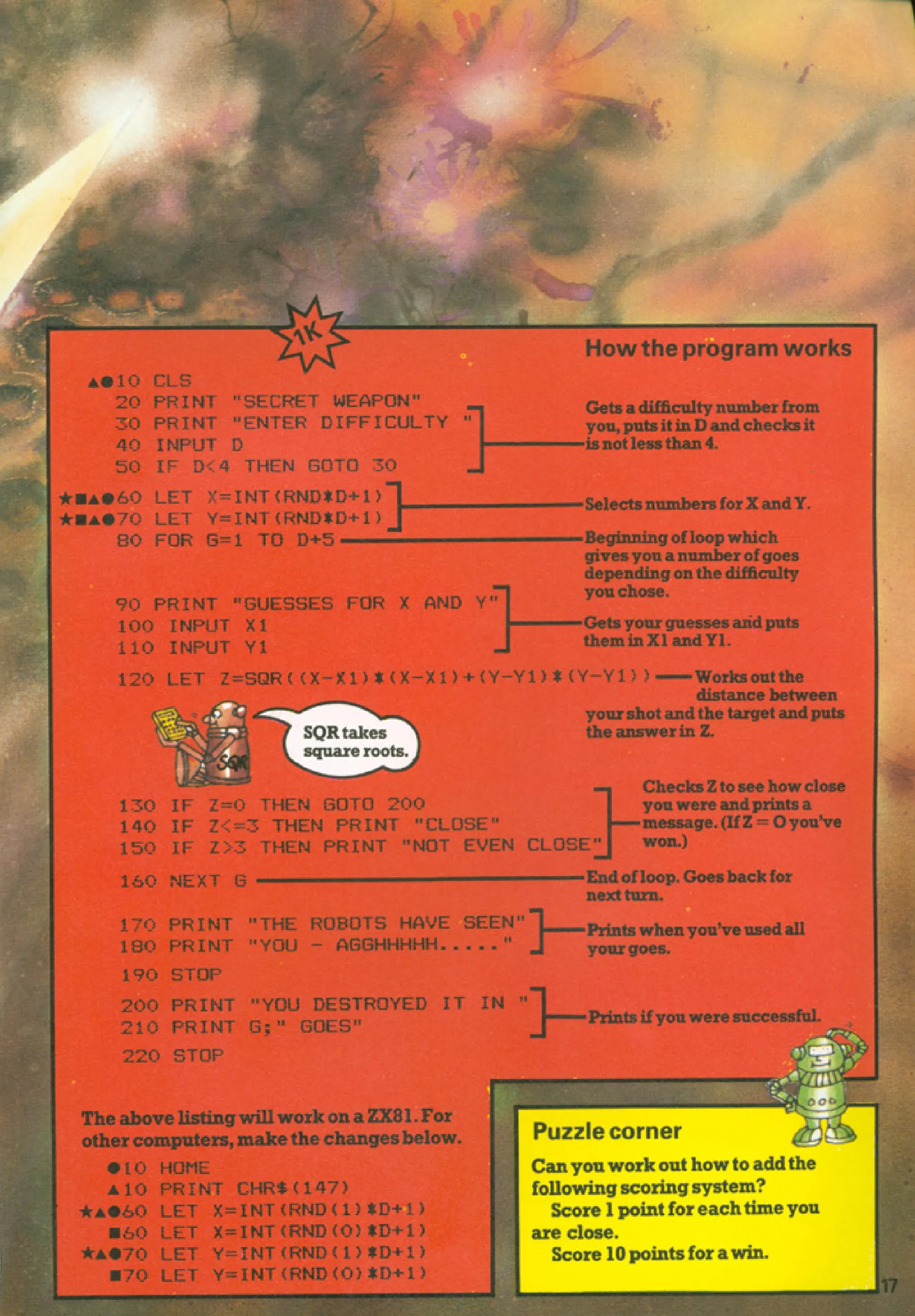
10 CLS20 PRINT "SECRET WEAPON"30 PRINT "ENTER DIFFICULTY "40 INPUT D50 IF D<4 THEN GOTO 3060 LET X=INT(RND*D+1)70 LET Y=INT(RND*D+1)80 FOR G=1 TO D+590 PRINT "GUESSES FOR X AND Y"100 INPUT X1110 INPUT Y1120 LET Z=SQR((X-X1)*(X-X1)+(Y-Y1)*(Y-Y1))130 IF Z=0 THEN GOTO 200140 IF Z<3 THEN PRINT "CLOSE"150 IF Z>3 THEN PRINT "NOT EVEN CLOSE"160 NEXT G170 PRINT "THE ROBOTS HAVE SEEN"180 PRINT "YOU - AGGHHHH....."190 PRINT200 PRINT "YOU DESTROYED IT IN"210 PRINT G; " GOES"220 STOPC#
using System;
class Program{    static void Main()    {        Console.Clear();        Console.WriteLine("SECRET WEAPON");        Console.WriteLine("ENTER DIFFICULTY (minimum 4):");
        int difficulty;        do        {            if (!int.TryParse(Console.ReadLine(), out difficulty) || difficulty < 4)            {                Console.WriteLine("Invalid input. Enter a number >= 4:");            }        } while (difficulty < 4);
        Random rand = new Random();        int targetX = rand.Next(1, difficulty + 1);        int targetY = rand.Next(1, difficulty + 1);
        for (int g = 1; g <= difficulty + 5; g++)        {            int guessX;            do            {                Console.WriteLine("GUESS X:");            } while (!int.TryParse(Console.ReadLine(), out guessX));
            int guessY;            do            {                Console.WriteLine("GUESS Y:");            } while (!int.TryParse(Console.ReadLine(), out guessY));
            double distance = Math.Sqrt(Math.Pow(targetX - guessX, 2) + Math.Pow(targetY - guessY, 2));
            if (distance == 0)            {                Console.WriteLine($"YOU DESTROYED IT IN {g} GOES!");                return;            }            else if (distance < 3)            {                Console.WriteLine("CLOSE");            }            else            {                Console.WriteLine("NOT EVEN CLOSE");            }        }
        Console.WriteLine("THE ROBOTS HAVE SEEN YOU - AGGHHHH.....");    }}
Python
import mathimport random
def main():    print("SECRET WEAPON")    difficulty = 0
    while difficulty < 4:        try:            difficulty = int(input("ENTER DIFFICULTY (minimum 4): "))        except ValueError:            pass
    target_x = random.randint(1, difficulty)    target_y = random.randint(1, difficulty)
    for g in range(1, difficulty + 6):        guess_x = int(input("GUESS X: "))        guess_y = int(input("GUESS Y: "))
        distance = math.sqrt((target_x - guess_x) ** 2 + (target_y - guess_y) ** 2)
        if distance == 0:            print(f"YOU DESTROYED IT IN {g} GOES!")            return        elif distance < 3:            print("CLOSE")        else:            print("NOT EVEN CLOSE")
    print("THE ROBOTS HAVE SEEN YOU - AGGHHHH.....")
if __name__ == "__main__":    main()
Java
import java.util.Scanner;import java.util.Random;
public class SecretWeapon {    public static void main(String[] args) {        Scanner scanner = new Scanner(System.in);        Random random = new Random();
        System.out.println("SECRET WEAPON");        int difficulty = 0;
        while (difficulty < 4) {            System.out.print("ENTER DIFFICULTY (minimum 4): ");            difficulty = scanner.nextInt();        }
        int targetX = random.nextInt(difficulty) + 1;        int targetY = random.nextInt(difficulty) + 1;
        for (int g = 1; g <= difficulty + 5; g++) {            System.out.print("GUESS X: ");            int guessX = scanner.nextInt();
            System.out.print("GUESS Y: ");            int guessY = scanner.nextInt();
            double distance = Math.sqrt(Math.pow(targetX - guessX, 2) + Math.pow(targetY - guessY, 2));
            if (distance == 0) {                System.out.println("YOU DESTROYED IT IN " + g + " GOES!");                return;            } else if (distance < 3) {                System.out.println("CLOSE");            } else {                System.out.println("NOT EVEN CLOSE");            }        }
        System.out.println("THE ROBOTS HAVE SEEN YOU - AGGHHHH.....");    }}
Go
package main
import (  "fmt"  "math"  "math/rand"  "time")
func main() {  rand.Seed(time.Now().UnixNano())  fmt.Println("SECRET WEAPON")
  var difficulty int  for difficulty < 4 {    fmt.Print("ENTER DIFFICULTY (minimum 4): ")    fmt.Scan(&difficulty)  }
  targetX := rand.Intn(difficulty) + 1  targetY := rand.Intn(difficulty) + 1
  for g := 1; g <= difficulty+5; g++ {    var guessX, guessY int    fmt.Print("GUESS X: ")    fmt.Scan(&guessX)    fmt.Print("GUESS Y: ")    fmt.Scan(&guessY)
    distance := math.Sqrt(math.Pow(float64(targetX-guessX), 2) + math.Pow(float64(targetY-guessY), 2))
    if distance == 0 {      fmt.Printf("YOU DESTROYED IT IN %d GOES!\n", g)      return    } else if distance < 3 {      fmt.Println("CLOSE")    } else {      fmt.Println("NOT EVEN CLOSE")    }  }
  fmt.Println("THE ROBOTS HAVE SEEN YOU - AGGHHHH.....")}
C++
#include <iostream>#include <cmath>#include <cstdlib>#include <ctime>
int main() {    std::cout << "SECRET WEAPON" << std::endl;
    int difficulty = 0;    while (difficulty < 4) {        std::cout << "ENTER DIFFICULTY (minimum 4): ";        std::cin >> difficulty;    }
    srand(time(0));    int targetX = rand() % difficulty + 1;    int targetY = rand() % difficulty + 1;
    for (int g = 1; g <= difficulty + 5; g++) {        int guessX, guessY;        std::cout << "GUESS X: ";        std::cin >> guessX;        std::cout << "GUESS Y: ";        std::cin >> guessY;
        double distance = std::sqrt(std::pow(targetX - guessX, 2) + std::pow(targetY - guessY, 2));
        if (distance == 0) {            std::cout << "YOU DESTROYED IT IN " << g << " GOES!" << std::endl;            return 0;        } else if (distance < 3) {            std::cout << "CLOSE" << std::endl;        } else {            std::cout << "NOT EVEN CLOSE" << std::endl;        }    }
    std::cout << "THE ROBOTS HAVE SEEN YOU - AGGHHHH....." << std::endl;    return 0;}
Explanation
- The game generates random X and Y coordinates for a target based on the chosen difficulty level.
- The player must guess the coordinates, with feedback given based on how close the guess is.
- The distance is calculated using the Pythagorean theorem.
- The game ends when the player guesses correctly or runs out of attempts.
Challenges
- Scoring System:
- Award 1 point for each close guess.
- Award 10 points for a direct hit.
- Increase Difficulty:
- Decrease the “close” threshold to make the game harder.
- Add Features:
- Introduce multiple targets.
- Add a timer to limit how long players have to make guesses.
Copyright
These programs are adaptations of the original Usborne Computer Guides published in the 1980s. The books are free to download for personal or educational use from Usborne’s Computer and Coding Books. Programs and adaptations may not be used for commercial purposes.
Return to Computer Battlegames.