Secret Message Maker
Book: Computer Spy Games
Author: Jenny Tyler and Chris Oxlade
Translator: Marcus Medina
Story
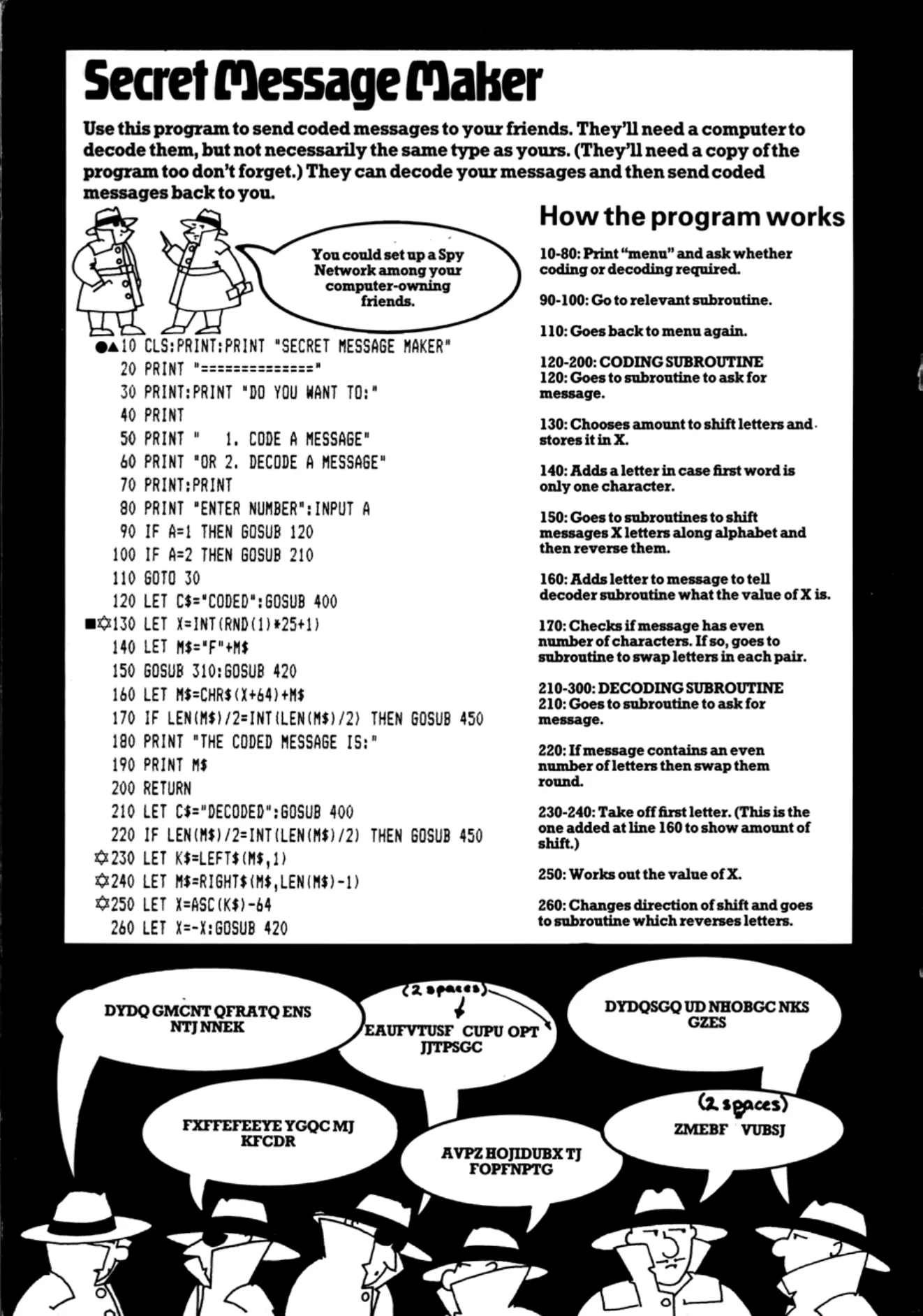
Use this program to send coded messages to your friends. They’ll need a computer to decode them, but not necessarily the same type as yours. (They’ll need a copy of the program too don’t forget.) They can decode your messages and then send coded messages back to you.
Pseudocode
LOOP ASK "Code a message (1) or Decode a message (2)?" IF coding: ASK for the message PICK a random shift amount (1-25) PREPEND a dummy letter SHIFT every letter along the alphabet by the shift amount REVERSE the whole string PREPEND a letter representing the shift amount IF the result has an even length THEN swap each pair of letters DISPLAY the coded message IF decoding: ASK for the coded message IF it has an even length THEN swap each pair of letters back REMOVE the first letter and read it as the shift amount REVERSE the string back SHIFT every letter backwards by that amount REMOVE the leading dummy letter DISPLAY the decoded messageEND LOOPFlowchart
flowchart TD
    Start --> Menu[Ask: Code or Decode?]
    Menu -->|Code| AskMsg1[Ask for the message]
    AskMsg1 --> Shift1[Prepend dummy letter, shift by random amount]
    Shift1 --> Rev1[Reverse the string]
    Rev1 --> Key[Prepend shift-amount letter]
    Key --> Swap1{Even length?}
    Swap1 -->|Yes| DoSwap1[Swap letter pairs]
    Swap1 -->|No| ShowCoded
    DoSwap1 --> ShowCoded[Display coded message]
    ShowCoded --> Menu
    Menu -->|Decode| AskMsg2[Ask for the coded message]
    AskMsg2 --> Swap2{Even length?}
    Swap2 -->|Yes| DoSwap2[Swap letter pairs back]
    Swap2 -->|No| Key2
    DoSwap2 --> Key2[Remove first letter as shift key]
    Key2 --> Rev2[Reverse the string back]
    Rev2 --> Shift2[Shift letters backwards]
    Shift2 --> Strip[Remove leading dummy letter]
    Strip --> ShowDecoded[Display decoded message]
    ShowDecoded --> Menu
Code
Pages
ZX-81 BASIC
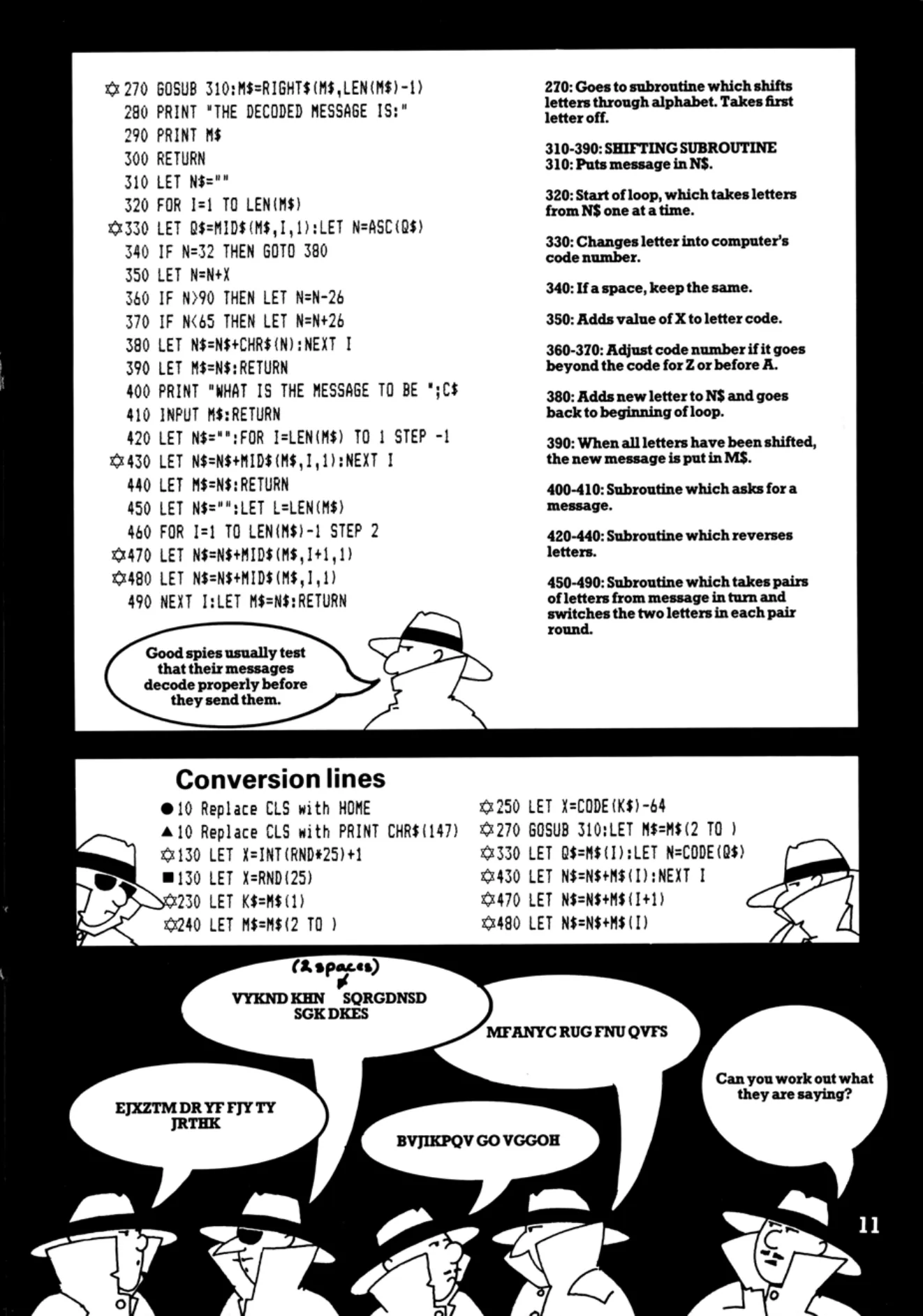
10 CLS:PRINT:PRINT "SECRET MESSAGE MAKER"20 PRINT "==============="30 PRINT:PRINT "DO YOU WANT TO:"40 PRINT50 PRINT " 1. CODE A MESSAGE"60 PRINT "OR 2. DECODE A MESSAGE"70 PRINT:PRINT80 PRINT "ENTER NUMBER":INPUT A90 IF A=1 THEN GOSUB 120100 IF A=2 THEN GOSUB 210110 GOTO 30120 LET C$="CODED":GOSUB 400130 LET X=INT(RND(1)*25+1)140 LET M$="F"+M$150 GOSUB 310:GOSUB 420160 LET M$=CHR$(X+64)+M$170 IF LEN(M$)/2=INT(LEN(M$)/2) THEN GOSUB 450180 PRINT "THE CODED MESSAGE IS:"190 PRINT M$200 RETURN210 LET C$="DECODED":GOSUB 400220 IF LEN(M$)/2=INT(LEN(M$)/2) THEN GOSUB 450230 LET K$=LEFT$(M$,1)240 LET M$=RIGHT$(M$,LEN(M$)-1)250 LET X=ASC(K$)-64260 LET X=-X:GOSUB 420270 GOSUB 310:M$=RIGHT$(M$,LEN(M$)-1)280 PRINT "THE DECODED MESSAGE IS:"290 PRINT M$300 RETURN310 LET N$="":FOR I=1 TO LEN(M$)320 LET Q$=MID$(M$,I,1):LET N=ASC(Q$)330 IF N=32 THEN GOTO 380340 LET N=N+X350 IF N>90 THEN LET N=N-26360 IF N<65 THEN LET N=N+26370 LET N$=N$+CHR$(N):GOTO 390380 LET N$=N$+CHR$(N)390 NEXT I395 LET M$=N$:RETURN400 PRINT "WHAT IS THE MESSAGE TO BE ";C$410 INPUT M$:RETURN420 LET N$="":FOR I=LEN(M$) TO 1 STEP -1430 LET N$=N$+MID$(M$,I,1):NEXT I440 LET M$=N$:RETURN450 LET N$="":LET L=LEN(M$)460 FOR I=1 TO LEN(M$)-1 STEP 2470 LET N$=N$+MID$(M$,I+1,1)480 LET N$=N$+MID$(M$,I,1)490 NEXT I:LET M$=N$:RETURNC#
using System;using System.Text;
class SecretMessageMaker{    static Random rnd = new Random();
    static void Main()    {        while (true)        {            Console.WriteLine("SECRET MESSAGE MAKER");            Console.WriteLine("===============");            Console.WriteLine("\nDO YOU WANT TO:");            Console.WriteLine("  1. CODE A MESSAGE");            Console.WriteLine("OR 2. DECODE A MESSAGE");            Console.Write("\nENTER NUMBER: ");            string choice = Console.ReadLine()?.Trim();            if (choice == null) return;
            if (choice == "1") Code();            else if (choice == "2") Decode();        }    }
    static void Code()    {        Console.Write("What is the message to be CODED? ");        string m = Console.ReadLine();        if (m == null) return;
        int x = rnd.Next(1, 26);        m = "F" + m;        m = Shift(m, x);        m = Reverse(m);        m = (char)(x + 64) + m;        if (m.Length % 2 == 0) m = SwapPairs(m);
        Console.WriteLine("THE CODED MESSAGE IS:");        Console.WriteLine(m);    }
    static void Decode()    {        Console.Write("What is the message to be DECODED? ");        string m = Console.ReadLine();        if (m == null) return;
        if (m.Length % 2 == 0) m = SwapPairs(m);        char k = m[0];        m = m.Substring(1);        int x = -(k - 64);        m = Reverse(m);        m = Shift(m, x);        m = m.Substring(1);
        Console.WriteLine("THE DECODED MESSAGE IS:");        Console.WriteLine(m);    }
    static string Shift(string m, int x)    {        var sb = new StringBuilder();        foreach (char ch in m)        {            if (ch == ' ') { sb.Append(ch); continue; }            int n = ch + x;            if (n > 90) n -= 26;            if (n < 65) n += 26;            sb.Append((char)n);        }        return sb.ToString();    }
    static string Reverse(string m)    {        char[] arr = m.ToCharArray();        Array.Reverse(arr);        return new string(arr);    }
    static string SwapPairs(string m)    {        var sb = new StringBuilder();        for (int i = 0; i < m.Length - 1; i += 2)        {            sb.Append(m[i + 1]);            sb.Append(m[i]);        }        return sb.ToString();    }}
Python
import random
def shift(m, x):    result = []    for ch in m:        if ch == " ":            result.append(ch)            continue        n = ord(ch) + x        if n > 90:            n -= 26        if n < 65:            n += 26        result.append(chr(n))    return "".join(result)
def reverse(m):    return m[::-1]
def swap_pairs(m):    result = []    for i in range(0, len(m) - 1, 2):        result.append(m[i + 1])        result.append(m[i])    return "".join(result)
def code():    m = input("What is the message to be CODED? ")    x = random.randint(1, 25)    m = "F" + m    m = shift(m, x)    m = reverse(m)    m = chr(x + 64) + m    if len(m) % 2 == 0:        m = swap_pairs(m)    print("THE CODED MESSAGE IS:")    print(m)
def decode():    m = input("What is the message to be DECODED? ")    if len(m) % 2 == 0:        m = swap_pairs(m)    k = m[0]    m = m[1:]    x = -(ord(k) - 64)    m = reverse(m)    m = shift(m, x)    m = m[1:]    print("THE DECODED MESSAGE IS:")    print(m)
def secret_message_maker():    while True:        print("SECRET MESSAGE MAKER")        print("===============")        print("\nDO YOU WANT TO:")        print("  1. CODE A MESSAGE")        print("OR 2. DECODE A MESSAGE")        choice = input("\nENTER NUMBER: ").strip()
        if choice == "1":            code()        elif choice == "2":            decode()
if __name__ == "__main__":    secret_message_maker()
Java
import java.util.Random;import java.util.Scanner;
public class SecretMessageMaker {    static Random rnd = new Random();    static Scanner scanner = new Scanner(System.in);
    public static void main(String[] args) {        while (true) {            System.out.println("SECRET MESSAGE MAKER");            System.out.println("===============");            System.out.println("\nDO YOU WANT TO:");            System.out.println("  1. CODE A MESSAGE");            System.out.println("OR 2. DECODE A MESSAGE");            System.out.print("\nENTER NUMBER: ");            if (!scanner.hasNextLine()) return;            String choice = scanner.nextLine().trim();
            if (choice.equals("1")) code();            else if (choice.equals("2")) decode();        }    }
    static void code() {        System.out.print("What is the message to be CODED? ");        if (!scanner.hasNextLine()) return;        String m = scanner.nextLine();
        int x = rnd.nextInt(25) + 1;        m = "F" + m;        m = shift(m, x);        m = reverse(m);        m = (char) (x + 64) + m;        if (m.length() % 2 == 0) m = swapPairs(m);
        System.out.println("THE CODED MESSAGE IS:");        System.out.println(m);    }
    static void decode() {        System.out.print("What is the message to be DECODED? ");        if (!scanner.hasNextLine()) return;        String m = scanner.nextLine();
        if (m.length() % 2 == 0) m = swapPairs(m);        char k = m.charAt(0);        m = m.substring(1);        int x = -(k - 64);        m = reverse(m);        m = shift(m, x);        m = m.substring(1);
        System.out.println("THE DECODED MESSAGE IS:");        System.out.println(m);    }
    static String shift(String m, int x) {        StringBuilder sb = new StringBuilder();        for (char ch : m.toCharArray()) {            if (ch == ' ') { sb.append(ch); continue; }            int n = ch + x;            if (n > 90) n -= 26;            if (n < 65) n += 26;            sb.append((char) n);        }        return sb.toString();    }
    static String reverse(String m) {        return new StringBuilder(m).reverse().toString();    }
    static String swapPairs(String m) {        StringBuilder sb = new StringBuilder();        for (int i = 0; i < m.length() - 1; i += 2) {            sb.append(m.charAt(i + 1));            sb.append(m.charAt(i));        }        return sb.toString();    }}
Go
package main
import (  "bufio"  "fmt"  "math/rand"  "os"  "strings"  "time")
func shift(m string, x int) string {  var sb strings.Builder  for _, ch := range m {    if ch == ' ' {      sb.WriteRune(ch)      continue    }    n := int(ch) + x    if n > 90 {      n -= 26    }    if n < 65 {      n += 26    }    sb.WriteRune(rune(n))  }  return sb.String()}
func reverse(m string) string {  runes := []rune(m)  for i, j := 0, len(runes)-1; i < j; i, j = i+1, j-1 {    runes[i], runes[j] = runes[j], runes[i]  }  return string(runes)}
func swapPairs(m string) string {  var sb strings.Builder  runes := []rune(m)  for i := 0; i < len(runes)-1; i += 2 {    sb.WriteRune(runes[i+1])    sb.WriteRune(runes[i])  }  return sb.String()}
func code(reader *bufio.Reader) {  fmt.Print("What is the message to be CODED? ")  line, err := reader.ReadString('\n')  if err != nil {    return  }  m := strings.TrimRight(line, "\r\n")
  x := rand.Intn(25) + 1  m = "F" + m  m = shift(m, x)  m = reverse(m)  m = string(rune(x+64)) + m  if len(m)%2 == 0 {    m = swapPairs(m)  }
  fmt.Println("THE CODED MESSAGE IS:")  fmt.Println(m)}
func decode(reader *bufio.Reader) {  fmt.Print("What is the message to be DECODED? ")  line, err := reader.ReadString('\n')  if err != nil {    return  }  m := strings.TrimRight(line, "\r\n")
  if len(m)%2 == 0 {    m = swapPairs(m)  }  runes := []rune(m)  k := runes[0]  m = string(runes[1:])  x := -(int(k) - 64)  m = reverse(m)  m = shift(m, x)  m = string([]rune(m)[1:])
  fmt.Println("THE DECODED MESSAGE IS:")  fmt.Println(m)}
func main() {  rand.Seed(time.Now().UnixNano())  reader := bufio.NewReader(os.Stdin)
  for {    fmt.Println("SECRET MESSAGE MAKER")    fmt.Println("===============")    fmt.Println("\nDO YOU WANT TO:")    fmt.Println("  1. CODE A MESSAGE")    fmt.Println("OR 2. DECODE A MESSAGE")    fmt.Print("\nENTER NUMBER: ")    line, err := reader.ReadString('\n')    if err != nil {      return    }    choice := strings.TrimSpace(line)
    if choice == "1" {      code(reader)    } else if choice == "2" {      decode(reader)    }  }}
C++
#include <iostream>#include <string>#include <cstdlib>#include <ctime>#include <algorithm>
std::string shiftMsg(const std::string& m, int x) {    std::string result;    for (char ch : m) {        if (ch == ' ') { result += ch; continue; }        int n = ch + x;        if (n > 90) n -= 26;        if (n < 65) n += 26;        result += (char)n;    }    return result;}
std::string reverseMsg(const std::string& m) {    std::string r = m;    std::reverse(r.begin(), r.end());    return r;}
std::string swapPairs(const std::string& m) {    std::string result;    for (size_t i = 0; i + 1 < m.length(); i += 2) {        result += m[i + 1];        result += m[i];    }    return result;}
void codeMessage() {    std::cout << "What is the message to be CODED? ";    std::string m;    if (!std::getline(std::cin, m)) return;
    int x = rand() % 25 + 1;    m = "F" + m;    m = shiftMsg(m, x);    m = reverseMsg(m);    m = std::string(1, (char)(x + 64)) + m;    if (m.length() % 2 == 0) m = swapPairs(m);
    std::cout << "THE CODED MESSAGE IS:" << std::endl;    std::cout << m << std::endl;}
void decodeMessage() {    std::cout << "What is the message to be DECODED? ";    std::string m;    if (!std::getline(std::cin, m)) return;
    if (m.length() % 2 == 0) m = swapPairs(m);    char k = m[0];    m = m.substr(1);    int x = -((int)k - 64);    m = reverseMsg(m);    m = shiftMsg(m, x);    m = m.substr(1);
    std::cout << "THE DECODED MESSAGE IS:" << std::endl;    std::cout << m << std::endl;}
int main() {    srand(time(0));
    while (true) {        std::cout << "SECRET MESSAGE MAKER" << std::endl;        std::cout << "===============" << std::endl;        std::cout << "\nDO YOU WANT TO:" << std::endl;        std::cout << "  1. CODE A MESSAGE" << std::endl;        std::cout << "OR 2. DECODE A MESSAGE" << std::endl;        std::cout << "\nENTER NUMBER: ";        std::string choice;        if (!std::getline(std::cin, choice)) return 0;
        if (choice == "1") codeMessage();        else if (choice == "2") decodeMessage();    }}
Explanation
Your message gets a dummy letter tacked on the front, every letter is shifted along the alphabet by a random amount, the whole thing is reversed, and a key letter recording the shift is prepended — with one more twist for even-length results: adjacent letter pairs get swapped. Send the coded text to a friend running the same program, and choosing “Decode” walks all of those steps back in reverse to recover your original words.
Challenges
- Verify before sending: Good spies test that their messages decode properly before they send them, as the book itself suggests.
- Spy network: Set up a code exchange among several friends’ computers.
- Stronger cipher: Add a second, independent shift amount for extra security.
Copyright
These programs are adaptations of the original Usborne Computer Guides published in the 1980s. The books are free to download for personal or educational use from Usborne’s Computer and Coding Books. Programs and adaptations may not be used for commercial purposes.
Return to Computer Spy Games.