Robot Invaders
Book: Computer Battlegames
Author: Usborne Publishing
Translator: Marcus Medina
Story
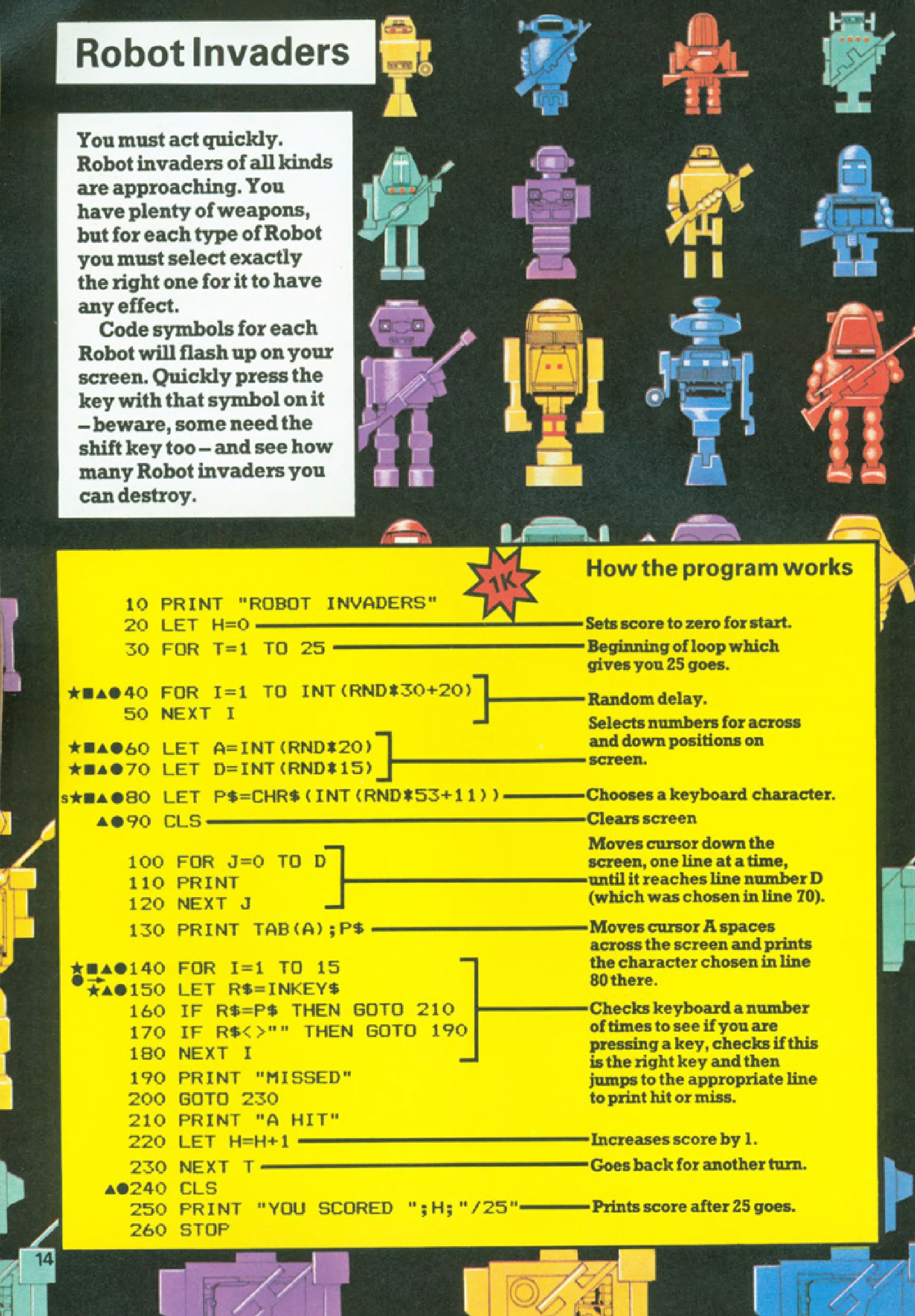
Robot invaders of all kinds are approaching! Your task is to identify and destroy them by pressing the correct key matching their unique symbol. Beware, some require the shift key as well. See how many robots you can destroy before the game ends.
Pseudocode
STARTPRINT "Robot Invaders"SET score to 0FOR 25 TURNS:    CREATE delay    CHOOSE random horizontal and vertical positions    CHOOSE random character for robot    CLEAR screen    MOVE cursor to robot's position    DISPLAY robot's symbol    WAIT for player input
    IF input matches robot's symbol THEN        INCREMENT score        PRINT "A hit!"    ELSE IF wrong input THEN        PRINT "Missed"
PRINT final scoreEND
Flowchart
graph TD
    Start --> Init[Initialize variables]
    Init --> Loop[Start game loop - 25 turns]
    Loop --> Delay[Create delay]
    Delay --> Generate[Generate random position and robot symbol]
    Generate --> Clear[Clear screen and move cursor to position]
    Clear --> DisplayRobot[Display robot symbol]
    DisplayRobot --> Input[Wait for player input]
    Input --> CheckInput[Check if input matches symbol]
    CheckInput -->|Match| Hit[Print 'A hit!' and increment score]
    CheckInput -->|Mismatch| Miss[Print 'Missed']
    Hit --> NextTurn[Go to next turn]
    Miss --> NextTurn
    NextTurn -->|More turns| Loop
    NextTurn -->|No more turns| EndGame[Print final score and end]
Code
Pages
ZX-81 BASIC
10 PRINT "ROBOT INVADERS"20 LET H=030 FOR T=1 TO 2540 FOR I=1 TO INT(RND*30+20)50 NEXT I60 LET A=INT(RND*20)70 LET D=INT(RND*15)80 LET P$=CHR$(INT(RND*53+11))90 CLS100 FOR J=0 TO D110 PRINT120 NEXT J130 PRINT TAB(A);P$140 FOR I=1 TO 15150 LET R$=INKEY$160 IF R$=P$ THEN GOTO 210170 IF R$<>"" THEN GOTO 190180 NEXT I190 PRINT "MISSED"200 GOTO 230210 PRINT "A HIT"220 LET H=H+1230 NEXT T240 CLS250 PRINT "YOU SCORED ";H;" /25"260 STOPC#
using System;
class RobotInvaders{    static void Main()    {        Console.WriteLine("Robot Invaders");        Random random = new Random();        int score = 0;
        for (int turn = 0; turn < 25; turn++)        {            System.Threading.Thread.Sleep(random.Next(200, 500));            int x = random.Next(0, 20);            int y = random.Next(0, 15);            char robotSymbol = (char)(random.Next(33, 87));
            Console.Clear();            for (int i = 0; i < y; i++)            {                Console.WriteLine();            }            Console.SetCursorPosition(x, y);            Console.Write(robotSymbol);
            Console.SetCursorPosition(0, 20);            Console.Write("Type the character: ");            string input = Console.ReadLine();
            if (!string.IsNullOrEmpty(input) && input[0] == robotSymbol)            {                Console.WriteLine("A hit!");                score++;            }            else            {                Console.WriteLine("Missed");            }        }
        Console.Clear();        Console.WriteLine($"You scored {score} / 25");    }}
Python
import randomimport time
print("Robot Invaders")score = 0
for turn in range(25):    time.sleep(random.uniform(0.2, 0.5))    x = random.randint(0, 20)    y = random.randint(0, 15)    robot_symbol = chr(random.randint(33, 87))
    print("\033[H\033[J", end="")  # Clear screen    print("\n" * y + " " * x + robot_symbol)
    player_input = input("Type the character: ").strip()
    if player_input == robot_symbol:        print("A hit!")        score += 1    else:        print("Missed")
print(f"You scored {score} / 25")
Java
import java.util.Scanner;import java.util.Random;
public class RobotInvaders {    public static void main(String[] args) {        Scanner scanner = new Scanner(System.in);        Random random = new Random();
        System.out.println("Robot Invaders");        int score = 0;
        for (int turn = 0; turn < 25; turn++) {            try {                Thread.sleep(random.nextInt(300) + 200);            } catch (InterruptedException e) {                e.printStackTrace();            }
            int x = random.nextInt(20);            int y = random.nextInt(15);            char robotSymbol = (char)(random.nextInt(53) + 33);
            for (int i = 0; i < y; i++) {                System.out.println();            }            System.out.println(" ".repeat(x) + robotSymbol);
            System.out.print("Type the character: ");            String input = scanner.nextLine();
            if (!input.isEmpty() && input.charAt(0) == robotSymbol) {                System.out.println("A hit!");                score++;            } else {                System.out.println("Missed");            }        }
        System.out.println("You scored " + score + " / 25");    }}
Go
package main
import (  "fmt"  "math/rand"  "time")
func main() {  fmt.Println("Robot Invaders")
  rand.Seed(time.Now().UnixNano())  score := 0
  for turn := 0; turn < 25; turn++ {    time.Sleep(time.Duration(rand.Intn(300)+200) * time.Millisecond)    x := rand.Intn(20)    y := rand.Intn(15)    robotSymbol := string(rune(rand.Intn(53) + 33))
    fmt.Print("\033[H\033[J") // Clear screen    for i := 0; i < y; i++ {      fmt.Println()    }    fmt.Printf("%*s\n", x+1, robotSymbol)
    var input string    fmt.Print("Type the character: ")    fmt.Scanln(&input)
    if input == robotSymbol {      fmt.Println("A hit!")      score++    } else {      fmt.Println("Missed")    }  }
  fmt.Printf("You scored %d / 25\n", score)}
C++
#include <iostream>#include <cstdlib>#include <ctime>#include <unistd.h>
using namespace std;
int main() {    srand(time(0));
    cout << "Robot Invaders" << endl;    int score = 0;
    for (int turn = 0; turn < 25; turn++) {        usleep((rand() % 300 + 200) * 1000);        int x = rand() % 20;        int y = rand() % 15;        char robotSymbol = static_cast<char>(rand() % 53 + 33);
        cout << "\033[H\033[J"; // Clear screen        for (int i = 0; i < y; i++) {            cout << endl;        }        cout << string(x, ' ') << robotSymbol << endl;
        string input;        cout << "Type the character: ";        cin >> input;
        if (!input.empty() && input[0] == robotSymbol) {            cout << "A hit!" << endl;            score++;        } else {            cout << "Missed" << endl;        }    }
    cout << "You scored " << score << " / 25" << endl;    return 0;}
Explanation
In “Robot Invaders,” you must act quickly to type the character displayed on the screen, matching the robot’s symbol. Each correct input increases your score. The game tests your speed and accuracy.
Challenges
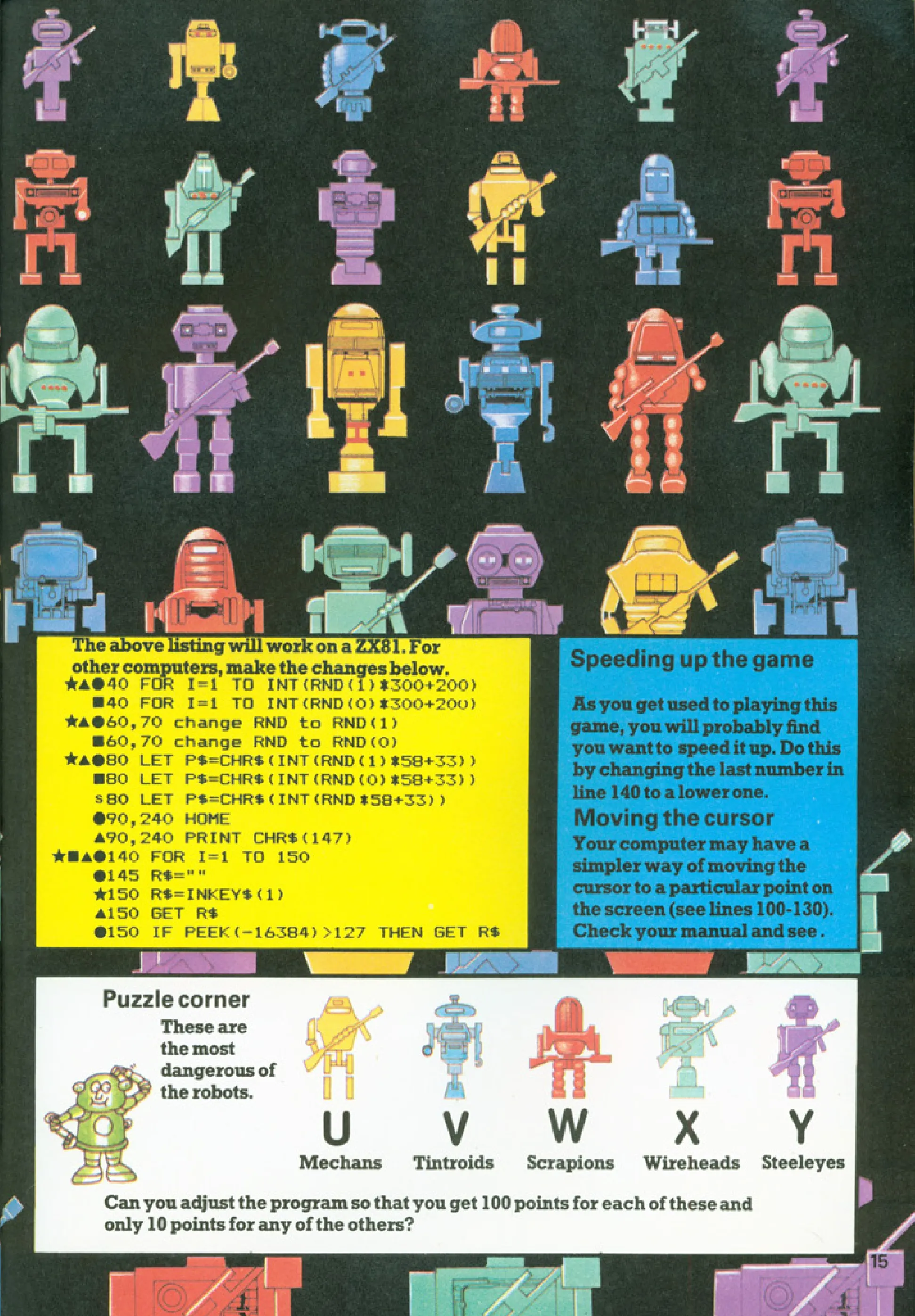
- Speed up gameplay: Decrease the delay between robots.
- Different scores: Assign higher points to certain robot symbols.
- Multiplayer mode: Add competitive scoring for two players.
Copyright
These programs are adaptations of the original Usborne Computer Guides published in the 1980s. The books are free to download for personal or educational use from Usborne’s Computer and Coding Books. Programs and adaptations may not be used for commercial purposes.
Return to Computer Battlegames.