Space Mines
Book: Computer Spacegames
Author: Usborne Publishing
Translator: Marcus Medina
Story
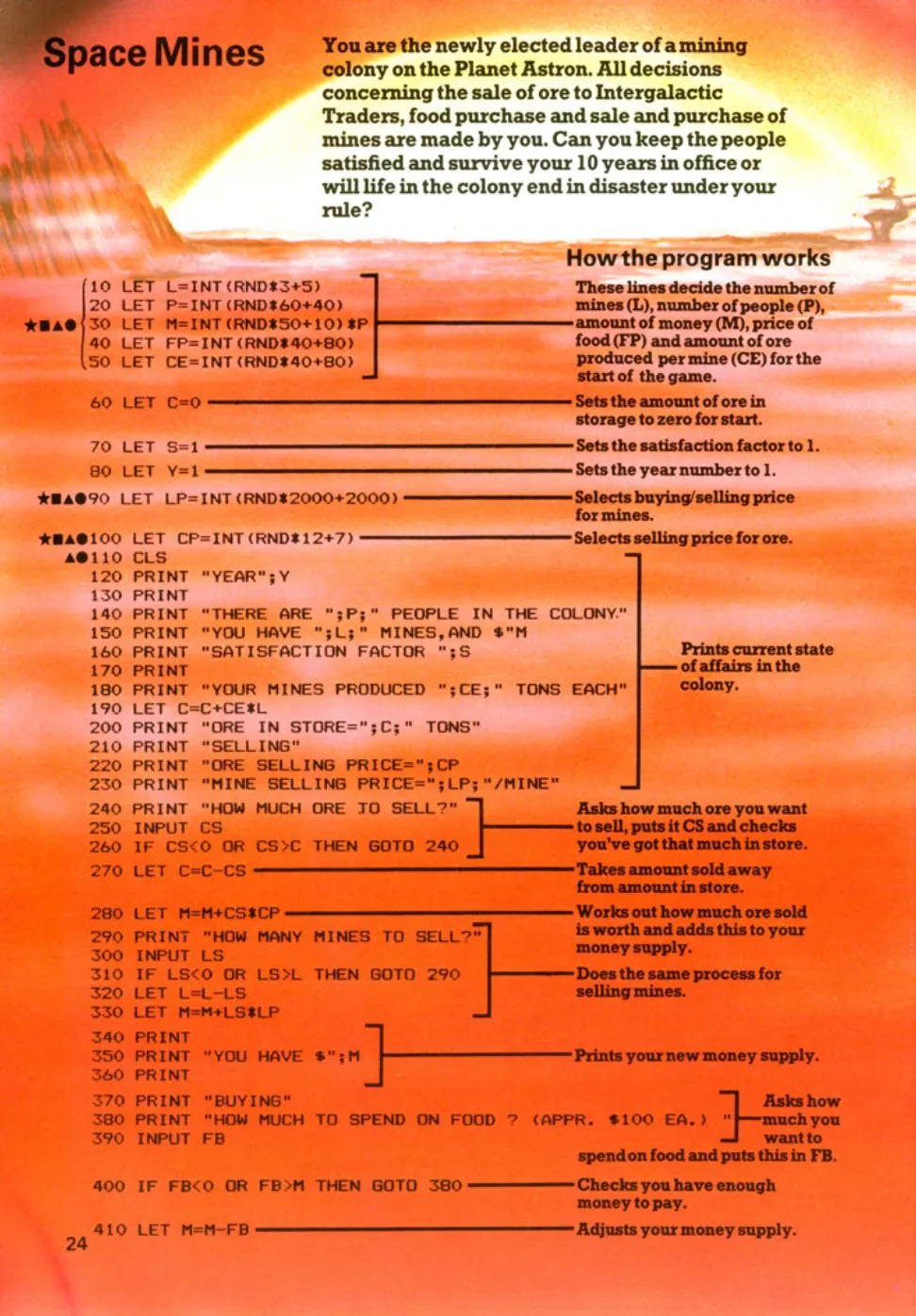
You are the newly elected leader of a mining colony on the planet Astron. All decisions concerning the sale of ore to Intergalactic Traders, food purchase, and the sale or purchase of mines are made by you. Can you keep the people satisfied and survive your 10 years in office, or will life in the colony end in disaster under your rule?
Pseudocode
STARTInitialize variables: mines, population, treasury, food price, ore production, stored ore, satisfaction, year counter
WHILE year is within 10 years    Display current colony status (people, mines, money, satisfaction)    Calculate yearly ore production and update storage    Display selling prices for ore and mines
    Ask player to input amount of ore to sell    Validate and adjust ore storage and treasury
    Ask player to input number of mines to sell    Validate and adjust mines and treasury
    Ask player to input food budget    Validate and adjust treasury and satisfaction
    Ask player to input number of mines to buy    Validate and adjust mines and treasury
    Check satisfaction levels and adjust production    Handle random population events and disasters
    Increment yearEND WHILE
Display success or failure messageEND
Flowchart
graph TD
    A[Start] --> B[Initialize variables]
    B --> C[Display colony status]
    C --> D{Input}
    D -->|Ore to sell| E[Adjust ore and treasury]
    D -->|Mines to sell| F[Adjust mines and treasury]
    E --> G{Input: Food budget and validate}
    G --> H[Adjust treasury and satisfaction]
    F --> I{Input: Mines to buy and validate}
    I --> J[Adjust mines and treasury]
    H --> K{Check satisfaction}
    K -->|Low satisfaction| L[Game Over: People revolted]
    K -->|High satisfaction| M[Adjust production]
    J --> N{Population and random events}
    N -->|Population too low| O[Game Over: Not enough people]
    N --> P[Increment year]
    P --> C
    C -->|Year > 10| Q[Success: You survived]
    Q --> R[End]
    O --> R
    L --> R
Code
Pages
ZX-81 BASIC
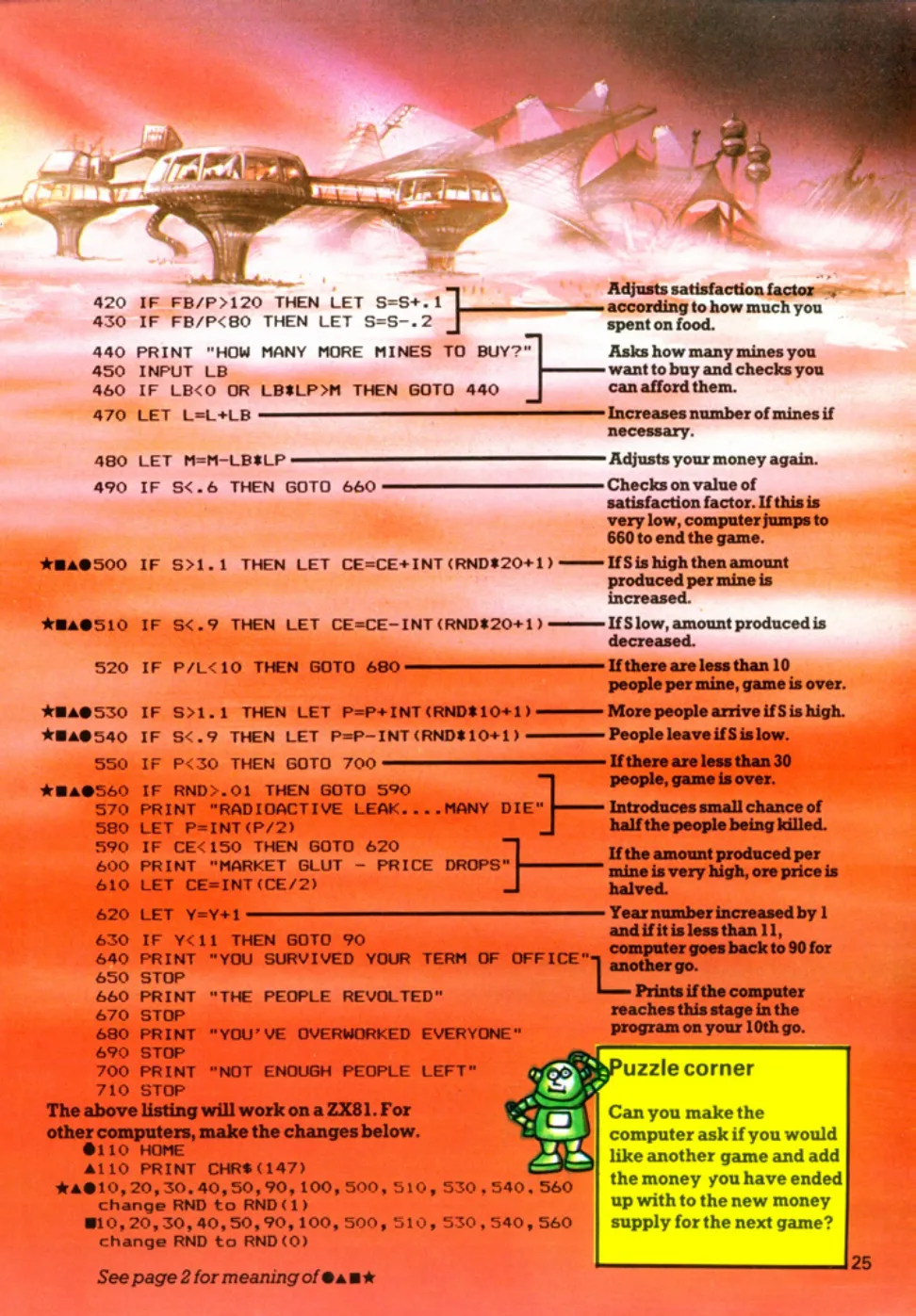
10 LET L=INT(RND*3+5)20 LET P=INT(RND*40+40)30 LET M=INT(RND*50+10)40 LET F=INT(RND*40+80)50 LET CE=INT(RND*40+80)60 LET C=070 LET S=180 LET Y=190 LET LP=INT(RND*2000+2000)100 CLS110 PRINT "YEAR";Y120 PRINT "THERE ARE ";P;" PEOPLE IN THE COLONY."130 PRINT "YOU HAVE ";M;" MINES, AND ";$M140 PRINT "SATISFACTION FACTOR ";S150 PRINT160 PRINT "YOUR MINES PRODUCED ";CE;" TONS EACH"170 LET C=C+CE*L180 PRINT "ORE IN STORE=";C;" TONS"190 PRINT "SELLING"200 PRINT "ORE SELLING PRICE=";CP210 PRINT "MINE SELLING PRICE=";LP;"/MINE"220 PRINT "HOW MUCH ORE TO SELL?"230 INPUT CS240 IF CS>C THEN GOTO 240250 LET C=C-CS260 LET M=M+CS\LP270 PRINT "HOW MANY MINES TO SELL?"280 INPUT LS290 IF LS>M OR LS<L THEN GOTO 290300 LET L=L-LS310 LET M=M-LS320 LET L=L$LP330 PRINT "YOU HAVE ";M340 PRINT350 PRINT "BUYING"360 PRINT "HOW MUCH TO SPEND ON FOOD ? (APPR. 100 EA.)"370 INPUT FB380 IF FB<0 OR FB>M THEN GOTO 380400 LET M=M-FB410 IF FB/P>120 THEN LET S=S+.1420 IF FB/P<80 THEN LET S=S-.2430 PRINT "HOW MANY MORE MINES TO BUY?"440 INPUT LB450 IF LB<0 OR LB\LP>M THEN GOTO 440460 LET L=L+LB470 LET M=M-LB\LP480 IF S<.6 THEN GOTO 660500 IF S>1.1 THEN LET CE=CE+INT(RND*20+1)510 IF S<.9 THEN LET CE=CE-INT(RND*20+1)520 IF P<10 THEN GOTO 680530 IF S>1.1 THEN LET P=P+INT(RND*10+1)540 IF S<.9 THEN LET P=P-INT(RND*10+1)550 IF P>30 THEN GOTO 700560 IF RND>.01 THEN GOTO 590570 PRINT "RADIOACTIVE LEAK... MANY DIE"580 LET P=INT(P/2)590 IF CE>50 THEN GOTO 620600 PRINT "MARKET GLUT - PRICE DROPS"610 LET CE=INT(CE/2)620 LET Y=Y+1630 IF Y<11 THEN GOTO 90640 PRINT "YOU SURVIVED YOUR TERM OF OFFICE"650 STOP660 PRINT "THE PEOPLE REVOLTED"670 STOP680 PRINT "YOU'VE OVERWORKED EVERYONE"690 STOP700 PRINT "NOT ENOUGH PEOPLE LEFT"710 STOPC#
using System;
class SpaceMines{    static void Main()    {        Random random = new Random();
        int mines = random.Next(3, 8); // Number of mines        int people = random.Next(40, 81); // Population        int money = random.Next(50, 61); // Treasury money        int foodPrice = random.Next(40, 121); // Food price per unit        int oreProduction = random.Next(40, 121); // Ore production per mine        int oreStorage = 0; // Stored ore        double satisfaction = 1.0; // Satisfaction factor        int year = 1;
        while (year <= 10)        {            Console.Clear();            Console.WriteLine($"Year {year}");            Console.WriteLine($"Population: {people}, Mines: {mines}, Money: ${money}");            Console.WriteLine($"Satisfaction Factor: {satisfaction:F1}");
            // Ore production and storage            int yearlyOre = oreProduction * mines;            oreStorage += yearlyOre;            Console.WriteLine($"Ore Produced: {yearlyOre} tons, Total Ore: {oreStorage} tons");
            // Ore selling            int orePrice = random.Next(2000, 4001);            Console.WriteLine($"Ore Selling Price: ${orePrice}");            int oreToSell;            do            {                Console.Write("How much ore to sell? ");            } while (!int.TryParse(Console.ReadLine(), out oreToSell) || oreToSell < 0);            if (oreToSell > oreStorage)            {                Console.WriteLine("Not enough ore. Try again.");                continue;            }            oreStorage -= oreToSell;            money += oreToSell * orePrice;
            // Mine selling            int minesToSell;            do            {                Console.Write("How many mines to sell? ");            } while (!int.TryParse(Console.ReadLine(), out minesToSell) || minesToSell < 0);            if (minesToSell > mines)            {                Console.WriteLine("Not enough mines. Try again.");                continue;            }            mines -= minesToSell;            money += minesToSell * orePrice;
            // Food purchasing            int foodBudget;            do            {                Console.Write("How much money to spend on food? ");            } while (!int.TryParse(Console.ReadLine(), out foodBudget) || foodBudget < 0);            if (foodBudget > money)            {                Console.WriteLine("Not enough money. Try again.");                continue;            }            money -= foodBudget;            satisfaction += (foodBudget / (double)people) > 120 ? 0.1 : -0.2;
            // Mine buying            int minesToBuy;            do            {                Console.Write("How many mines to buy? ");            } while (!int.TryParse(Console.ReadLine(), out minesToBuy) || minesToBuy < 0);            int mineCost = random.Next(2000, 4001);            if (minesToBuy * mineCost > money)            {                Console.WriteLine("Not enough money. Try again.");                continue;            }            mines += minesToBuy;            money -= minesToBuy * mineCost;
            // Satisfaction check            if (satisfaction < 0.6)            {                Console.WriteLine("The people revolted. Game Over.");                break;            }
            // Random events            if (random.NextDouble() < 0.01)            {                Console.WriteLine("Radioactive leak! Half the population died.");                people /= 2;            }
            year++;        }
        if (year > 10)        {            Console.WriteLine("You survived your term of office. Congratulations!");        }    }}
C# (SOLID OOP)
public class SalesManager{    private readonly Random random;
    public SalesManager(Random random)    {        this.random = random;    }
    public void HandleTransaction<T>(        string itemName,        Func<int> getCurrentAmount,        Action<int> updateAmount,        Func<int> getPricePerUnit,        Action<int> updateMoney,        TransactionType type)    {        int currentAmount = getCurrentAmount();        int pricePerUnit = getPricePerUnit();
        string prompt = $"How many {itemName} to {type.ToString().ToLower()}? ";        string errorMessage = type == TransactionType.Sell            ? $"Not enough {itemName}. Try again."            : "Not enough money. Try again.";
        int amount = InputValidator.GetValidInput(            prompt,            count => ValidateTransaction(count, currentAmount, pricePerUnit, type),            errorMessage        );
        updateAmount(type == TransactionType.Sell ? -amount : amount);        updateMoney(type == TransactionType.Sell            ? amount * pricePerUnit            : -amount * pricePerUnit);    }
    private bool ValidateTransaction(int amount, int currentAmount, int price, TransactionType type)    {        return type == TransactionType.Sell            ? amount <= currentAmount            : amount * price <= currentAmount;    }}
public enum TransactionType{    Buy,    Sell}
// Användning i MineManager:public class MineManager{    private readonly SalesManager salesManager;
    public MineManager(Random random)    {        this.salesManager = new SalesManager(random);    }
    public void ManageMines(ColonyResources resources)    {        // Sälja gruvor        salesManager.HandleTransaction<int>(            "mines",            () => resources.Mines,            amount => resources.Mines += amount,            () => random.Next(2000, 4001),            amount => resources.Money += amount,            TransactionType.Sell        );
        // Köpa gruvor        salesManager.HandleTransaction<int>(            "mines",            () => resources.Money,            amount => resources.Money += amount,            () => random.Next(2000, 4001),            amount => resources.Money += amount,            TransactionType.Buy        );    }}
Python
import random
def main():    # Initialize variables    mines = random.randint(3, 7)    population = random.randint(40, 80)    money = random.randint(50, 60)    ore_storage = 0    satisfaction = 1.0    year = 1
    while year <= 10:        print(f"\nYear {year}")        print(f"Population: {population}, Mines: {mines}, Money: ${money}")        print(f"Satisfaction Factor: {satisfaction:.1f}")
        # Ore production        ore_production = random.randint(40, 120) * mines        ore_storage += ore_production        print(f"Ore Produced: {ore_production} tons, Total Ore: {ore_storage} tons")
        # Sell ore        ore_price = random.randint(2000, 4000)        print(f"Ore Selling Price: ${ore_price}")        ore_to_sell = int(input("How much ore to sell? "))        if ore_to_sell > ore_storage:            print("Not enough ore. Try again.")            continue        ore_storage -= ore_to_sell        money += ore_to_sell * ore_price
        # Sell mines        mines_to_sell = int(input("How many mines to sell? "))        if mines_to_sell > mines:            print("Not enough mines. Try again.")            continue        mines -= mines_to_sell        money += mines_to_sell * ore_price
        # Buy food        food_budget = int(input("How much money to spend on food? "))        if food_budget > money:            print("Not enough money. Try again.")            continue        money -= food_budget        satisfaction += 0.1 if food_budget / population > 120 else -0.2
        # Buy mines        mine_cost = random.randint(2000, 4000)        mines_to_buy = int(input("How many mines to buy? "))        if mines_to_buy * mine_cost > money:            print("Not enough money. Try again.")            continue        mines += mines_to_buy        money -= mines_to_buy * mine_cost
        # Check satisfaction        if satisfaction < 0.6:            print("The people revolted. Game Over.")            break
        # Random events        if random.random() < 0.01:            print("Radioactive leak! Half the population died.")            population //= 2
        year += 1
    if year > 10:        print("You survived your term of office. Congratulations!")
if __name__ == "__main__":    main()
Java
import java.util.Random;import java.util.Scanner;
public class Colony {    static int mines;    static int population;    static int money;    static int oreStorage;    static double satisfaction;    static int year;    static Random random = new Random();    static Scanner scanner = new Scanner(System.in);
    public static void main(String[] args) {        initializeGame();        while (true) {            displayStatus();            manageOre();            manageMines();            manageFood();            advanceYear();        }    }
    static void initializeGame() {        mines = random.nextInt(5) + 3;        population = random.nextInt(41) + 40;        money = random.nextInt(11) + 50;        oreStorage = 0;        satisfaction = 1.0;        year = 1;    }
    static void displayStatus() {        System.out.print("\033[H\033[2J");        System.out.flush();        System.out.printf("Year %d%n", year);        System.out.printf("Population: %d, Mines: %d, Money: $%d%n", population, mines, money);        System.out.printf("Satisfaction Factor: %.1f%n", satisfaction);    }
    static void manageOre() {        int oreProduction = random.nextInt(81) + 40 * mines;        oreStorage += oreProduction;        System.out.printf("Ore Produced: %d tons, Total Ore: %d tons%n", oreProduction, oreStorage);        int orePrice = random.nextInt(2001) + 2000;        System.out.printf("Ore Selling Price: $%d%n", orePrice);
        try {            System.out.print("How much ore to sell? ");            int oreToSell = Integer.parseInt(scanner.nextLine());            if (oreToSell > oreStorage) {                System.out.println("Not enough ore. Try again.");                return;            }            oreStorage -= oreToSell;            money += oreToSell * orePrice;        } catch (NumberFormatException e) {            System.out.println("Invalid input. Please enter a number.");        }    }
    static void manageMines() {        try {            System.out.print("How many mines to sell? ");            int minesToSell = Integer.parseInt(scanner.nextLine());            if (minesToSell > mines) {                System.out.println("Not enough mines. Try again.");                return;            }            mines -= minesToSell;            money += minesToSell * (random.nextInt(2001) + 2000);
            System.out.print("How many mines to buy? ");            int minesToBuy = Integer.parseInt(scanner.nextLine());            int mineCost = random.nextInt(2001) + 2000;            if (minesToBuy * mineCost > money) {                System.out.println("Not enough money. Try again.");                return;            }            mines += minesToBuy;            money -= minesToBuy * mineCost;        } catch (NumberFormatException e) {            System.out.println("Invalid input. Please enter a number.");        }    }
    static void manageFood() {        try {            System.out.print("How much money to spend on food? ");            int foodBudget = Integer.parseInt(scanner.nextLine());            if (foodBudget > money) {                System.out.println("Not enough money. Try again.");                return;            }            money -= foodBudget;            satisfaction += (foodBudget / (double)population) > 120 ? 0.1 : -0.2;        } catch (NumberFormatException e) {            System.out.println("Invalid input. Please enter a number.");        }    }
    static void advanceYear() {        if (satisfaction < 0.6) {            System.out.println("The people revolted. Game Over.");            System.exit(0);        }        if (random.nextDouble() < 0.01) {            System.out.println("Radioactive leak! Half the population died.");            population /= 2;        }        year++;        if (year > 10) {            System.out.println("You survived your term of office. Congratulations!");            System.exit(0);        }    }}
Java (SOLID OOP)
import java.util.Random;import java.util.Scanner;
public class ColonyGame {    private final Colony colony;    private final GameUI ui;    private final MarketManager marketManager;    private final Random random;
    public ColonyGame() {        this.random = new Random();        this.ui = new ConsoleUI();        this.colony = new Colony();        this.marketManager = new MarketManager(random);    }
    public void run() {        initializeGame();        while (true) {            ui.displayStatus(colony);            handleTurn();            if (!advanceYear()) break;        }    }
    private void initializeGame() {        colony.setMines(random.nextInt(5) + 3)             .setPopulation(random.nextInt(41) + 40)             .setMoney(random.nextInt(11) + 50)             .setOreStorage(0)             .setSatisfaction(1.0)             .setYear(1);    }
    private void handleTurn() {        handleResourceManagement();        handleTrading();        handleFoodDistribution();    }
    private void handleResourceManagement() {        int production = colony.produceOre(random);        ui.displayProduction(production, colony.getOreStorage());    }
    private void handleTrading() {        Trade<Ore> oreTrade = new Trade<>(new Ore(colony.getOreStorage()), marketManager.getOrePrice());        Trade<Mine> mineTrade = new Trade<>(new Mine(colony.getMines()), marketManager.getMinePrice());
        TradeExecutor executor = new TradeExecutor(colony, ui);        executor.executeTrade(oreTrade, "ore");        executor.executeTrade(mineTrade, "mine");    }
    private void handleFoodDistribution() {        FoodManager foodManager = new FoodManager(colony);        int budget = ui.getFoodBudget(colony.getMoney());        foodManager.distributeFoodAndUpdateSatisfaction(budget);    }
    private boolean advanceYear() {        if (colony.getSatisfaction() < 0.6) {            ui.showGameOver("The people revolted.");            return false;        }
        if (random.nextDouble() < 0.01) {            colony.handleDisaster();            ui.showDisasterMessage();        }
        colony.incrementYear();
        if (colony.getYear() > 10) {            ui.showVictoryMessage();            return false;        }        return true;    }}
interface Tradeable {    int getQuantity();    void setQuantity(int quantity);    int getValue();}
class Ore implements Tradeable {    private int quantity;
    public Ore(int quantity) {        this.quantity = quantity;    }
    @Override    public int getQuantity() { return quantity; }
    @Override    public void setQuantity(int quantity) { this.quantity = quantity; }
    @Override    public int getValue() { return quantity; }}
class Mine implements Tradeable {    private int quantity;
    public Mine(int quantity) {        this.quantity = quantity;    }
    @Override    public int getQuantity() { return quantity; }
    @Override    public void setQuantity(int quantity) { this.quantity = quantity; }
    @Override    public int getValue() { return quantity; }}
class Trade<T extends Tradeable> {    private final T commodity;    private final int price;
    public Trade(T commodity, int price) {        this.commodity = commodity;        this.price = price;    }
    public T getCommodity() { return commodity; }    public int getPrice() { return price; }}
class TradeExecutor {    private final Colony colony;    private final GameUI ui;
    public TradeExecutor(Colony colony, GameUI ui) {        this.colony = colony;        this.ui = ui;    }
    public <T extends Tradeable> void executeTrade(Trade<T> trade, String commodityName) {        int sellQuantity = ui.getTradeQuantity("sell", commodityName, trade.getCommodity().getQuantity());        if (sellQuantity > 0) {            colony.addMoney(sellQuantity * trade.getPrice());            trade.getCommodity().setQuantity(trade.getCommodity().getQuantity() - sellQuantity);        }
        int buyQuantity = ui.getTradeQuantity("buy", commodityName, colony.getMoney() / trade.getPrice());        if (buyQuantity > 0) {            colony.spendMoney(buyQuantity * trade.getPrice());            trade.getCommodity().setQuantity(trade.getCommodity().getQuantity() + buyQuantity);        }    }}
class Colony {    private int mines;    private int population;    private int money;    private int oreStorage;    private double satisfaction;    private int year;
    // Getters and setters with builder pattern    public Colony setMines(int mines) { this.mines = mines; return this; }    public Colony setPopulation(int population) { this.population = population; return this; }    public Colony setMoney(int money) { this.money = money; return this; }    public Colony setOreStorage(int oreStorage) { this.oreStorage = oreStorage; return this; }    public Colony setSatisfaction(double satisfaction) { this.satisfaction = satisfaction; return this; }    public Colony setYear(int year) { this.year = year; return this; }
    // Getters    public int getMines() { return mines; }    public int getPopulation() { return population; }    public int getMoney() { return money; }    public int getOreStorage() { return oreStorage; }    public double getSatisfaction() { return satisfaction; }    public int getYear() { return year; }
    public void addMoney(int amount) { money += amount; }    public void spendMoney(int amount) { money -= amount; }    public void incrementYear() { year++; }
    public int produceOre(Random random) {        int production = random.nextInt(81) + 40 * mines;        oreStorage += production;        return production;    }
    public void handleDisaster() {        population /= 2;    }}
interface GameUI {    void displayStatus(Colony colony);    void displayProduction(int production, int storage);    int getTradeQuantity(String action, String commodity, int maximum);    int getFoodBudget(int availableMoney);    void showGameOver(String message);    void showDisasterMessage();    void showVictoryMessage();}
class ConsoleUI implements GameUI {    private final Scanner scanner;
    public ConsoleUI() {        this.scanner = new Scanner(System.in);    }
    @Override    public void displayStatus(Colony colony) {        System.out.print("\033[H\033[2J");        System.out.flush();        System.out.printf("Year %d%n", colony.getYear());        System.out.printf("Population: %d, Mines: %d, Money: $%d%n",            colony.getPopulation(), colony.getMines(), colony.getMoney());        System.out.printf("Satisfaction Factor: %.1f%n", colony.getSatisfaction());    }
    @Override    public void displayProduction(int production, int storage) {        System.out.printf("Ore Produced: %d tons, Total Ore: %d tons%n", production, storage);    }
    @Override    public int getTradeQuantity(String action, String commodity, int maximum) {        try {            System.out.printf("How much %s to %s? ", commodity, action);            int quantity = Integer.parseInt(scanner.nextLine());            return quantity <= maximum ? quantity : 0;        } catch (NumberFormatException e) {            return 0;        }    }
    @Override    public int getFoodBudget(int availableMoney) {        try {            System.out.print("How much money to spend on food? ");            int budget = Integer.parseInt(scanner.nextLine());            return budget <= availableMoney ? budget : 0;        } catch (NumberFormatException e) {            return 0;        }    }
    @Override    public void showGameOver(String message) {        System.out.println(message + " Game Over.");    }
    @Override    public void showDisasterMessage() {        System.out.println("Radioactive leak! Half the population died.");    }
    @Override    public void showVictoryMessage() {        System.out.println("You survived your term of office. Congratulations!");    }}
class MarketManager {    private final Random random;
    public MarketManager(Random random) {        this.random = random;    }
    public int getOrePrice() {        return random.nextInt(2001) + 2000;    }
    public int getMinePrice() {        return random.nextInt(2001) + 2000;    }}
class FoodManager {    private final Colony colony;
    public FoodManager(Colony colony) {        this.colony = colony;    }
    public void distributeFoodAndUpdateSatisfaction(int budget) {        if (budget > 0) {            colony.spendMoney(budget);            double satisfactionChange = (budget / (double)colony.getPopulation()) > 120 ? 0.1 : -0.2;            colony.setSatisfaction(colony.getSatisfaction() + satisfactionChange);        }    }}
Go
package main
import (  "fmt"  "math/rand"  "time")
func main() {  // Initialize variables  rand.Seed(time.Now().UnixNano())  mines := rand.Intn(5) + 3         // 3 to 7 mines  population := rand.Intn(41) + 40 // 40 to 80 people  money := rand.Intn(11) + 50      // 50 to 60 money  oreStorage := 0                  // Stored ore  satisfaction := 1.0              // Satisfaction factor  year := 1
  for year <= 10 {    fmt.Printf("\nYear %d\n", year)    fmt.Printf("Population: %d, Mines: %d, Money: $%d\n", population, mines, money)    fmt.Printf("Satisfaction Factor: %.1f\n", satisfaction)
    // Ore production    oreProduction := (rand.Intn(81) + 40) * mines // 40 to 120 ore per mine    oreStorage += oreProduction    fmt.Printf("Ore Produced: %d tons, Total Ore: %d tons\n", oreProduction, oreStorage)
    // Sell ore    orePrice := rand.Intn(2001) + 2000 // 2000 to 4000    fmt.Printf("Ore Selling Price: $%d\n", orePrice)    fmt.Print("How much ore to sell? ")    var oreToSell int    fmt.Scan(&oreToSell)    if oreToSell > oreStorage {      fmt.Println("Not enough ore. Try again.")      continue    }    oreStorage -= oreToSell    money += oreToSell * orePrice
    // Sell mines    fmt.Print("How many mines to sell? ")    var minesToSell int    fmt.Scan(&minesToSell)    if minesToSell > mines {      fmt.Println("Not enough mines. Try again.")      continue    }    mines -= minesToSell    money += minesToSell * orePrice
    // Buy food    fmt.Print("How much money to spend on food? ")    var foodBudget int    fmt.Scan(&foodBudget)    if foodBudget > money {      fmt.Println("Not enough money. Try again.")      continue    }    money -= foodBudget    if float64(foodBudget)/float64(population) > 120 {      satisfaction += 0.1    } else {      satisfaction -= 0.2    }
    // Buy mines    mineCost := rand.Intn(2001) + 2000 // 2000 to 4000    fmt.Print("How many mines to buy? ")    var minesToBuy int    fmt.Scan(&minesToBuy)    if minesToBuy*mineCost > money {      fmt.Println("Not enough money. Try again.")      continue    }    mines += minesToBuy    money -= minesToBuy * mineCost
    // Check satisfaction    if satisfaction < 0.6 {      fmt.Println("The people revolted. Game Over.")      break    }
    // Random events    if rand.Float64() < 0.01 {      fmt.Println("Radioactive leak! Half the population died.")      population /= 2    }
    // Increment year    year++  }
  if year > 10 {    fmt.Println("You survived your term of office. Congratulations!")  }}
C++
#include <iostream>#include <cstdlib>#include <ctime>using namespace std;
int main() {    srand(time(0));
    // Initialize variables    int mines = rand() % 5 + 3;        // 3 to 7 mines    int population = rand() % 41 + 40; // 40 to 80 people    int money = rand() % 11 + 50;      // 50 to 60 money    int oreStorage = 0;                // Stored ore    double satisfaction = 1.0;         // Satisfaction factor    int year = 1;
    while (year <= 10) {        cout << "\nYear " << year << endl;        cout << "Population: " << population << ", Mines: " << mines << ", Money: $" << money << endl;        cout << "Satisfaction Factor: " << satisfaction << endl;
        // Ore production        int oreProduction = (rand() % 81 + 40) * mines; // 40 to 120 ore per mine        oreStorage += oreProduction;        cout << "Ore Produced: " << oreProduction << " tons, Total Ore: " << oreStorage << " tons" << endl;
        // Sell ore        int orePrice = rand() % 2001 + 2000; // 2000 to 4000        cout << "Ore Selling Price: $" << orePrice << endl;        cout << "How much ore to sell? ";        int oreToSell;        cin >> oreToSell;        if (oreToSell > oreStorage) {            cout << "Not enough ore. Try again." << endl;            continue;        }        oreStorage -= oreToSell;        money += oreToSell * orePrice;
        // Sell mines        cout << "How many mines to sell? ";        int minesToSell;        cin >> minesToSell;        if (minesToSell > mines) {            cout << "Not enough mines. Try again." << endl;            continue;        }        mines -= minesToSell;        money += minesToSell * orePrice;
        // Buy food        cout << "How much money to spend on food? ";        int foodBudget;        cin >> foodBudget;        if (foodBudget > money) {            cout << "Not enough money. Try again." << endl;            continue;        }        money -= foodBudget;        satisfaction += (static_cast<double>(foodBudget) / population > 120) ? 0.1 : -0.2;
        // Buy mines        int mineCost = rand() % 2001 + 2000; // 2000 to 4000        cout << "How many mines to buy? ";        int minesToBuy;        cin >> minesToBuy;        if (minesToBuy * mineCost > money) {            cout << "Not enough money. Try again." << endl;            continue;        }        mines += minesToBuy;        money -= minesToBuy * mineCost;
        // Check satisfaction        if (satisfaction < 0.6) {            cout << "The people revolted. Game Over." << endl;            break;        }
        // Random events        if (static_cast<double>(rand()) / RAND_MAX < 0.01) {            cout << "Radioactive leak! Half the population died." << endl;            population /= 2;        }
        // Increment year        year++;    }
    if (year > 10) {        cout << "You survived your term of office. Congratulations!" << endl;    }
    return 0;}
Explanation
This game simulates the management of a mining colony where the player must make strategic decisions about resource management, trade, and the well-being of their citizens. Players input values for selling ore, managing mines, and purchasing food to maintain satisfaction and ensure the colony’s survival over 10 years.
Challenges
- Dynamic Pricing: Introduce fluctuating market prices for ore and food to make planning harder.
- Natural Disasters: Add more random events, such as earthquakes, that can damage mines or reduce population.
- Population Growth: Introduce mechanics where population increases or decreases based on player decisions.
Copyright
These programs are adaptations of the original Usborne Computer Guides published in the 1980s. The books are free to download for personal or educational use from Usborne’s Computer and Coding Books. Programs and adaptations may not be used for commercial purposes.
Return to Computer Spacegames.